The main signs of carpet moths and clothes moths are irregular holes in wool, cashmere or silk, bare patches in rugs and carpets, fine silk webbing or small tube-shaped cases, tiny cream larvae with brown heads, gritty droppings, and small golden moths that scuttle across fabric rather than fly away.
Reviewed by James Rhoades, Owner, ThermoPest · Last reviewed 15 October 2026
Moths are easy to miss until the damage shows. The adults don’t eat anything; it’s the larvae, hidden in dark, undisturbed fabric, that do the harm. This guide covers what to look for in carpets and wardrobes, what the moths and larvae look like, and how to tell them from other insects.
What are the first signs of carpet moths and clothes moths?
According to the British Pest Control Association (BPCA), the first sign is usually adult moths flying around, because the eggs and larvae tend to be hidden. After that, most people notice:
- small holes in jumpers, scarves or coats, especially wool, cashmere and silk;
- a thin or bare patch in a rug or carpet, often under furniture or along a wall;
- fine silky threads or small tubes stuck to fabric;
- tiny cream-coloured grubs in carpet edges, drawers or folded clothes.
One moth on its own doesn’t always mean an infestation. Several moths over a few weeks, or any damage to fabric, is worth a proper look.
Signs of Carpet Moths in Rugs and Carpets
Bare Patches and Thinning Pile
Larvae graze the pile down to the backing, leaving irregular bald or thin areas. Look where carpet is rarely walked on or vacuumed: under beds and sofas, behind doors, along skirting boards and in the corners of spare rooms. Wool and wool-blend carpets and rugs are the usual targets.

Loose Tufts and Fibres
Short tufts of carpet lying loose on the surface, or fibres that pull out easily when you run your hand across the pile, can mean larvae have chewed through the base of the tufts.
Silk Webbing and Cases
The Natural History Museum explains that common clothes moth larvae spin tunnels of silk mixed with nearby fibres, which can build up into dense mats, while case-bearing clothes moth larvae spin small tube-shaped cases that they carry with them. English Heritage notes that the cases often include fragments of the fabric being eaten, so they can blend in and look like bits of fluff.
Larvae
Larvae are pale, soft grubs with a brown head. You’ll usually find them by lifting the edge of a rug or parting the pile in a damaged area rather than seeing them out in the open.
Droppings (Frass) and Empty Cases
English Heritage lists empty cases and small pellets of droppings, called frass, as signs of case-bearing clothes moths. Frass looks like fine grit and collects in folds or on the surface underneath.
Signs of Clothes Moths in Your Wardrobe
Holes in Clothes
Moth holes are usually small, irregular and scattered, rather than one neat tear. They often appear in places that stay folded or out of the light, such as under collars, in cuffs and along seams. The BPCA notes that moths are attracted to perspiration and food stains, so clothes put away unwashed are more at risk.
How to Tell Moth Holes From Other Wear
- Moth damage is usually in natural fibres; pure synthetic fabrics are rarely eaten.
- There may be grazed, thin areas around the holes, not just the holes themselves.
- You may find webbing, cases or frass in the folds, or on the shelf underneath.
- Damage tends to be worst on items that haven’t been worn for a while.
Moths in the Wardrobe or Drawers
The Natural History Museum says clothes moths prefer low light and that adults often scramble across fabrics rather than fly. A small moth that runs into a fold when you open the wardrobe is a stronger sign than one fluttering around a lamp.
What do carpet moths look like?
In the UK, “carpet moth” is usually an everyday name for the same clothes moths that damage clothing. The two you’re most likely to find are the common clothes moth and the case-bearing clothes moth.
Adult Moths
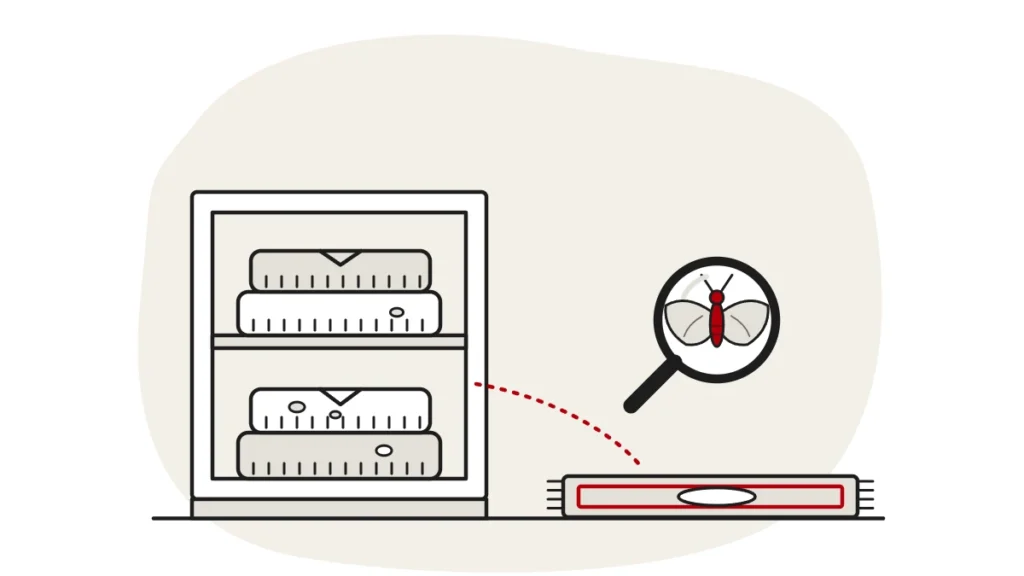
The BPCA describes the common clothes moth as small, shiny and silvery-gold, with no markings, gingery-brown hairs on the head, and 5–8mm in size. The Natural History Museum gives its wingspan as 12–17mm and says the wings are held back along the body. The case-bearing clothes moth is a duller silver grey-brown, with dark spots on the forewings and a wingspan of 9–16mm, according to the same Natural History Museum guide.
Carpet Moth Larvae
The Natural History Museum describes common clothes moth larvae as white with a hard brown head, reaching up to 13mm. The same guide says case-bearing larvae look similar and reach up to 12mm. They live inside their silk case, which, according to English Heritage, they enlarge as they grow.
Eggs
Eggs are tiny and very hard to see without magnification. The BPCA says females lay them deliberately among fibres the larvae can eat, and English Heritage notes they’re tucked into folds and crevices. In practice, you’ll find the larvae or damage long before you spot eggs.
| Feature | Common clothes moth | Case-bearing clothes moth |
|---|---|---|
| Adult colour | Shiny golden, no spots | Silver grey-brown with dark spots |
| Wingspan (NHM) | 12–17mm | 9–16mm |
| Larvae | White, brown head, in silk tunnels and webbing | White, brown head, inside a portable silk case |
| Typical sign | Webbing and mats on fabric | Small tube-shaped cases on fabric |
Are carpet moths the same as clothes moths?
Mostly, yes. The same species eat carpets, rugs, clothing, upholstery and soft furnishings. The larvae feed on keratin, a protein in wool, cashmere, silk, fur and feathers, so they’ll move between a wool rug and a wardrobe of jumpers. That’s why, if you find signs in one place, it’s worth checking the other.
Carpet Moth Life Cycle: Why Damage Builds Quietly
The BPCA gives the common clothes moth’s life cycle as about 3 to 10 months: eggs hatch in 1 to 5 weeks, larvae feed for 2 to 7 months, pupae take 2 weeks to 2 months, and adults live only days. Almost all of that time is spent as a hidden larva, eating.
This explains two things people often notice. First, damage can be well under way before you see a single moth. Second, moths can keep appearing after a clean-up, because larvae and eggs that were missed carry on developing. Any treatment has to allow for this, which is why a follow-up visit may be needed.
Is it clothes moths or something else?
Pantry Moths
If the moths are in the kitchen, you’re more likely dealing with pantry moths. The BPCA says the Indian meal moth, a common pantry moth, infests stored foods such as flour, cereal and dried fruit. Clothes moths are found near textiles, usually in dark, undisturbed places.
White-Shouldered House Moth
The BPCA describes this as a brown moth with mottled wings and a white head and shoulders. Its larvae feed on organic debris, and the BPCA says it can thrive in animal hair and fluff in central heating ducts and radiators. The BPCA also advises checking stored clothing and textiles regularly.
Carpet Beetles
Holes in carpets and clothes can also be caused by carpet beetle larvae. The Natural History Museum says they’re called woolly bears because their bodies are covered in hairs, that the see-through skins they shed are a clear sign of infestation, and that their holes are small and clean, without the silk webbing clothes moths leave. If you find hairy larvae or shed skins instead of webbing and cases, it’s probably carpet beetles.
Where to Check If You Think You Have Moths
- Under beds, sofas and heavy furniture that’s rarely moved.
- Carpet edges along skirting boards and behind doors.
- Rugs, especially the underside and fringes.
- Wardrobe floors, the backs of drawers and shelves of folded knitwear.
- Stored clothes in boxes, bags or suitcases, and items in the loft.
- Wool throws, feather cushions, fur trims and upholstered chairs.
Use a torch, and take photos of anything you find. Clear pictures of the larvae, cases or moths make it much easier to confirm what you’re dealing with.
What to Do If You’ve Found the Signs
Finding moth damage is frustrating, but it’s very common and it can be dealt with. Bag up affected clothes so they don’t spread larvae to other items, and avoid moving infested rugs around the home. Our step-by-step guide on how to get rid of carpet and clothes moths covers cleaning, washing, freezing and storage in detail. If you’ve seen home remedies online, read does vinegar kill carpet moths? before relying on them. If you’re seeing lots of adults, why are there so many moths in my house? explains the likely causes.
When damage keeps spreading or the infestation is across several rooms, professional carpet moth treatment is the next step. ThermoPest’s approach is heat-led, with targeted spray where it’s needed, and starts with an inspection to confirm the species and find where the larvae are.
FAQs
How do I know if I have moths?
Look for small irregular holes in natural fabrics, thin or bare patches in carpets and rugs, silk webbing or small tube-shaped cases, and pale larvae with brown heads. Small golden moths scuttling across fabric in a wardrobe or along a carpet edge are another strong sign.
Can carpet moths bite?
No. The Natural History Museum notes that adult clothes moths don’t feed, and the larvae eat natural fibres, not people. Our guide are carpet moths dangerous? covers health questions in more detail.
Are small white moths in my house clothes moths?
Probably not. Adult clothes moths are golden or grey-brown, not white. It’s the larvae that are white. A moth with a white head and shoulders may be a white-shouldered house moth, whose larvae feed on organic debris, according to the BPCA.
What do carpet moth eggs look like?
They’re tiny and almost impossible to see without magnification. They’re laid among fibres, in folds and crevices, so you’ll usually notice the larvae, webbing or damage first.
When are clothes moths active?
Because they live indoors, you can find signs of clothes moths at any time of year. Many people notice adults more in warmer months, but larvae can be feeding out of sight whenever the moths aren’t visible.
Found signs of moths?
An inspection will confirm whether it’s clothes moths, carpet beetles or something else, and show where the larvae are. ThermoPest is a member of the BPCA and NPTA, and our technicians arrive in unmarked vans.