No. Smoke bombs, foggers and bug bombs don’t get rid of bed bugs. The smoke or mist settles on open surfaces but barely reaches the seams, cracks and voids where bed bugs and their eggs hide, and many populations tolerate the insecticides used. Foggers also tend to scatter bugs into new hiding places, and they carry fire and health risks.
Reviewed by James Rhoades, Owner, ThermoPest · Last reviewed 16 October 2026
You’ve probably seen a smoke bomb for bed bugs in a DIY shop or online and wondered whether it’s worth a try. It’s an understandable thought: one canister, close the door, job done. This guide explains what these products are, why they don’t work, why they can make an infestation harder to treat, and what to do instead. ThermoPest doesn’t use smoke bombs or foggers for bed bugs; our treatment is heat-led, with targeted spray where it’s needed.
What is a bed bug smoke bomb or fogger?
Several products get called “bed bug bombs”. They work in slightly different ways but share the same idea: fill the room with insecticide and hope it reaches the bugs.
- Insecticidal smoke generators (“smoke bombs” or “fumers”): a small tin or canister you light. It smoulders and releases a dry smoke carrying an insecticide, usually a pyrethroid. Sold for fleas, moths, cockroaches and bed bugs.
- Total-release aerosol foggers (“bug bombs”): a pressurised can with a locking button. Once pressed it empties itself as a fine mist until the can is spent.
- Plug-in or electric foggers: heat a liquid insecticide into a vapour.
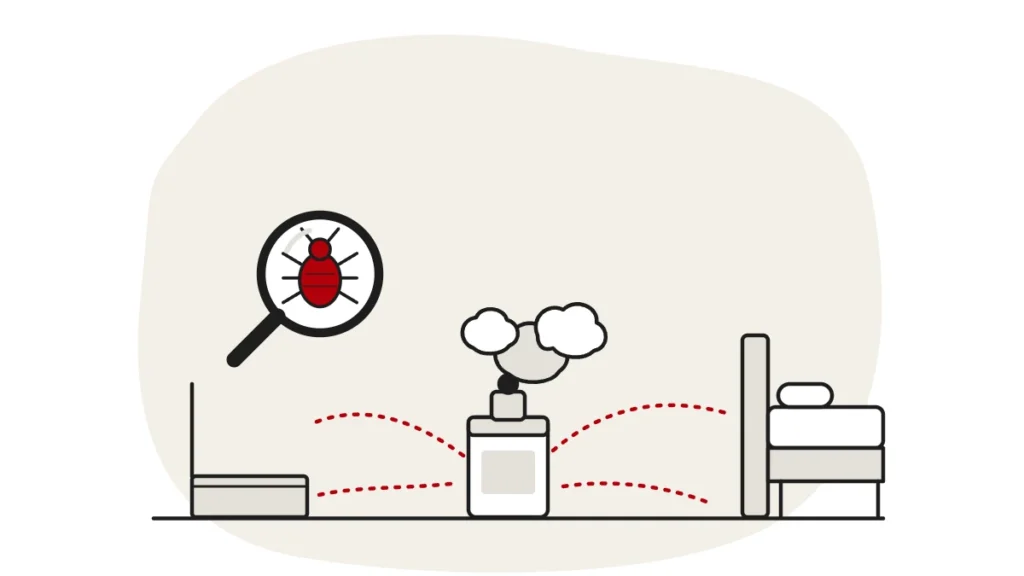
Whatever the format, the product is designed to drift through the air of a room and settle on exposed surfaces. That’s the root of the problem, because bed bugs don’t live on exposed surfaces.
Why don’t smoke bombs work on bed bugs?
The Smoke Doesn’t Reach Where Bed Bugs Hide
The British Pest Control Association (BPCA) describes bed bugs hiding in crevices in the bed and surrounding furniture, behind skirting boards, under loose wallpaper, behind pictures and even in plug sockets. A fogger or smoke bomb released in the middle of a room can’t follow them there. Very little of the insecticide penetrates into cracks, voids and other secluded locations, and pyrethrin-based foggers are seldom lethal to bed bugs and other crawling pests.
Even Direct Exposure Often Fails
Even when bed bugs are hit directly, foggers often fail. Bed bugs from real infestations frequently show little, if any, effect after direct exposure to over-the-counter foggers, and even bugs that are still sensitive to the insecticide can survive when a thin layer of fabric gives them somewhere to hide. In our experience, a fogger is not a bed bug treatment.
Many Bed Bugs Tolerate the Insecticide Anyway
The NHS notes that bed bugs may be resistant to some insecticides, and the BPCA’s public advice leaflet lists suspected tolerance to some pesticides as one reason bed bugs have become so common. The pyrethroids in most amateur smoke and fogger products are exactly the type many populations have adapted to. Our guide to chemical treatments for bed bugs explains why that matters when choosing a treatment.
Eggs Are the Hardest Part
Bed bug eggs are cemented into seams, joints and crevices, usually close to where the adults hide. A brief pass of smoke or mist over the outside of a mattress or bed frame doesn’t deal with them. Anything that hatches after you’ve aired the room restarts the infestation, which is why people often report a quiet week or two and then new bites.
Do smoke bombs make bed bugs worse?
They can. Fogger ingredients tend to be repellent, so insects scatter and move deeper into walls, crevices and other hard-to-reach areas. For bed bugs that means:
- bugs that were concentrated around the bed spread into the rest of the room, or into other rooms;
- in flats and terraces, bugs can be pushed towards neighbouring homes through wall voids and service gaps;
- the infestation becomes harder to find and harder to treat properly afterwards, because the hiding places are now spread out.
That last point matters if you later call a professional. A well-defined infestation around one bed is simpler to treat than one that has been chased around the property. If you live in a flat, bear in mind that when we treat flats we ask to inspect neighbouring flats, because spread between properties is common.
Are bed bug smoke bombs safe to use at home?
Used exactly as the label says, these are legal amateur products. The trouble is that the label conditions are easy to get wrong, and the consequences range from a ruined evening to a house fire.
Fire and Explosion
The ingredients in some bug bombs may be flammable near an open flame, and house fires have started when a pilot light on a cooker or heating appliance was left lit, or when a fogger was set off near a lit cigarette. Smoke generators are lit with a match, so they bring their own flame into the room.
Breathing Problems
People with asthma and other respiratory conditions can react severely to the pyrethrin and pyrethroid ingredients. Breathing problems are the most common effect of fogger exposure, along with stomach upsets and nervous system symptoms. The usual cause is simply not leaving the premises while the fogger goes off, or going back in too early.
Residue on Surfaces
Everything that comes out of the canister lands somewhere. Letting pesticide residue settle on worktops, bedding, seating and other exposed surfaces is unwise, and many users don’t follow the instructions to cover or clean food, utensils and surfaces afterwards. In a bedroom that means the mattress, pillows and bedding you then sleep on.
Smoke Alarms and Neighbours
Smoke generators can set off smoke alarms. In shared buildings that can mean a building-wide alarm and an unhappy call from the fire service. Check what the label says about detectors before you even consider one; it’s a reminder of how much smoke the product makes.
Does ordinary smoke kill bed bugs?
A lot of people also ask whether cigarette smoke, incense or wood smoke kills bed bugs. There’s no evidence that it does. Bed bugs are found in smokers’ and non-smokers’ homes alike, and normal household smoke doesn’t reach the concentrations or temperatures that would matter. Smoke of any kind isn’t a treatment.
Smoke Bombs Compared With Other Treatments
Here’s how a fogger stacks up against the approaches a professional would consider. “Targeted spray” means a professional-use insecticide applied directly into harbourages by a trained technician, not an aerosol fogger.
| Question | Smoke bomb / fogger | Targeted professional spray | Professional heat treatment |
|---|---|---|---|
| Reaches cracks, seams and voids? | No, settles on open surfaces | Yes, applied directly into harbourages | Yes, heat moves through furniture and fabrics |
| Kills eggs? | Not reliably | Depends on product and contact; follow-up visits are usual | Yes, when the lethal temperature is reached and held |
| Affected by insecticide resistance? | Yes | Can be; professionals choose products accordingly | No |
| Scatters bugs? | Yes | Minimal when applied correctly | Less likely, as rooms are sealed and heated together |
| Residue left behind? | On all exposed surfaces | Only where applied | None from the heat itself |
What to Do Instead of a Smoke Bomb
If you’ve found signs of bed bugs, these steps are safe, won’t scatter the infestation, and will make professional treatment more effective.
- Don’t move your bed or your bedroom. Keep sleeping where you are. Moving to the sofa or another room draws hungry bugs after you and spreads the problem.
- Confirm what you’re dealing with. Check mattress seams, the bed frame, the headboard and skirting boards with a torch for live bugs, shed skins and dark spotting. The NHS says adults are around 5mm long.
- Wash what you can. The NHS advises washing affected bedding and clothing on a hot wash (60°C) and tumble drying on a hot setting for at least 30 minutes. Items that can’t be washed can go in a sealed bag in the freezer for two to three weeks. Only throw things away if they can’t be washed or treated.
- Bag, don’t bomb. Keep washed items in sealed bags until the room has been treated.
- Get a professional inspection. The NHS says it’s very difficult to get rid of bed bugs yourself and that self-treatment is unlikely to get rid of them completely; the BPCA says the same. A bed bug inspection will tell you where the bugs are and how far they’ve spread.
If you’re weighing up other shop-bought options, we’ve looked at the evidence for several: does Dettol kill bed bugs, does Indorex kill bed bugs and does UV light kill bed bugs. The pattern is the same each time: some products kill bugs they touch, none of them clear an infestation.
How ThermoPest Treats Bed Bugs Without Fogging
ThermoPest doesn’t use smoke bombs or foggers. Our approach is heat-led, with targeted spray where it’s needed. We seal the room, bring in heaters and fans, and raise the temperature of the whole space, including the inside of mattresses and furniture and the cracks and gaps where smoke never reaches.
Bed bugs and their eggs die when held above about 50°C for long enough. We heat rooms to 50–60°C and hold that heat until the hardest-to-reach spots stay above 50°C. Rooms don’t heat evenly, so we place temperature monitors in known cold spots and hard-to-reach areas.
Heat doesn’t depend on whether the local bed bugs have become tolerant of insecticides, and because the whole room is heated at once, bugs have far less chance to escape into the next one. You can usually re-enter a treated home two hours after a heat treatment unless the technician advises otherwise. Read more about how bed bug heat treatment works, and what to expect on the day.
FAQs
Do smoke bombs kill bed bug eggs?
Not reliably. Eggs are glued into seams, joints and crevices that smoke and mist barely reach. Foggers often fail to kill adult bed bugs even with direct exposure, and eggs tucked out of sight are harder still to affect. Survivors and hatching eggs are why infestations return after a bombed room looks clear.
Do bed bug smoke bombs work at all?
They can kill some bugs that are out in the open and sensitive to the insecticide. They don’t deal with the ones hidden in the bed frame, mattress seams, skirting boards and sockets, which is most of them. Foggers seldom resolve indoor pest problems and can make them worse.
Does fogging kill bed bugs if a professional does it?
Fogging has the same limitation whoever does it: the product settles on surfaces rather than penetrating harbourages. That’s why ThermoPest doesn’t fog for bed bugs. Professional treatment relies on reaching the bugs where they hide, through heat or targeted application into cracks and crevices, with follow-up visits where needed.
Do flea bombs or moth bombs kill bed bugs?
No. They’re the same type of product with the same drawbacks. Some smoke generators are sold as suitable for several pests, but the problem isn’t the pest named on the tin; it’s that smoke doesn’t reach hidden bed bugs and many bed bugs tolerate the insecticide.
Should I use a smoke bomb before professional treatment?
No. It can scatter bugs away from the bed and into walls and other rooms, which makes the infestation harder to find and treat. Leave the room as it is, keep sleeping in your own bed, and follow the preparation advice your pest controller gives you.
Tempted by a smoke bomb?
Put it back on the shelf. If you’ve found signs of bed bugs, an inspection will confirm what you’re dealing with and where they’re hiding, so treatment goes where it’s needed. ThermoPest is a member of the BPCA and NPTA, and our technicians arrive in unmarked vans.