Bed bugs at work aren’t named in UK health and safety law, but the general duties still apply. Your employer must protect your health, safety and welfare so far as is reasonably practicable and keep furniture clean. You should report bed bugs promptly, and you’re protected from being punished for raising a genuine health and safety concern.
Reviewed by James Rhoades, Owner, ThermoPest · Last reviewed 15 October 2026
Finding a bed bug on an office chair, or hearing that a colleague has them at home, is unsettling. This guide explains what the law in Great Britain (England, Wales and Scotland) says, what you can do as an employee, and how employers should handle it.
This is general information, not legal advice. Checked: October 2026.
Are bed bugs a health and safety issue at work?
No UK law we’ve found mentions bed bugs by name. Instead, the general duties cover them, in the same way they cover other risks to staff.
- Health and Safety at Work etc. Act 1974, section 2: every employer must ensure, “so far as is reasonably practicable, the health, safety and welfare at work of all his employees”. That includes keeping a workplace under their control “in a condition that is safe and without risks to health” and providing a working environment that is adequate for staff welfare. Read section 2 on legislation.gov.uk.
- Workplace (Health, Safety and Welfare) Regulations 1992, regulation 9: “Every workplace and the furniture, furnishings and fittings therein shall be kept sufficiently clean.” This applies in England, Wales and Scotland. Read regulation 9.
Bed bugs aren’t known to spread disease, but the NHS notes their bites can be itchy and, rarely, cause a serious allergic reaction. Whether a particular case breaks the law depends on the facts and on what the employer did once they knew. Acas guidance is clear on the starting point: “If someone reports a risk, the employer must take it seriously and take action to protect everyone at work” (Acas, health and safety at work).
Which nation does this apply to?
The 1974 Act’s general duties, regulation 9 and the employment protections below (Employment Rights Act 1996) apply in Great Britain: England, Wales and Scotland. Northern Ireland has its own legislation. For example, the Workplace (Health, Safety and Welfare) Regulations (Northern Ireland) 1993 contain the same cleanliness wording, and the Health and Safety Executive for Northern Ireland (HSENI) enforces health and safety there, with district councils covering workplaces such as offices, shops and hotels (HSENI, enforcement responsibilities). If you work in Northern Ireland, check NI-specific guidance on employment rights.
What are my rights if there are bed bugs at work?
As an employee in England, Wales or Scotland, the law gives you these protections:
- A workplace your employer looks after: the section 2 and regulation 9 duties above.
- Protection when you raise a concern: under section 44 of the Employment Rights Act 1996, you have the right not to be subjected to a detriment for bringing to your employer’s attention, by reasonable means, circumstances at work you reasonably believe are harmful or potentially harmful to health or safety. This applies where there’s no safety representative or committee, or it wasn’t reasonably practicable to go through them.
- Protection from dismissal: under section 100, dismissing an employee mainly for raising such a concern is treated as unfair. Acas says employees are protected from automatically unfair dismissal “from the first day they start a job” (Acas, protection from dismissal and detriment).
You also have duties. Section 7 of the 1974 Act says every employee must take reasonable care of their own health and safety and that of others affected by what they do, and co-operate with their employer on health and safety. In practice, that means reporting bed bugs rather than ignoring them, and following any steps your employer asks you to take.
Can I refuse to work because of bed bugs?
Be careful here. Section 44(1A) protects workers who leave, or refuse to return to, their place of work in circumstances of danger they reasonably believe to be “serious and imminent” and couldn’t reasonably have been expected to avert. That’s a high bar, and whether a bed bug problem could meet it would depend on the circumstances. Before refusing to work, report the problem in writing and get advice from Acas, a union or a solicitor. Asking to work in a different area, or from home, while the problem is dealt with is often a simpler route.
Can I sue my employer for bed bugs?
Acas says that if raising an issue with your employer doesn’t resolve it, you “could consider making a claim to an employment tribunal” for detriment or unfair dismissal linked to raising a health and safety concern. Tribunal claims have strict time limits. If you’ve been harmed, or think you have a claim for loss or damage, speak to a solicitor or Acas before doing anything else.
Bed Bugs at Work: What to Do
- Don’t squash and run. If you can, trap the bug under clear tape or put it in a sealed bag. A sample or a clear photo helps a professional confirm it’s a bed bug and not a similar-looking beetle.
- Note where and when. Which chair, sofa, locker or room, and the date.
- Report it. Acas advises speaking to a health and safety representative first, or your employer if there isn’t one, and following any reporting procedure your organisation has. Email keeps a record.
- Keep your things off the floor and soft furniture. Use a hard chair and keep your bag zipped and on a desk or hard surface until it’s sorted.
- At home, deal with clothes and bags. The NHS advises washing affected clothing and bedding on a hot wash (60°C) and tumble drying on a hot setting for at least 30 minutes. Our guide to whether bed bugs can live in clothes covers the rest.
What if my employer doesn’t act?
The HSE says to speak to your employer and try to resolve the issue first, or talk to your safety or union representative. If your employer hasn’t responded or taken action, Acas says workers can report the issue to the HSE or their local authority. For most offices, shops and hotels, the enforcer is the local authority’s environmental health department, not the HSE; government offices are covered by the HSE (HSE, which authority to contact). In Northern Ireland, offices, shops and hotels are covered by the district council’s environmental health team, and HSENI covers many other workplaces.
Can you catch bed bugs from someone at work?
It’s possible, but it’s not like catching a cold. Bed bugs don’t jump or fly, and they don’t live on people. They travel by crawling into bags, coats and furniture, and the NHS lists clothing and furniture among the places they hide. A colleague with bed bugs at home could carry one in on a bag or jacket, and a bug could, in turn, crawl into yours.
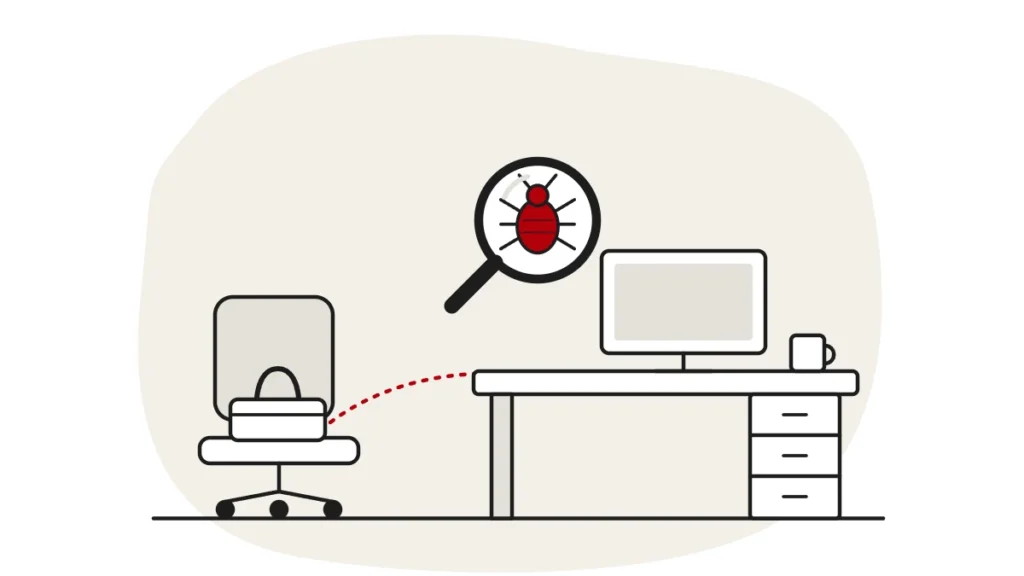
At work, the places to check are upholstered chairs, staff-room sofas, lockers, coat areas and anywhere bags are left on soft furnishings.
Bed Bug Exposure at Work: What to Do at Home
- Leave your bag and coat on a hard floor or in the bath, not on the bed or sofa.
- Check the seams and pockets of your bag with a torch.
- Watch for signs: bites in a line or cluster, blood spots or small dark marks on sheets.
If you commute by public transport, our guide to bed bugs on the Tube and trains explains the real level of risk.
Can I go to work if I have bed bugs at home?
We’re not aware of any UK rule that says you must stay off work because you have bed bugs at home. Bed bugs aren’t known to spread disease, and they aren’t a sign of a dirty home: the NHS says they’re found in both clean and dirty places. What matters is not carrying them in with you.
- Change into freshly washed and dried clothes before you leave, kept sealed in a bag away from the bedroom.
- Don’t take bags or coats that have been kept in the bedroom, and keep your things off office soft furnishings.
- Get the problem at home treated. If you rent and your landlord is slow to act, our step-by-step guide for when a landlord won’t treat bed bugs sets out what to do.
Telling your manager early means the workplace can be checked quietly before anything spreads.
What Employers Should Do When Bed Bugs Are Reported
The law sets general duties, not a bed bug procedure, so the steps below are good practice rather than legal requirements.
| Step | What to do | Why it helps |
|---|---|---|
| 1. Take it seriously | Thank the person, record the report and act the same day | Acas says employers must take reported risks seriously; quick action keeps it small |
| 2. Confirm it | Arrange a professional inspection of the reported area and nearby seating | Many insects look alike; treatment should be based on evidence |
| 3. Limit spread | Close off affected chairs or rooms; ask staff to keep bags off soft furniture | Stops bugs being carried to other desks or homes |
| 4. Communicate | Tell staff what’s happening and what to do, without naming anyone | Calms rumours and encourages early reporting |
| 5. Treat and follow up | Use a professional; plan for a follow-up inspection | Return visits may be needed to confirm the problem has gone |
| 6. Tell the person back | Let the person who reported it know what you did and why | Acas guidance says employers should do this |
Don’t use shop-bought foggers or bug bombs. They tend to scatter bed bugs into new hiding places rather than clear them. For offices and commercial buildings, ThermoPest’s office pest control starts with an inspection, and treatment is heat-led, with targeted spray where it’s needed. If you’re also a landlord or managing agent dealing with tenants’ homes, see our bed bug control for landlords.
Keeping It Confidential
Fear of being blamed stops people reporting early, so discretion is a practical tool, not just good manners.
- Employers: share only what staff need to know (which area, what to do), not who reported it or whose home is affected. Treat any information an employee shares about their home or health with care, and limit it to the people who need it.
- Employees: you can raise a concern without making it public. If your contract or a settlement agreement has a confidentiality clause, GOV.UK says such clauses aren’t valid if they try to stop you making a whistleblowing disclosure, which includes reporting that someone’s health and safety is in danger (GOV.UK, whistleblowing).
Our technicians work discreetly and arrive in unmarked vans, which helps when you’d rather staff and visitors didn’t notice a pest visit. For wider background, see our overview of bed bug laws and regulations.
FAQs
What are my employee rights if there are bed bugs at work?
In England, Wales and Scotland, your employer has a general duty to protect your health, safety and welfare so far as is reasonably practicable, and to keep workplace furniture sufficiently clean. You’re protected from detriment or dismissal for raising a genuine health and safety concern by reasonable means. Report it in writing and keep a copy.
Is it a health and safety issue if bed bugs are found at work?
Bed bugs aren’t named in UK health and safety law, but the general duties apply. Acas says that when someone reports a risk, the employer must take it seriously and act to protect everyone at work. If your employer doesn’t respond, you can contact your local authority’s environmental health team or the HSE.
Can I sue my employer if I got bed bugs from work?
If you’ve been treated badly or dismissed for raising a concern, Acas says you could consider an employment tribunal claim, and strict time limits apply. For any claim about loss or harm, get advice from Acas or a solicitor first.
Can you get fired for bringing bed bugs to work?
Bed bugs aren’t a sign of a dirty home, and anyone can pick them up. No UK law deals with this directly. Sections 44 and 100 of the Employment Rights Act 1996 protect you if you’re treated unfairly or dismissed for raising a health and safety concern by reasonable means, but they don’t cover every dismissal, and other unfair dismissal rights usually depend on how long you’ve worked there. If you’re worried about your job, speak to Acas or your union.
Found bed bugs at work?
If you’ve spotted a bug or bites at work, an inspection will confirm what you’re dealing with before it spreads. ThermoPest is a member of the BPCA and NPTA, and our technicians arrive in unmarked vans, so the visit stays discreet.