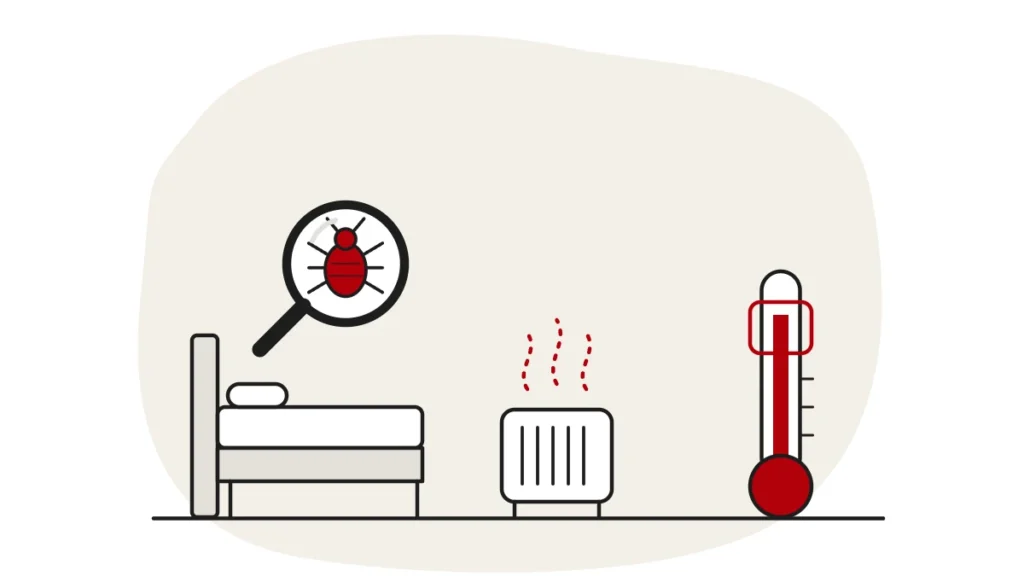
Heat kills bed bugs, but time matters as much as temperature. Eggs need more heat, or more time, than adults, and just a few degrees below the lethal range they can survive for hours.
Reviewed by James Rhoades, Owner, ThermoPest · Last reviewed 16 October 2026
If you’ve found bed bugs, it’s natural to wonder whether you can simply cook them out. Heat can kill every life stage, eggs included, but only when the right temperature reaches the bugs themselves and stays there long enough. Below we explain the temperatures that matter, what they mean for washing, drying and freezing, and why heat at home so often misses some of them.
What temperature kills bed bugs and their eggs?
Bed bugs and their eggs die when held above about 50°C for long enough. Adults die at slightly lower temperatures than eggs, and the closer you are to that threshold, the longer the heat has to be held. A few degrees below it, eggs can survive for hours.
Why Eggs Are the Hardest Part
Eggs need more heat, or more time, than adults and nymphs. At temperatures that kill adults, eggs can still survive for hours. That’s why any heat method has to be judged on whether it kills the eggs, not just the bugs you can see. If eggs survive, they hatch and the infestation carries on.
Is there a temperature that kills bed bugs instantly?
Not in any useful sense at home. Higher temperatures kill faster, but the heat still has to travel into the seam, crack or mattress where the bugs are hiding, and that takes time. A thermometer reading in the air of a room tells you very little about the temperature inside a sofa cushion or behind a skirting board.
How long do bed bugs need to be exposed to heat?
It depends on the temperature, and the gap between “hot enough” and “not quite” is small. Just a few degrees can make the difference between eggs dying and surviving for hours. A 2018 article from the British Pest Control Association’s PestAware service, drawing on heat-treatment developer David Hammond, gives a target of “50°C for two-hours or 52°C for one-hour”, and stresses that this temperature has to be reached on the insect itself, not just in the room. Treat these as research and industry guide figures: how long a real room takes depends on how quickly its coldest spots heat up.
That point is the one most people miss. Bed bugs hide in the insulated, hard-to-heat places, so the time only starts counting once those places are hot.
Does washing at 60°C kill bed bugs?
Yes. The NHS advises washing affected bedding and clothing on a hot wash (60°C) and tumble drying on a hot setting for at least 30 minutes. That’s above the temperature that kills both adults and eggs.
- Bag items in the room where you find them, then carry the bag straight to the machine so bugs don’t drop off on the way.
- Don’t overload the drum, so heat can reach the middle of the load.
- Put clean items into fresh bags or a sealed box, not back on the bed until it has been dealt with.
- Only throw away items that can’t be washed or treated.
What about things you can’t wash?
For items that can’t go in the washing machine, a spell in a hot tumble dryer can be used instead of washing, and it works faster if items go in dry. Check the care label before you do. Our guide on whether ironing kills bed bugs covers smaller items and why an iron only treats the surface.
Can you kill bed bugs by freezing them?
Yes, but it takes much longer than heat. The NHS suggests putting items that can’t be washed in a plastic bag and into the freezer for 2 to 3 weeks.
Patience matters. Bed bugs can survive moderate freezing for a long time, so a freezer that isn’t properly cold, or one that’s packed so tightly the middle never gets cold, may not work.
- Bag items first, and keep the bags loosely packed.
- Use a freezer thermometer to check your freezer is actually reaching a low enough temperature.
- Leave items for the full time the NHS suggests before taking them out.
Does cold weather kill bed bugs?
Don’t rely on it. Bed bugs need long, steady exposure to hard frost to die, and the inside of a heated home never gets anywhere near that. Leaving a sofa or mattress outside overnight won’t do it, and it risks spreading bugs to anyone who picks it up.
Can a hot car, sauna or heater kill bed bugs?
A Hot Car
Some people try wrapping items in plastic and leaving them inside a closed car parked in the sun. On a British day you can’t assume a car will get the middle of a bag hot enough, so you’d need a thermometer inside the load to know whether it has reached a lethal temperature and held it.
A Sauna or Airing Cupboard
The same rule applies to any hot space: what counts is the temperature at the centre of the item, held for long enough, not the temperature of the air around it. Thick items such as pillows and bags take a long time to heat through, and without a thermometer inside them you’re guessing.
Plug-In Heaters and Turning Up the Heating
Turning up the central heating won’t work: raising or lowering the thermostat won’t get rid of bed bugs. Plug-in fan heaters aren’t a substitute either: in the BPCA PestAware article, David Hammond says he “cannot condone the use of general fan heaters that plug into a wall socket”, pointing to their low power output. Heaters left running in a closed room full of bedding and furniture are also a fire risk.
Steamers
Steam kills bugs and eggs on contact. The catch is that contact: steam treats the surface it touches, not the inside of a mattress, a joint in a bed frame or the gap behind a skirting board. Read more in our guide on whether a handheld steamer kills bed bugs.
Why does DIY heat treatment often fail?
Because rooms don’t heat evenly, and bed bugs live in exactly the places that heat up last. The BPCA PestAware article puts it plainly: “Cold spots are the core of all issues relating to heat treatment efficacy.” It warns against measuring only the general air temperature, because the insects and their eggs are typically tucked away in insulated areas.
Common cold spots include:
- the core of a mattress or sofa;
- cracks and joints in wooden bed frames;
- gaps behind skirting boards and fixed headboards; and
- socket voids.
A hairdryer, heater or steamer can make one area very hot while a spot close by stays at a temperature the bugs survive. Bugs and eggs left in that spot carry the infestation on, which is why so many people try heat at home and find bites coming back weeks later.
How Professional Heat Treatment Deals With Cold Spots
Professional bed bug heat treatment is built around this problem. Bed bugs and their eggs die when held above about 50°C for long enough. We heat rooms to 50–60°C and hold that heat until the hardest-to-reach spots stay above 50°C. Rooms don’t heat evenly, so we place temperature monitors in known cold spots and hard-to-reach areas.
In a treated room, some spots get much hotter than others. The hottest reading isn’t what matters. What matters is that every area, including the coldest, reaches a lethal temperature, and the monitors in the cold spots are how we know it has. ThermoPest’s treatment is heat-led, with targeted spray where it’s needed, and a return visit may be needed. If you live in a flat, we’ll ask to inspect neighbouring flats too.
If you’re worried about what the heat will do to your things, see will heat treatment damage furniture or electronics? For timings, read how long bed bug treatment takes, and if you’re weighing up your options, our guide to council vs private bed bug treatment sets out the differences. If you’re in the capital, see our bed bug treatment in London.
FAQs
Do bed bugs die at 60°C?
Yes, if the heat reaches them. 60°C is above the temperature that kills both adults and eggs, and the NHS recommends a 60°C wash for affected bedding and clothes. The hard part isn’t the number, it’s getting every hiding place to that temperature.
Will 90 degrees kill bed bugs?
If you mean a 90°C wash, you don’t need it: the NHS advises 60°C, so follow the care label rather than turning the machine up. Bed bugs and their eggs die when held above about 50°C for long enough, so a 60°C wash followed by a hot tumble dry is enough.
What temperature can bed bugs survive?
More than most people expect. Eggs can survive for hours just a few degrees below the lethal range, and at the cold end bed bugs can survive moderate freezing for a long time. Normal room temperatures don’t harm them.
Can a hairdryer kill bed bugs?
Only the ones it heats directly, and only for as long as you hold it there. It can’t heat the inside of a mattress, a bed frame joint or the gap behind a skirting board, which is where most bugs and eggs hide, so it won’t clear an infestation.
Not sure the heat has reached them all?
If you’re still getting bites or finding signs, an inspection will confirm what you’re dealing with and where they’re hiding. ThermoPest is a member of the BPCA and NPTA. Our technicians arrive in unmarked vans and monitor the cold spots, not just the room air.