UV light won’t clear bed bugs from your home. Lab work suggests ultraviolet light can harm bed bug eggs and young nymphs exposed directly at very close range, but in a real bedroom the bugs hide in seams, cracks and joints where light can’t reach. A UV torch can help you look; it isn’t a treatment.
Reviewed by James Rhoades, Owner, ThermoPest · Last reviewed 15 October 2026
UV wands, lamps and torches are widely sold as bed bug killers or bed bug detectors, so it’s a fair question to ask before you spend money on one. This guide explains what the evidence says, the difference between using UV to spot bed bugs and using it to kill them, the safety risks of UV-C, and what actually works.
Does UV light kill bed bugs?
Not in a way that will solve an infestation. Ultraviolet light can damage living cells, which is why UV-C lamps are used for disinfecting surfaces. The question isn’t whether UV can harm a bed bug in the open. It’s whether a handheld device can reach every bug and every egg in a home. It can’t.
What the Research Shows
There’s very little published research on UV and bed bugs. Lab work has found that exposing bed bug eggs and newly hatched nymphs to ultraviolet light at very close range, for a few seconds, can reduce their survival and their ability to find a host.
That’s useful to know, but look at the set-up: bugs and eggs laid out in the open, a few centimetres from the lamp, in a lab. It doesn’t tell you a wand waved over a mattress will clear bed bugs.
How does UV light affect bed bugs?
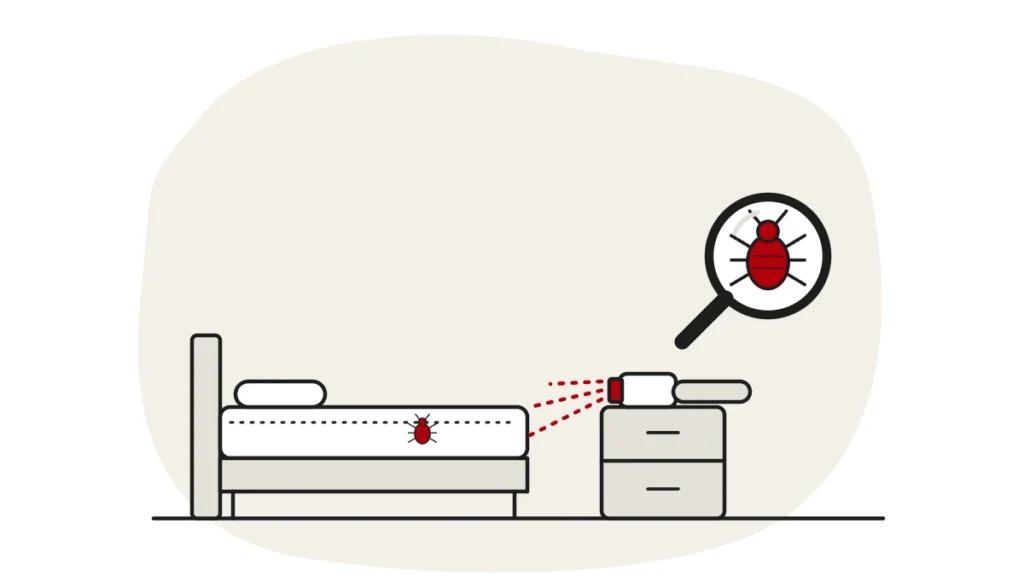
UV light works on whatever it shines directly on. It doesn’t pass through fabric, wood, dust or the bugs’ own bodies stacked together, and it doesn’t travel round corners. So the only bugs it can affect are the ones in plain view, close to the lamp, for long enough. Those are the few you could have found and dealt with anyway.
Why UV Light Won’t Clear an Infestation
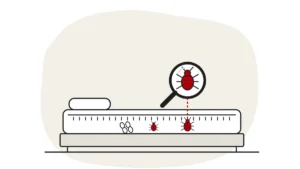
Bed bugs spend most of their time hidden. They pack into mattress seams and piping, under labels, inside bed frame joints and screw holes, behind headboards, along skirting boards and under the edges of carpet. Eggs are glued into the same tight spaces. None of those places is in the line of sight of a lamp.
- Line of sight only: anything in shadow, under a fold or inside a crack is untouched.
- No penetration: UV doesn’t go into a mattress, a sofa cushion or the gap behind a skirting board.
- Close range only: the lab effects above were seen only at a few centimetres. A wand held further away, or moved quickly, delivers far less.
- Eggs and survivors: any eggs or bugs that are missed carry on, and the infestation rebuilds.
The NHS says it’s very difficult to get rid of bed bugs yourself, and that home measures are unlikely to get rid of them completely. A gadget that only works on what it can see doesn’t change that.
Does UV light kill bed bugs overnight?
No. Leaving a UV lamp on in the bedroom overnight still only lights exposed surfaces, and bed bugs don’t come out and sit in the beam. Leaving a UV-C lamp running in a room where people are can also be dangerous, as explained below.
How long does it take UV light to kill bed bugs?
There’s no reliable answer for a home setting, because it depends on the device’s strength, the distance and whether the light reaches the bug at all. For bugs hidden in a seam or crack, no amount of time will help, because the light never gets there.
UV for Spotting Bed Bugs vs UV for Killing Them
Two different kinds of device get called “bed bug UV lights”, and it’s worth knowing which is which.
| Feature | UV torch (black light) | UV-C wand or lamp |
|---|---|---|
| What it’s sold for | Spotting bugs, stains and marks | Killing bugs, germs or mites |
| Type of light | Usually UV-A, which makes some materials glow | UV-C, the germicidal kind |
| Can it help? | A little, as an inspection aid alongside a bright torch | Only on bugs in the open, very close up |
| Main risk | False reassurance or false alarms | Eye and skin injury; false sense that the problem is dealt with |
Do bed bugs show up under UV light?
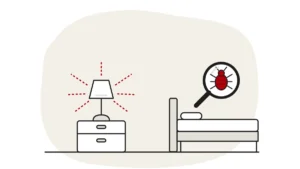
Some people use a UV torch to look for bed bugs, and it can make marks on pale fabric stand out. But lots of everyday things glow under UV, including washing powder residue and the brighteners used in white sheets, so a glow isn’t proof of bed bugs, and no glow doesn’t rule them out. Don’t expect bed bugs themselves to light up clearly.
For most people, a bright ordinary torch and a methodical look are more useful. Check:
- mattress seams, piping and labels, and the underside of the mattress;
- bed frame joints, slats, screw holes and the headboard;
- bedside furniture, skirting boards and carpet edges near the bed.
Look for live bugs (flat, reddish-brown, around 5mm long as adults, according to the NHS), pale shed skins, small dark spots of droppings and tiny blood spots on sheets.
Are bed bugs attracted to UV light?
Bed bugs aren’t drawn to light the way moths are. They’re drawn to people: warmth and the carbon dioxide we breathe out. That’s also why sleeping with the lights on won’t stop bed bugs, and why light traps sold for flying insects don’t work for them.
Is UV-C light safe to use at home?
This is the part the product listings tend to skip. UV-C is the type of ultraviolet used for germicidal lamps, and it can injure people. Shining a UV-C germicidal lamp on the body exposes you to harmful ultraviolet radiation, which may cause injury and increase the risk of skin cancer and permanent eye damage. Short-term effects include skin reddening and severe eye irritation.
- Never shine a UV-C device at skin, and never look at the light or point it towards anyone’s face.
- Don’t leave a UV-C lamp running unattended, especially in a room where people or pets sleep.
- Keep UV devices away from children.
- If your eyes become painful, gritty or watery after using a UV device, or your skin burns, speak to a pharmacist, GP or NHS 111.
Hand-held UV devices vary a lot in how they’re made and labelled, and their packaging rarely tells you enough to judge either their effect or their safety. That’s another reason not to rely on one.
What about sunlight, blue light and other “light” fixes?
Can sunlight kill bed bugs?
Putting a mattress or bags of clothes out in the sun won’t reliably work in the UK. Sealed black bags left in a hot, closed car are sometimes suggested, but success depends on the weather, and on a British day you can’t count on it. Sunlight also doesn’t reach the bugs hiding inside seams.
Does blue light kill bed bugs?
We’re not aware of evidence that blue light devices sold for home use will clear bed bugs. The same problem applies as with UV: light only affects what it reaches.
UV Gadgets Combined With Other Features
Some devices combine UV with heat, vibration or ozone. Adding features doesn’t change the basic problem. Bed bugs and eggs hidden in the structure of a bed or room won’t be reached by a hand-held gadget.
What to Do Instead
If you’ve found signs, these steps help while you arrange proper treatment:
- Wash and dry what you can: the NHS advises a hot wash at 60°C and a hot tumble dry for at least 30 minutes for affected bedding and clothing. Items that can’t be washed can be sealed in a plastic bag and put in the freezer for 2 to 3 weeks.
- Don’t move things between rooms: moving bedding, cushions or furniture around can spread bugs.
- Skip foggers and bug bombs: they tend to scatter bed bugs into new hiding places, and fogger spray won’t reach the cracks and crevices where bed bugs hide.
- Be wary of shop sprays and household products: see our guides on whether Dettol kills bed bugs, whether Indorex kills bed bugs and whether permethrin kills bed bugs.
- Get it confirmed: if you’re not sure what you’ve found, a professional bed bug inspection will tell you whether it’s bed bugs and how far they’ve spread.
How Professional Treatment Reaches What UV Can’t
The reason heat works where light doesn’t is that heat travels into mattresses, furniture and the gaps around a room, rather than only hitting exposed surfaces. At ThermoPest our approach is heat-led, with targeted spray where it’s needed, so the hiding places a lamp can never reach are treated too. Read how our bed bug heat treatment works. If you live in a flat, we’ll ask to inspect neighbouring flats as well, because bed bugs can move between them. Follow-up visits may be needed, and your technician will explain what to expect.
FAQs
Can UV-C light kill bed bugs?
Limited lab research suggests ultraviolet light can harm bed bug eggs and young nymphs exposed directly at very close range. A lamp can’t reach bugs hidden in seams, cracks or furniture joints, so it won’t clear an infestation. UV-C can also injure eyes and skin, so it needs careful handling.
Can you see bed bugs with a UV light?
A UV torch can make some marks on fabric stand out, but many everyday things glow under UV too, so it can give false alarms. A bright ordinary torch and a careful check of mattress seams, bed frame joints and skirting boards near the bed is usually more useful.
Do bed bugs glow under a black light?
Don’t count on it. A black light isn’t a reliable way to confirm bed bugs. Look for live bugs, pale shed skins, dark spots of droppings and small blood spots on sheets instead, or arrange an inspection if you’re unsure.
Is there a UV light that kills bed bugs?
UV devices are sold with bed bug claims, but we’re not aware of any hand-held light that can reach bugs and eggs hidden inside a bed or room. Treat these as inspection aids at best, not a treatment.
Does UV light kill bed bug eggs?
Lab work exposing eggs and newly hatched nymphs to UV at close range has reported reduced survival, but in a home eggs are glued into seams and cracks out of the light’s reach, so a UV device won’t deal with them.
Found signs of bed bugs?
A UV gadget won’t reach where bed bugs hide. If you’ve found bites, bugs or marks on the mattress, an inspection will confirm what you’re dealing with and the best way to treat it. ThermoPest is a member of the BPCA and NPTA, and our technicians arrive in unmarked vans.