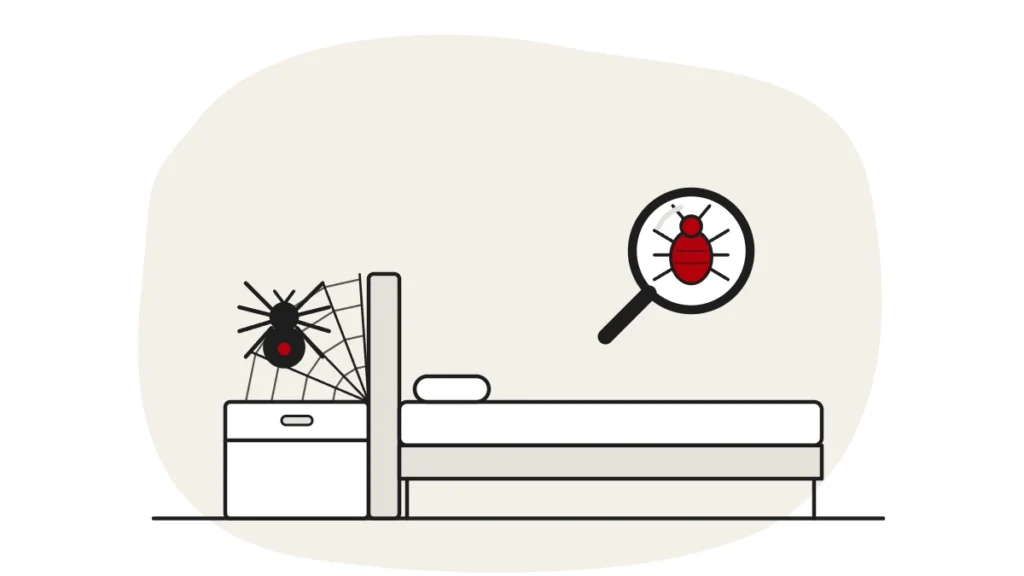
Yes, spiders will eat bed bugs if they happen to catch one, but they won’t get rid of an infestation. Spiders hunt whatever small insects cross their path, while bed bugs spend most of their time hidden in mattress seams and cracks near the bed. Nothing that eats bed bugs in a home can keep up with them.
Reviewed by James Rhoades, Owner, ThermoPest · Last reviewed 15 October 2026
It’s a fair question if you’ve spotted spiders in the bedroom and you’re also waking up with bites. Below we look at which spiders might eat bed bugs, what else is known to prey on them, why none of it helps you in practice, and what to do instead.
Do spiders eat bed bugs?
Spiders are general predators. They don’t pick out particular insects; they eat what they can catch. A bed bug that walks into a web, or past a hunting spider, can end up as a meal like any other small insect.
The catch is that the two rarely meet. Bed bugs feed at night, then go straight back to dark, tight hiding places: mattress piping, bed frame joints, the back of the headboard, skirting boards. Most of the time they’re out of reach. Spiders tend to sit in corners, behind furniture and in quiet rooms, waiting for insects that wander or fly about. Bed bugs can’t fly and don’t wander far from where people sleep, so few of them end up where spiders are waiting.
We’re not aware of any published study showing spiders controlling a bed bug infestation in a home, and we wouldn’t expect one to.
Which spiders eat bed bugs?
People search for specific spiders, so here’s how the common ones fit in. None of them targets bed bugs.
House Spiders
The large house spiders you see running across the carpet build webs in corners, behind furniture and in sheds, and catch insects that blunder into them. A bed bug could end up in one, but bed bugs stay close to the bed, so it’s unlikely to happen often.
Daddy Long-Legs and Cellar Spiders
In the UK, “daddy long-legs” can mean two different creatures. Often it’s the crane fly, which isn’t a spider and doesn’t prey on other insects. People also use the name for the thin, long-legged cellar spider that hangs in loose webs in ceiling corners. A cellar spider will eat small insects caught in its web, but it doesn’t go looking for bed bugs in mattress seams.
Jumping Spiders and Wolf Spiders
These spiders don’t rely on webs. They stalk or ambush prey, so they’re the most likely to bump into a bed bug walking across a floor or wall. Even so, they hunt in the open, while bed bugs spend their time hidden in the dark. A hunting spider might take the odd bed bug, but that’s all.
Can spiders get rid of bed bugs?
No. Even a spider that eats bed bugs now and then won’t stop an infestation, for three simple reasons:
- They’re in different places. Bed bugs hide in the bed and furniture you sleep or sit on. Spiders live in corners, ceilings and quiet spaces.
- Spiders don’t seek them out. They take what comes along. They won’t search mattress seams for hidden bugs or eggs.
- The bugs you can’t see matter most. Eggs and young bed bugs (nymphs) tucked into cracks keep the infestation going, whatever happens to the odd adult that wanders into the open.
Please don’t try to encourage spiders, or anything else, into your bedroom to deal with bed bugs. It won’t work, and the longer an infestation goes untreated, the further it can spread.
What Eats Bed Bugs? Other Natural Predators
A few other creatures have been recorded eating bed bugs. Here’s what the sources we checked actually say.
| Predator | What the source says | Will it help you? |
|---|---|---|
| Spiders | General predators that eat small insects they catch | No. They rarely meet bed bugs and don’t seek them out |
| Cockroaches | A 1930 letter in Nature recorded American cockroaches eating bed bugs, mostly young ones | No. Cockroaches are a pest problem of their own |
| Masked hunter | Indoors it feeds on any insect or similar creature it can overpower, including bed bugs | No. It can give a painful bite if handled, and its presence points to another pest problem |
Cockroaches
In 1930, A. N. Gulati wrote to the journal Nature after watching cockroaches visit bed bug-infested bedsteads at night. In jar experiments, the American cockroach (Periplaneta americana) ate bed bugs, preferring young ones that had recently fed and sometimes rejecting adults. The most any one cockroach ate was three of the twelve bed bugs it was given over 48 hours. That shows cockroaches can eat bed bugs, not that they can control them, and nobody wants cockroaches as a solution.
The Masked Hunter
The masked hunter is a type of assassin bug. It’s native to Europe and western Asia and, indoors, feeds on any arthropod it can overpower, including bed bugs. It doesn’t seek out people to bite, but it will bite if handled or squashed, and the bite is painful. Finding masked hunters is often a sign of another pest problem, and the way to reduce them is to deal with the pests they’re feeding on.
Do bed bugs attract spiders?
Spiders go where there’s food, so any home with plenty of insects can have more spiders. But seeing spiders tells you nothing about bed bugs. Spiders are common in perfectly healthy homes, where they feed on flies, moths and other small insects.
If you’re worried, look for the signs of bed bugs themselves rather than reading anything into spiders:
- bites in a line or small cluster on skin left uncovered in bed;
- small dark spots on mattress seams, the bed frame or headboard;
- tiny blood spots on sheets or pillowcases;
- pale shed skins in seams and cracks;
- live bugs. The NHS says adults are around 5mm long.
Our step-by-step guide on how to check a mattress for bed bugs shows you where to look.
Spider or Bed Bug? How to Tell Them Apart
Bed bugs aren’t spiders and aren’t arachnids. They’re insects, with six legs and a flat, oval, reddish-brown body. Spiders have eight legs and a body in two clear parts. Very young bed bugs are paler and much smaller, which is where confusion sometimes starts.
If you’ve found something small near the bed and you’re not sure what it is, our guide to bugs that look like bed bugs covers the common lookalikes. Keep the insect in a sealed bag or take a clear photo, which helps a technician confirm what it is.
What actually works against bed bugs?
Natural predators won’t control an infestation, and neither will most quick fixes. The NHS says it’s very difficult to get rid of bed bugs yourself because they can be hard to find and may be resistant to some insecticides, and recommends contacting your local council or a pest control service.
While you arrange that, a few things help:
- Wash bedding and clothing on a hot wash (60°C) and tumble dry on a hot setting for at least 30 minutes, as the NHS advises.
- For items you can’t wash, the NHS suggests sealing them in a plastic bag and putting them in the freezer for 2 to 3 weeks.
- Don’t move furniture or bedding to other rooms, and don’t start sleeping on the sofa, which can spread bed bugs around the home.
- Don’t use foggers, bug bombs or smoke bombs. They tend to scatter bed bugs deeper into walls and other rooms.
- If you live in a flat, let your landlord or managing agent know early, as neighbouring flats may need checking too.
ThermoPest’s bed bug heat treatment is heat-led, with targeted spray where it’s needed. Heat reaches bugs and eggs hidden deep in seams and cracks, the places spiders and other predators never get to. When we treat a flat, we ask to inspect neighbouring flats as well. If you’re wondering whether bed bugs are lurking in every bed anyway, our guide do all beds have bed bugs? separates the facts from the fears.
FAQs
Do spiders eat bed bug eggs?
We’re not aware of any evidence that they do. Bed bug eggs are tiny and tucked into seams, cracks and crevices close to where people sleep, places spiders don’t hunt. Eggs are one of the main reasons infestations keep coming back, which is why treatment needs to reach those hiding places.
Do house centipedes eat bed bugs?
A house centipede might eat one it comes across, as it preys on small insects. Like spiders, though, they hunt in the open and won’t clear bed bugs hidden in a mattress or bed frame.
Do daddy long-legs eat bed bugs?
If you mean the crane fly, no, it doesn’t prey on other insects. If you mean the long-legged cellar spider, it may eat a bed bug caught in its web, but it won’t make any real difference to an infestation.
Will spiders kill bed bugs in my bed?
Very unlikely. Spiders don’t search beds for bed bugs, and bed bugs spend the day hidden in seams and joints. If you’re getting bites and finding marks on the mattress, check for bed bugs directly rather than hoping spiders will deal with them.
Are bed bugs arachnids?
No. Bed bugs are insects with six legs. Spiders, mites and ticks are arachnids with eight legs. The two groups are easy to tell apart up close, even if very young bed bugs are small and pale.
Found bed bugs, not just spiders?
If you’ve found signs of bed bugs, an inspection will confirm what you’re dealing with and how far it’s spread. ThermoPest is a member of the BPCA and NPTA, and our technicians arrive in unmarked vans.