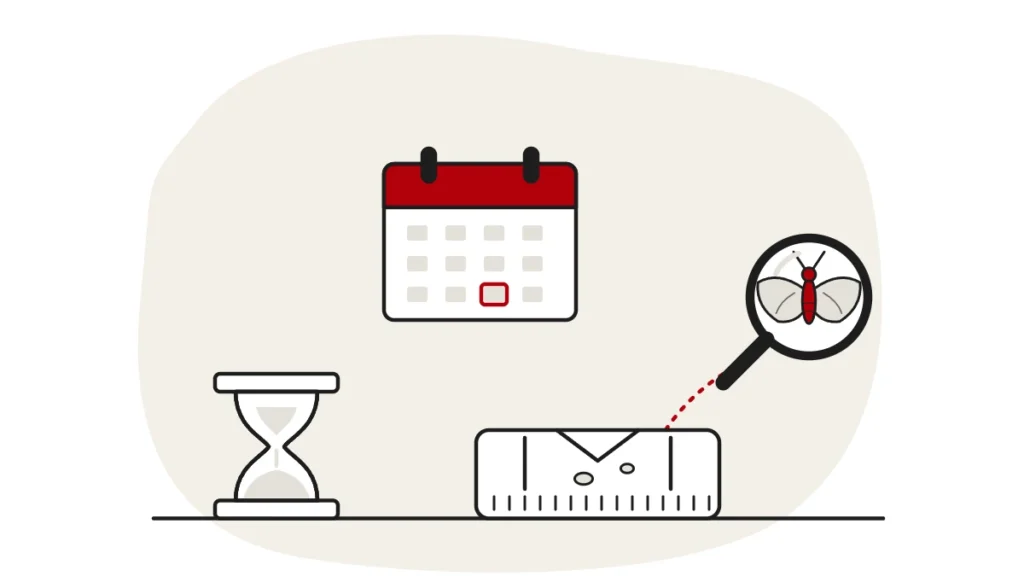
Adult clothes moths don’t live long. The British Pest Control Association (BPCA) says adult common clothes moths live only days. The whole life cycle is much longer: about 3–10 months from egg to adult, according to the BPCA, and most of that time is spent as a larva eating natural fibres in your home.
Reviewed by James Rhoades, Owner, ThermoPest · Last reviewed 16 October 2026
So the moth you see fluttering in the wardrobe is near the end of its life, not the start. This guide explains how long each stage lasts, why moths seem to stick around for months in a warm house, how long the bigger moths that fly in from the garden live, and what you can do to break the cycle.
How Long Do Moths Live? The Life Cycle at a Glance
Moths go through four stages: egg, larva (caterpillar), pupa and adult. When people ask how long a moth lives, they usually mean the adult, but the larva is the stage that lasts longest and does the damage. The figures below are for the common clothes moth (Tineola bisselliella), the moth behind most holes in jumpers and bare patches in wool carpets in UK homes.
| Stage | BPCA | Natural History Museum | What’s happening |
|---|---|---|---|
| Egg | 1–5 weeks to hatch | 4–10 days in summer, up to three weeks in colder weather | Tiny eggs laid among wool, silk, fur or feathers |
| Larva | 2–7 months | One month to two years, depending on conditions | Small cream caterpillars feed on natural fibres; this is the damaging stage |
| Pupa | 2 weeks to 2 months | 10–50 days | The larva spins a silk cocoon and changes into an adult |
| Adult | Only days | Not stated; adults don’t feed | Adults mate and lay eggs, then die |
| Whole life cycle | About 3–10 months | Varies widely with temperature | Faster in warm homes, slower in cold ones |
The two sources give slightly different ranges because development speed depends so much on warmth and humidity. Treat the figures as a guide rather than a timetable.
How long can a moth live in your house?
Indoors, the answer depends mostly on how warm your home is. English Heritage’s guidance on the webbing clothes moth (another name for the common clothes moth) says larvae in unheated buildings may take nearly a year to finish growing, while heated buildings can see two complete cycles a year, and very warm buildings even three, with moths appearing at any time.
That’s why a moth problem can feel endless. Each adult only lives a short while, but a centrally heated flat or house keeps new generations coming. By the time you notice adults, there are often larvae at different stages already feeding in carpet edges, under furniture or in stored clothes.
How long does a moth live in your house if you leave it alone?
An individual adult moth will die on its own fairly soon. An infestation won’t. As long as there’s wool, silk, fur or feathers to eat and somewhere dark and undisturbed to hide, the cycle carries on. Removing the food source and the larvae is what stops it, not waiting for the adults to die.
How long do adult moths live?
Adult clothes moths are short-lived. The BPCA says they live only a few days, so the adult stage is a small part of the moth’s life.
The Natural History Museum notes that adult clothes moths don’t feed at all, because their mouthparts are reduced. Their job is to mate and lay eggs. That’s also why the adults themselves don’t damage clothes; their larvae do.
Other Moths You Might Find Indoors
- Case-bearing clothes moth (Tinea pellionella): similar to the common clothes moth, but its larvae carry a small silk case made from the fibres they’ve eaten. The Natural History Museum gives its adult wingspan as 9–16mm.
- White-shouldered house moth: the BPCA says its eggs hatch in 7–25 days depending on temperature, its larval stage lasts 2–5 months and adults live 2–3 weeks.
- Indian meal moth: a food-store moth found in kitchen cupboards rather than wardrobes. The BPCA gives its full life cycle as 27 to 300 days, depending on conditions.
How long do big moths live in the UK?
The larger moths that fly in through an open window at night and circle the light are usually garden species, not clothes moths. Butterfly Conservation says there are around 2,500 species of moth in the UK, and that the change from caterpillar to adult can take from a few days to many months depending on the species. Adult lifespans vary too, so there’s no single answer for “big moths”.
These moths don’t eat your clothes or carpets and are generally harmless. If you’re seeing a lot of them, our guide on why there are so many moths in your house explains how to tell garden visitors from clothes moths.
How long do carpet moths live?
“Carpet moths” are usually the same species as clothes moths, just found in a different place. So the same life cycle applies: a short adult life, with larvae feeding for months in the pile, along skirting boards and under beds and sofas. A carpet moth problem and a clothes moth problem often turn out to be one and the same, so check both. Our guide to the signs of carpet moths and clothes moths shows what to look for.
Do moths live all year round?
Indoors, they can. The BPCA says moths can be a problem all year round. English Heritage notes that in unheated buildings adults tend to emerge in spring, heated buildings see a second emergence in autumn, and in very warm buildings moths can appear at any time.
Many people notice clothes moths most in late spring and summer, when adults are more active and windows are open. That’s a good time to check wardrobes, drawers and the edges of wool rugs, but don’t assume the problem has gone in winter. Larvae keep feeding wherever the house stays warm.
How to Shorten the Moth Life Cycle in Your Home
You can’t change how long a moth lives, but you can remove the eggs and larvae and make your home less inviting:
- Vacuum the hidden spots. Use a crevice tool along carpet edges and skirting boards, under furniture and on both sides of rugs. Repeat every few days at first, and empty the vacuum into a sealed bag in the outside bin.
- Freeze small items. The BPCA advises sealing clothes in a plastic bag and freezing them at -18°C for at least two weeks to kill larvae, longer for larger amounts. The Natural History Museum says freezing to -20°C for a week kills all life stages. Let items come back to room temperature inside the bag before opening.
- Store clean and sealed. Clean woollens before putting them away and keep them in airtight boxes or sealed garment bags.
- Wear and air. Moths prefer fabrics that sit untouched for months. Wearing, brushing and airing woollens regularly makes them less attractive.
- Use traps to monitor. Pheromone traps catch adult males only, so they tell you where moths are active rather than clearing them.
Home remedies have limits. Our guide to whether vinegar kills carpet moths covers one popular option, and our step-by-step guide on how to get rid of carpet and clothes moths goes through each room. If you’re worried about health, see are carpet moths dangerous?
When the Cycle Won’t Break
If you keep finding moths or new damage after several weeks of vacuuming and cleaning, eggs and larvae are probably hidden somewhere you can’t reach: deep in fitted carpet, inside upholstery or in stored items you haven’t checked. Because the larval stage can last months, a problem left alone usually grows.
That’s when professional moth control helps. At ThermoPest, treatment starts with an inspection to find every hotspot. Our approach is heat-led, with targeted spray where it’s needed, so it reaches larvae and eggs in carpet pile, furniture and fabrics. Some cases need a follow-up visit, and we give aftercare and monitoring advice afterwards. Moth treatments are covered by our 12-week guarantee. For costs, see our pricing page.
FAQs
How long do moths live in the UK?
For the common clothes moth, the BPCA gives a total life cycle of about 3–10 months, with adults living only days. Most of the moth’s life is spent as a larva, which is the stage that eats wool, silk and other natural fibres.
How long can a moth live in your house?
A single adult moth won’t live long, but an infestation can carry on for as long as there’s food. English Heritage says heated buildings can see two complete clothes moth cycles a year, and very warm buildings three, so moths can keep appearing month after month until the larvae are dealt with.
How long do moths live without food?
Adult clothes moths don’t eat at all. The Natural History Museum explains that their mouthparts are reduced, so they can’t feed. Depriving adults of food doesn’t shorten their lives; removing the larvae and the fabrics they feed on does.
How long do moths take to die?
Adult clothes moths die naturally after a short adult life of only days, according to the BPCA. But they lay eggs first, so new moths keep appearing. Freezing small items, thorough vacuuming or professional treatment are what clear the earlier stages.
Do moths live all year round?
Indoors, yes. The BPCA says moths can be a problem all year round. In a warm home, larvae keep feeding through winter and adults can appear in any season, though many people notice them most in spring and summer.
Moths keep coming back?
If you’re still finding moths or fresh damage after cleaning, an inspection will find where the larvae are feeding and what it will take to clear them. ThermoPest is a member of the BPCA and NPTA, and our technicians arrive in unmarked vans.