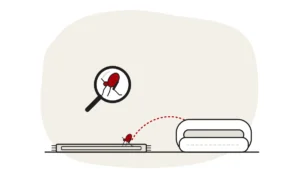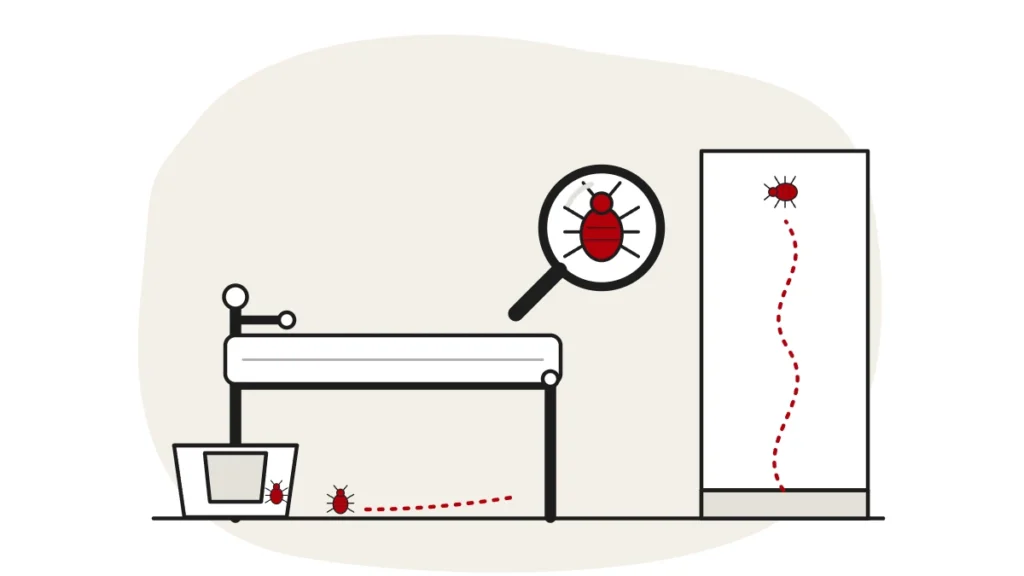
Bed bugs can’t fly and they can’t jump. They have no wings and no spring in their legs, so they get everywhere by crawling, and they crawl well: up walls, across ceilings, over bed frames and furniture. The one thing that slows them down is a very smooth, clean surface such as glass or polished metal.
Reviewed by James Rhoades, Owner, ThermoPest · Last reviewed 16 October 2026
If you’re finding bites but never see an insect, it’s natural to wonder how they’re reaching you. This guide explains how bed bugs move, which surfaces they can and can’t climb, whether a metal bed frame makes any difference, and how to use all of that to make your bed harder to reach while you sort out the real problem.
Can bed bugs fly?
No. The British Pest Control Association (BPCA) describes the bed bug as wingless. Bed bugs are built for hiding, not flying: their flat, oval bodies let them slip into cracks and seams, and they can fit into crevices no wider than a toothpick.
If you’ve seen something fly in the bedroom and assumed it was a bed bug, it was almost certainly another insect. Several other small household insects can be mistaken for bed bugs, and some of them fly. Our guide to what bed bugs look like shows the differences, and the NHS describes adults as around 5mm long and dark yellow, red or brown.
Can bed bugs jump?
No. Bed bugs don’t fly or jump like fleas, but they can crawl rapidly over floors, walls, ceilings and other surfaces. Fleas have powerful back legs built for leaping; bed bugs don’t. If something jumped at you, it wasn’t a bed bug.
Two things make people think they’ve seen a bed bug jump. The first is speed: a bed bug can scuttle across a sheet faster than you’d expect from something so small. The second is falling. Bed bugs do climb onto ceilings, and now and then one drops off, which can look like a jump out of the corner of your eye. So the honest answer to “how high can bed bugs jump?” is that they can’t, but they can fall from somewhere high.
Can bed bugs climb walls and ceilings?
Yes, easily. The BPCA notes that their legs “enable them to crawl up most vertical surfaces”, and walls and ceilings are no obstacle. In practice, most everyday surfaces in a home give them enough to hold on to: painted plaster, wallpaper, wood, fabric, textured plastic and carpet.
That’s why you can find bed bugs behind picture frames, in the edges of ceiling paper, around light fittings, inside electrical sockets and behind skirting boards. They also hide where walls meet the ceiling. Walking upside down across a ceiling is no harder for them than walking across a floor.
How high can bed bugs climb?
There’s no practical limit. A bed bug that can climb a wall can climb a stairwell, a wardrobe or a bunk bed. What limits them is reason, not height: they hide close to where people sleep or sit for long periods, and only wander further when they’re hungry and no one is nearby.
Can bed bugs climb stairs or move between flats?
Yes. Stairs are just a series of short vertical surfaces. More importantly, the BPCA warns that bed bugs “will migrate in search of a human host, so if you spot them in one room, they might be elsewhere in the building”. They can crawl from room to room, or floor to floor, through cracks and openings in walls. That’s why, when we treat a flat, we ask to inspect the neighbouring flats too. Our guide on bed bugs coming from neighbours covers what to do in a shared building.
What surfaces can’t bed bugs climb?
Bed bugs find very smooth, clean surfaces hard to grip. This is the principle behind interceptor traps: bugs crawl or fall into the cup but can’t climb back out because the inner surface is too slippery. The same idea tells you which surfaces give them trouble.
| Surface | Can bed bugs climb it? | Notes |
|---|---|---|
| Fabric, carpet, bedding | Yes, easily | Their favourite routes. A duvet touching the floor is a ready-made bridge. |
| Wood | Yes | Grain, joints and screw holes give grip and hiding places. |
| Painted walls, wallpaper, plaster | Yes | Most painted and papered walls give enough grip. |
| Textured plastic | Yes | Storage boxes, bed slats and most moulded plastics. |
| Smooth, clean plastic | Struggle | Interceptor cups rely on this. Dust, scratches or residue reduce the effect. |
| Glass | Struggle | Clean glass is hard for them to grip; fingerprints and dust make it easier. |
| Polished metal | Struggle | Only when truly smooth and clean. Painted, powder-coated or dusty metal is climbable. |
| Water | No | Not a surface they can climb. For what water does to them, see can bed bugs survive in water? |
These are practical rules of thumb based on how interceptor traps work, not measured limits. One caution: “struggle” isn’t “never”. Given a slightly angled surface, a speck of dust or a nearby bit of fabric, a bed bug will often find a way.
Can bed bugs climb metal bed frames?
Usually, yes. A common belief is that a metal bed frame keeps bed bugs off the bed because they can’t grip metal. In a real bedroom it rarely works like that:
- Most metal frames aren’t smooth. Paint, powder coating, light rust, dust and fingerprints all give enough texture to climb. Welds, corners and screw heads are stepping stones.
- Bed bugs use bridges. A headboard against the wall, a duvet trailing on the carpet, a bedside table touching the frame or a charging cable running to the floor all give a route that bypasses the legs.
- Bed bugs can already be on the bed. Climbing is only relevant if they’re on the floor. Most live in the mattress seams, the frame and the headboard, within a short crawl of where you sleep.
Can bed bugs live in a metal bed frame?
Yes. Bed bugs prefer wood and fabric to metal or plastic, and a metal frame has fewer hiding places than a wooden one: there’s no grain, fewer joints and no screw holes bored into timber. But bed bugs still hide in hollow tubes, end caps, the gaps where slats meet the rails, bolt holes and the fixings for the headboard. A metal frame makes inspection easier; it doesn’t make a bed bed-bug-proof. If you’re choosing a frame, pick the one with the fewest joints and voids, and check it regularly either way. Our room-by-room guide to checking for bed bugs covers where to look.
How far and how fast do bed bugs travel?
Bed bugs don’t need to travel far, because they live where you sleep. They hide in the seams, folds and crevices of the mattress, divan base, bed frame and headboard, crawl out to feed, then return to digest. They prefer to hide close to where they feed. Our guide to how often bed bugs feed explains the pattern.
When the nearest host goes away, they will crawl longer distances in search of a meal, including into other rooms. They don’t go outside by choice; a bed bug on a pavement is lost rather than hunting, as we explain in can bed bugs live outside? Be wary of any speed or distance quoted as fact. “Rapidly” is the honest description: quick enough to vanish while you fetch a torch.
Using This to Protect Your Bed
Knowing how bed bugs move won’t clear an infestation, but it can reduce bites and help you confirm what you’re dealing with. The idea is to pull the bed a little away from the walls and stop valances or blankets forming a bridge to the floor. In practice:
- Move the bed away from the wall and any furniture so the legs are the only route up.
- Keep duvets, sheets and valances off the floor, and don’t store anything under the bed.
- Stand each bed leg in an interceptor cup: a shallow dish with a smooth, slippery inner wall. Bugs climbing towards the bed, or dropping off it, end up in the cup where you can see them. We don’t sell these; any product of this type works on the same principle. Our guide to using bed bug interceptors covers setting them up.
- Check the cups every few days. Catching bugs tells you they’re active in the room, and which direction they’re coming from.
What none of this does is remove the bugs already in the mattress, frame and headboard, or the eggs tucked into seams. Foggers are ineffective against bed bugs, and the BPCA warns against amateur treatments, which “could prolong an infestation and lead to it spiralling out of control”. The NHS advice is to contact your local council or a pest control service.
If You’re Being Bitten
Because bed bugs can climb almost anything in your home, treatment has to reach wherever they’re hiding, not just the bed. That’s why ThermoPest’s approach is heat-led, with targeted spray where it’s needed. Bed bugs and their eggs die when held above about 50°C for long enough. We heat rooms to 50–60°C and hold that heat until the hardest-to-reach spots stay above 50°C. Rooms don’t heat evenly, so we place temperature monitors in known cold spots and hard-to-reach areas. Read how bed bug heat treatment works, and what to expect on the day.
FAQs
Do bed bugs fly or jump?
Neither. Bed bugs have no wings (BPCA) and can’t jump like fleas. They move only by crawling. If an insect in your bedroom flew or jumped, it was something else, such as a carpet beetle, a flea or a fly.
Can bed bugs climb walls?
Yes. The BPCA says their legs let them crawl up most vertical surfaces, and painted plaster, wallpaper and wood are all easy for them. That’s how they reach picture frames, sockets, curtain rails and the edges of ceilings near the bed.
Can bed bugs climb glass or plastic?
They struggle on clean, smooth glass and smooth plastic because there’s little for them to grip. This is why interceptor cups with slippery inner walls trap them. Textured plastic, and glass or plastic that’s dusty or scratched, is climbable.
Can bed bugs climb up metal bed frames?
Usually, yes. Painted or powder-coated metal, dust and welds all give grip, and bedding that touches the floor or a headboard against the wall gives them a route that avoids the legs altogether. A metal frame has fewer hiding places than wood, but it doesn’t keep bed bugs off a bed on its own.
Do bed bugs fall from the ceiling?
Occasionally. Bed bugs can walk across ceilings, and one may drop onto a bed below, which is sometimes mistaken for jumping. Bugs on the ceiling usually mean there’s an established population nearby, so it’s worth getting the room inspected.
Finding bed bugs on the walls or ceiling?
Bugs out in the open usually mean a settled infestation close by. An inspection will confirm where they’re hiding and how far they’ve spread. ThermoPest is a member of the BPCA and NPTA, and our technicians arrive in unmarked vans.