Yes, but only when the cold is severe and lasts long enough. Killing every life stage takes days of steady, deep cold, not a few hours. That makes a freezer useful for small items, which the NHS says to freeze for 2 to 3 weeks, but cold weather won’t clear a home.
Reviewed by James Rhoades, Owner, ThermoPest · Last reviewed 16 October 2026
Freezing sounds like an easy answer, especially when it’s cold outside. It can work, but on a much smaller scale than most people hope. Below, we explain what cold really does to bed bugs, how to freeze small items properly, why cold weather and open windows don’t help, and why heat is used to treat rooms.
Does freezing kill bed bugs and their eggs?
It can, but bed bugs cope with cold better than you might expect. A quick blast of cold isn’t enough, and eggs can survive a short exposure even at very low temperatures. What matters is how cold the bugs themselves get, and for how long. Bed bugs can’t survive their body fluids freezing, but they can lower the point at which that happens, which is why steady, long-lasting cold is needed.
Put simply, bed bugs will die at temperatures below freezing, but the cold must be kept up for a long time: think days or weeks, not hours.
How long do you need to freeze items to kill bed bugs?
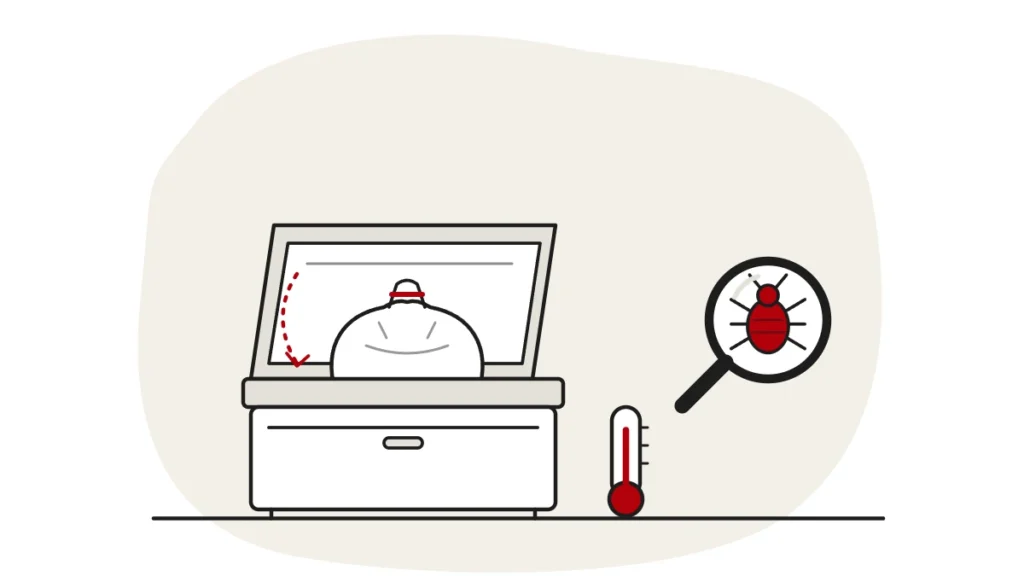
Follow the NHS: put items that can’t be washed in a plastic bag and into the freezer for 2 to 3 weeks. That may sound like a long time, but there’s good reason for it. Home freezers vary, they warm up a little each time the door opens, and the middle of a bag takes time to get as cold as the freezer. Leaving items for the full NHS time gives the cold a chance to reach every bug and egg.
How to Freeze Items to Kill Bed Bugs, Step by Step
- Bag it where it is. Put the item straight into a plastic bag in the room where you found it, and seal it. Bagging infested items helps stop bugs falling off while you carry them through your home.
- Keep it small and loose. Only freeze things that fit in the freezer with space around them. Squeeze out the air, but don’t cram items together: a tightly packed bag stays warmer in the middle for longer.
- Check your freezer. Put a freezer thermometer inside so you know it’s actually running cold, and turn it to its coldest setting if it has one.
- Leave it alone. Keep the bag in for the full 2 to 3 weeks the NHS suggests, and try not to open the freezer more than you need to.
- Thaw it sealed. When you take it out, let the bag come up to room temperature before you open it, so condensation forms on the outside of the bag rather than on the item.
- Keep it apart. Store frozen items in a clean, sealed bag away from the bedroom until the room itself has been dealt with, or they can pick up bugs again.
What can and can’t go in the freezer?
Freezing is for small things that can’t be washed. Everything else needs a different approach.
| Item | Freeze it? | Better option |
|---|---|---|
| Clothes, bedding, towels | Possible, but slow | Hot wash at 60°C and tumble dry hot for at least 30 minutes (NHS) |
| Shoes, books, soft toys, small bags | Yes, if they fit loosely | Bag and freeze for 2 to 3 weeks (NHS) |
| Delicate fabrics that can’t be washed | Yes, check the care label first | Bag and freeze, then thaw before opening |
| Phones, laptops, electronics | Not advised | Check the manufacturer’s guidance, and ask your pest controller how they’ll be handled |
| Mattresses, sofas, bed frames | No, too big | Professional treatment of the room |
Does freezing clothes kill bed bugs?
Yes, if you freeze them for long enough, but for most clothes washing is quicker and easier. The NHS advises washing bedding and clothing on a hot wash (60°C) and tumble drying on a hot setting for at least 30 minutes. Keep the freezer for things that can’t take a hot wash, such as wool, delicate fabrics or items with a “do not wash” label. Our guide on whether ironing, washing or drying kills bed bugs on clothes covers the options in more detail. Only throw away items that can’t be washed or treated.
Does cold weather kill bed bugs?
Not in a home, and rarely outdoors. Killing bed bugs with cold needs long, steady, deep cold. A British winter doesn’t give that, and bugs tucked inside a mattress, sofa or bag are sheltered from the coldest air anyway.
Opening Windows or Turning the Heating Off
This doesn’t work. Trying to rid a home of bed bugs by raising or lowering the thermostat won’t succeed. A cooler room slows bed bugs down rather than killing them, and they can wait it out until the room warms up again. You’ll just be cold. Our guide do bed bugs die in winter? explains what cold really does to them.
Leaving Furniture Outside, in a Shed or in a Garage
It isn’t a dependable method. Outdoor temperatures go up and down, a shed or garage gives some shelter from the weather, and the inside of a mattress or sofa is well insulated. Anything left on the street may also be picked up by someone else, spreading the problem. See can bed bugs live outside? for more.
What is bed bug freeze treatment?
Some pest controllers use spot-freezing equipment, which applies intense cold directly to places where bed bugs are found or suspected. Used correctly, spot-freezing kills bugs and eggs on contact. But it has two limits: it has limited ability to get through fabric and other materials where bed bugs often hide, and it gives no protection against any bugs that were missed.
That’s the same catch as with a steamer: it treats the surface it touches, not the inside of a mattress or the gap behind a skirting board. Read more in our guide on whether a handheld steamer kills bed bugs.
Is heat or cold better for killing bed bugs?
For treating a room, heat. Given how long freezing takes, heating tends to be the better option. A room can be heated far more reliably than it can be frozen, and heat can be pushed into the furniture, seams and cracks where bed bugs live.
Bed bugs and their eggs die when held above about 50°C for long enough. We heat rooms to 50–60°C and hold that heat until the hardest-to-reach spots stay above 50°C. Rooms don’t heat evenly, so we place temperature monitors in known cold spots and hard-to-reach areas. For the research behind the figures, see what temperature kills bed bugs and their eggs.
ThermoPest’s bed bug heat treatment is heat-led, with targeted spray where it’s needed. A return visit may be needed, and if you live in a flat, we’ll ask to inspect neighbouring flats too. In the meantime, freezing small items and hot-washing bedding are useful things you can do yourself.
FAQs
Does freezing kill bed bug eggs?
Yes, but eggs are tough. They can survive short exposures to very low temperatures, so only long, steady freezing kills them reliably. At home, follow the NHS and leave bagged items in the freezer for 2 to 3 weeks.
How long should I freeze clothes to kill bed bugs?
The NHS says to bag items that can’t be washed and freeze them for 2 to 3 weeks. For clothes that can be washed, a hot wash at 60°C followed by a hot tumble dry for at least 30 minutes is quicker, as the NHS advises.
Do bed bugs like the cold?
No, they do best in a warm home. Cold slows them down rather than killing them, and they can survive longer without feeding at cooler temperatures. That’s why a cold room or an empty flat won’t starve or freeze them out.
Can I put my mattress outside to freeze bed bugs?
It isn’t a reliable method. A British winter doesn’t give the long, steady, deep cold that’s needed, and the inside of a mattress is sheltered. It also risks spreading bed bugs to anyone who takes it. If you’re getting rid of a mattress, wrap it in plastic and arrange a proper collection.
Freezer not enough?
Freezing helps with small items, but it won’t reach the bugs in your bed, furniture and walls. If you’ve found signs, an inspection will confirm what you’re dealing with. ThermoPest is a member of the BPCA and NPTA, and our technicians arrive in unmarked vans.