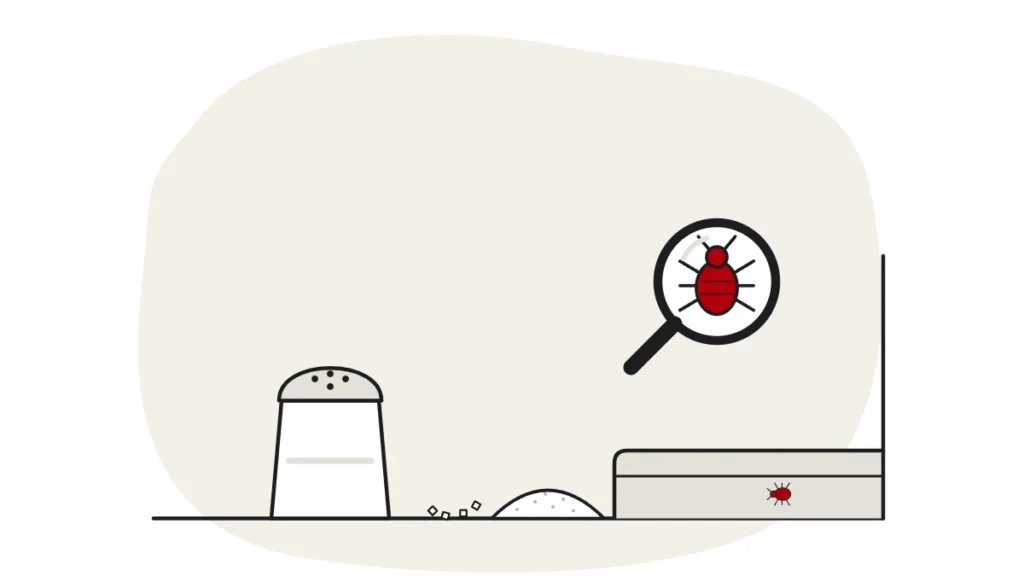
There’s no good evidence that salt kills bed bugs. Table salt isn’t an insecticide, and none of the public health or university guides we checked recommends it. Bed bugs spend most of their time hidden in seams and cracks, their eggs are stuck out of reach, and salt water or Epsom salt is no better.
Reviewed by James Rhoades, Owner, ThermoPest · Last reviewed 15 October 2026
Salt comes up a lot as a cheap, safe-sounding fix, and it’s easy to see why it appeals when you’re lying awake with fresh bites. Below is what the evidence does and doesn’t say, why salt doesn’t reach bed bugs where they live, how it compares with diatomaceous earth, and what’s worth doing instead.
Does Salt Kill Bed Bugs? What the Evidence Says
We looked for research or official advice supporting salt and couldn’t find any. The NHS guidance on bed bugs doesn’t list salt as a treatment at all.
The same goes for most bed bug products based on plant-derived materials or detergents: in our experience they’re ineffective.
So the honest answer to “can salt kill bed bugs?” is that there’s no evidence it does in a real home, and you shouldn’t rely on it while an infestation grows.
Why do people think salt kills bed bugs?
The idea usually comes from salt drying things out. Salt draws moisture from food and harms soft, moist creatures such as slugs, so it seems logical that it would dry out a bed bug too.
Bed bugs are built differently. They have a hard outer layer with a waxy coating that holds water in. Products that kill by drying, called desiccants, are designed to break down that waxy layer, and even they work slowly (more on that below). Ordinary salt grains aren’t made for that job, and there’s no study we could find showing they do it.
Salt Doesn’t Reach Where Bed Bugs Hide
Even if salt had some effect, bed bugs aren’t out in the open waiting to touch it. They hide in:
- mattress seams, piping and labels;
- bed frame joints, slats and screw holes;
- headboards, especially where they’re fixed to the wall;
- gaps behind skirting boards, sockets and picture frames;
- sofa seams and the folds of curtains.
They come out to feed, usually at night, and go straight back. Eggs are glued in place in those same seams and cracks, so a sprinkle of salt never touches them.
Does salt water kill bed bugs?
There’s no evidence that a salt water spray works any better than plain salt. Spraying salty water on a mattress or carpet leaves it damp and can leave a crusty residue once it dries, and it won’t reach bugs and eggs deep in joints and seams.
If you want to use water and heat on fabrics, the NHS route is the one to follow: wash bedding and clothing on a hot wash (60°C) and tumble dry on a hot setting for at least 30 minutes. It’s the heat that matters, not anything you add to the water.
Does salt kill bed bugs on a mattress?
No, and sprinkling it on your mattress can make things harder. Loose grains get into seams and piping, which are exactly the places you or a technician need to inspect. Salt also draws in moisture from the air, which isn’t something you want in a bed you sleep on.
Why did a salt barrier seem to cut my bites?
Some people put a ring of salt around the bed or along the skirting and notice fewer bites for a few nights. There’s no evidence the salt caused that. Bed bugs can reach a bed by climbing the headboard from the wall, or bedding that touches the floor, so a line of salt on the floor is easy to get around. Meanwhile the infestation carries on growing out of sight.
If you want to know whether bugs are travelling to and from the bed, use interceptors: small cups placed under bed and furniture legs that catch bugs as they climb. They’re a way to monitor, not a cure, but they give you real information instead of a guess.
Do bed bugs like salt? Does salt attract or repel them?
Neither, as far as anyone has shown. Bed bugs feed only on blood, so they have no reason to seek out salt, and there’s no evidence it keeps them away. They find you by your body warmth and the carbon dioxide you breathe out, which is why they gather near beds and sofas rather than in the kitchen.
Salt vs diatomaceous earth: is DE any better?
Diatomaceous earth (DE) is a fine powder that genuinely is a desiccant, and desiccants are among the products used against bed bugs. That makes it a step up from salt, but it’s not a fix on its own.
Bed bugs that cross a thin strip of DE once often survive, and in homes treated with DE alone, infestations tend to carry on growing. In our experience DE will seldom do much to eliminate an infestation, and desiccants can take several months to work.
| Product | How it’s meant to work | What the evidence says | Safety points |
|---|---|---|---|
| Table salt or salt water | Said to dry bugs out | No study or official guide we found supports it | Mostly harmless, but leaves residue in fabrics and seams |
| Diatomaceous earth | Dust that damages the waxy outer layer so bugs dry out | Kills with constant contact, but rarely makes a meaningful difference to an infestation on its own | Pool or food-grade DE can harm you if breathed in; use only a product labelled for bed bugs |
| Silica gel dust labelled for bed bugs | Desiccant dust, applied in tiny amounts to cracks | Generally more effective than DE, but it still only works on bugs that cross it | Follow the label and wear eye protection and gloves |
Our full guide on whether diatomaceous earth kills bed bugs covers the grades, how to use it safely and why it shouldn’t be your only plan.
What about other home remedies?
Salt sits alongside a long list of kitchen-cupboard ideas. Most have the same problem: they might affect a bug you hit directly, but they don’t reach hidden bugs or eggs.
- Vinegar: another popular tip with similar limits. See can vinegar kill bed bugs?
- Kerosene, petrol and rubbing alcohol: don’t use them, with or without salt. They could harm you and your family and can easily ignite with a spark or cigarette.
- Bleach: bleach, alcohol, lighters and bug bombs should not be used to control bed bugs.
- Foggers, bug bombs and smoke bombs: they don’t reach the cracks where bed bugs hide and tend to scatter them into other rooms and neighbouring flats.
- Household disinfectant sprays: our guides on whether Dettol kills bed bugs and whether Indorex spray kills bed bugs look at what each can and can’t do.
- Gadgets: read does UV light kill bed bugs? before buying one.
For a wider look, see DIY bed bug treatments and their limits, and what kills bed bugs instantly for the quick-kill claims you’ll see online.
What to Do Instead of Using Salt
These steps won’t clear an infestation on their own, but they help while you get it confirmed:
- Wash and dry what you can. The NHS advises a hot wash (60°C) and a hot tumble dry for at least 30 minutes. Items you can’t wash can be sealed in a plastic bag and put in the freezer for 2 to 3 weeks.
- Vacuum seams and cracks around the bed and skirting, then empty the vacuum into a sealed bag and put it in an outside bin.
- Fit a mattress encasement. With a cover that seals, any bed bugs inside get trapped and die, and an encasement makes new signs easier to spot.
- Use interceptors under bed legs to see whether bugs are still moving about.
- Don’t move bedding or furniture between rooms, and don’t start sleeping on the sofa. It spreads the problem.
The NHS is clear that it’s very difficult to get rid of bed bugs yourself and that these steps are unlikely to get rid of them completely. It recommends contacting your local council or a pest control service.
Where Professional Treatment Fits
Heat works because it reaches places salt and sprays can’t: inside seams, joints and furniture where bugs and eggs hide. ThermoPest’s bed bug heat treatment is heat-led, with targeted spray where it’s needed, and the heat doesn’t rely on bugs crossing a treated line. If you want the science, our page on what temperature kills bed bugs explains it.
In flats, we ask to inspect neighbouring flats too, because bed bugs move through gaps in shared walls. A return visit may be needed, and you’ll be told what to check for afterwards. For costs, see our pricing page.
FAQs
Does table salt kill bed bugs?
There’s no evidence it does. Table salt isn’t an insecticide, and the NHS doesn’t recommend it. Bed bugs and their eggs stay hidden in seams and cracks, so loose salt rarely touches them.
Does Epsom salt kill bed bugs?
No evidence supports Epsom salt either. It’s a different chemical from table salt, but it has the same problem: it isn’t designed or tested to kill bed bugs, and it won’t reach bugs or eggs hidden in the bed frame and seams.
Can salt and kerosene kill bed bugs?
Please don’t try this. Adding salt doesn’t make kerosene any safer. Kerosene, petrol and rubbing alcohol could harm you and your family and can easily ignite with a spark or cigarette.
What does salt do to bed bugs?
As far as anyone has shown, very little. Bed bugs have a waxy outer layer that holds water in, and they mostly stay in hiding, so a sprinkle of salt is easy for them to avoid or walk around.
Do bed bug eggs look like salt?
They’re tiny, pale and easy to mistake for specks of dust or grains on a mattress, which is one more reason not to sprinkle salt on the bed. Eggs are usually stuck in seams and folds rather than lying loose. If you’re unsure what you’re seeing, an inspection will confirm it.
Tried salt and still getting bitten?
An inspection will confirm whether it’s bed bugs and how far they’ve spread. ThermoPest is a member of the BPCA and NPTA. Our treatment is heat-led, with targeted spray where it’s needed, and our technicians arrive in unmarked vans.