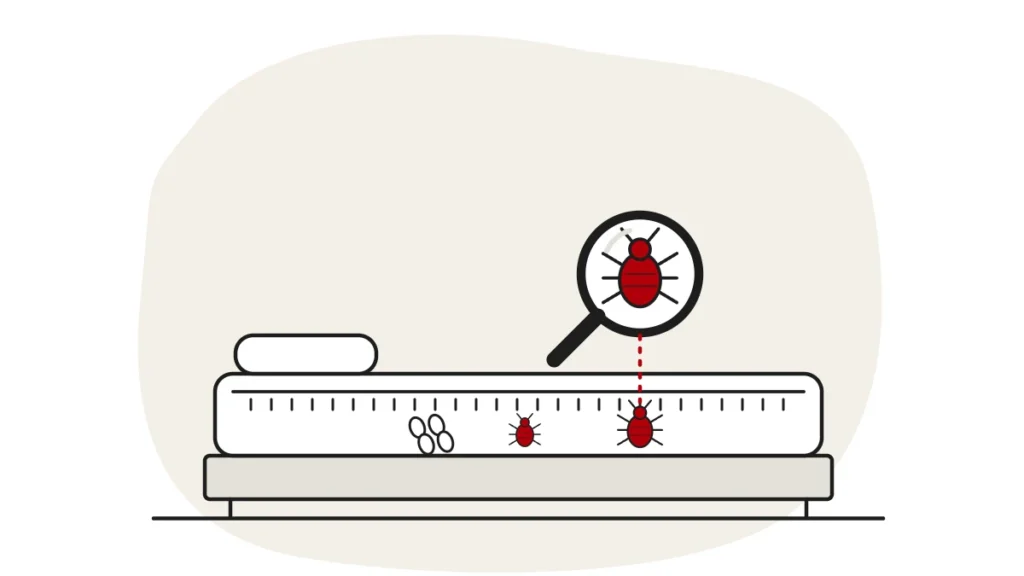
Adult bed bugs are flat, oval, reddish-brown insects about the size of an apple seed. The NHS says adults are around 5mm long. After feeding they swell and look longer and redder. Young bed bugs (nymphs) are smaller and pale yellowish, and eggs are pearl-white and about the size of a pinhead.
Reviewed by James Rhoades, Owner, ThermoPest · Last reviewed 15 October 2026
If you’ve just found a small bug in your bed, this guide will help you work out what it is. It covers adults, nymphs and eggs, with real photos, a size and colour table for every stage, and the other signs that tell you bed bugs are there. Where the NHS gives guidance on identifying bed bugs, we’ve included it.
What does a bed bug look like?

An adult bed bug is easy to see once you know what you’re looking for. Adults are reddish-brown, with oval, flattened bodies; their colour resembles an apple seed, while their size is closer to a lentil. Look for:
- Size: the NHS says adults are around 5mm long, about the size of an apple seed.
- Shape: flat and oval when unfed. Their flattened bodies fit into crevices no wider than a toothpick.
- Colour: brown to reddish-brown. The NHS says bed bugs can be dark yellow, red or brown.
- Wings: bed bugs have no working wings. They can’t fly; they crawl.
- Smell: a “musty-sweetish” odour can come from glands on the underside of the body.
What do bed bugs look like after feeding?
A bed bug that has just fed looks quite different. Recently fed adults become balloon-like, reddish-brown and more elongated. The flat, seed-like shape fills out into a longer, rounder body, which is why people sometimes describe the same bug as both brown and red.

How Big Are Bed Bugs? Actual Size at Each Stage
Bed bugs go through egg, five nymph stages and adulthood, and get bigger at each stage. Typical sizes are below. To picture the adult, think of an apple seed or a lentil, small but easy to see on a pale sheet.
| Stage | Size | Colour |
|---|---|---|
| Egg | About 1mm, the size of a pinhead | Pearl-white; an eye spot shows if more than five days old |
| 1st stage nymph | About 1.5mm | Translucent or whitish-yellow; straw-coloured when newly hatched |
| 5th stage nymph | About 4.5mm | Like a smaller, lighter-coloured adult |
| Adult | Around 5mm (NHS) | Brown to reddish-brown; redder and longer after feeding |
If what you’ve found is much bigger than an apple seed, or much smaller than a pinhead and moving fast, it’s probably something else. Our guide to bugs that look like bed bugs covers the usual suspects.
What colour are bed bugs?
Mostly brown. The NHS says bed bugs can be dark yellow, red or brown. Unfed adults are brown; recently fed adults look more reddish. Young nymphs are much paler, translucent to whitish-yellow, which is why they’re so hard to spot on a light mattress.
Are bed bugs orange?
Not usually, but a young bed bug can look yellowish or orange-tinted. Nymphs are translucent or whitish-yellow, and newly hatched nymphs are straw-coloured. So a tiny, pale yellow-orange bug in your bed seams could be a nymph, especially if you also find dark spots or shed skins nearby.
A small round bug with a pattern of orange, white and brown patches is more likely to be a carpet beetle, one of the insects people often mistake for bed bugs. Bed bugs don’t have spots or stripes.
Are bed bugs black, white or grey?
- Black: live bed bugs are brown, not black. Black or dark brown specks on sheets and seams are more likely bed bug droppings. Hiding places are often marked by dark spotting and staining, which is dried excrement.
- White: bed bug eggs are pearl-white, and newly hatched nymphs are very pale. A white bug that moves is likely a young nymph.
- Grey or see-through: empty shed skins are pale yellow to tan. Dead bed bugs can also look dull and dried out; see what dead bed bugs look like.
What do baby bed bugs and bed bug eggs look like?

Nymphs look like smaller, paler adults. Nymphs that haven’t fed recently can be nearly invisible to the naked eye because of their colour and size. After a feed they’re easier to see, because the blood shows through their pale bodies. For a closer look at each nymph stage and what finding them means, read our guide to bed bug nymph identification.
Eggs are even harder to spot. They are tiny, whitish and hard to see without magnification, and sticky when first laid, so they stay put in seams and cracks. Our guide on how to spot bed bug eggs shows where to look and how to tell them from other specks. In favourable conditions, with a ready supply of blood, bed bugs can mature in as little as a month; our bed bug life cycle guide explains each stage.
What do bed bugs look like on a mattress or bed?

On a bed, you’re often more likely to see the signs bed bugs leave behind than the bugs themselves. They hide in seams and cracks during the day and come out to feed at night. With a torch, look along the mattress piping, labels and corners, the bed frame joints and the headboard. You might find:
- Live bugs: small, flat, brown bugs tucked into seams, often in a group of different sizes.
- Dark spots: the NHS lists small brown spots on bedding or furniture (bed bug poo). They often bleed into fabric like a felt-tip dot.
- Blood spots: the NHS also lists spots of blood on your bedding, from bites or from squashing a bed bug.
- Shed skins: pale, papery, bug-shaped skins left as nymphs grow. They’re usually tan-coloured.
- Eggs and eggshells: tiny white ovals in seams and crevices.
Beyond the bed, the NHS says bed bugs can hide on bed frames, mattresses, clothing and furniture, behind pictures and under loose wallpaper. There isn’t a nest as such. Bed bugs gather in groups in their hiding places, and a well-used hiding spot looks like a cluster of bugs, dark staining, shed skins and eggs together.
What else could it be?
Bed bugs are sometimes mistaken for ticks, cockroaches, carpet beetles and other household insects. A few quick pointers:
- Carpet beetles: rounder, often patterned, and found near carpets, wardrobes and window sills rather than in mattress seams.
- Fleas: narrow from side to side, dark and they jump. Common in homes with pets.
- Ticks: arachnids rather than insects, rounder when fed, and usually picked up outdoors or from pets.
- Young cockroaches: longer and faster, with long antennae, and usually found in kitchens and bathrooms.
For side-by-side descriptions, see our full guide to how to tell bed bugs from lookalikes.
Think You’ve Found a Bed Bug? What to Do Next
- Keep the bug. Pick it up with clear sticky tape or put it in a sealed bag or small jar. A specimen is the quickest way to confirm what it is.
- Take a clear photo next to something for scale, such as a coin.
- Check the bed properly with a torch: seams, labels, frame joints and headboard.
- Wash what you can. The NHS advises washing affected bedding and clothing on a hot wash (60°C) and tumble drying on a hot setting for at least 30 minutes.
- Don’t reach for a fogger or bug bomb. These tend to scatter bed bugs into new hiding places, including neighbouring rooms, and make the problem harder to find.
If you’re still not sure, or you’ve found signs but no bugs, a professional bed bug inspection will confirm what you’re dealing with and how far it has spread. If it is bed bugs, ThermoPest’s treatment is heat-led, with targeted spray where it’s needed; read how bed bug heat treatment works.
FAQs
How big are bed bugs in the UK?
The common bed bug in UK homes is small but visible. The NHS says adults are around 5mm long, about the size of an apple seed. Nymphs range from about 1.5mm to 4.5mm, and eggs are about 1mm.
Can you see bed bugs with the naked eye?
Yes, adults are easy to see if you know where to look. Nymphs that haven’t fed recently and eggs are much harder, and unfed nymphs can be nearly invisible. A torch and a magnifying glass help. Read more in can you see bed bugs?
Are orange bugs in my bed bed bugs?
They could be young bed bugs, which are translucent or whitish-yellow. Look for dark spots, shed skins and eggs nearby. A round bug with orange, white and brown patches is more likely a carpet beetle.
Can bed bugs fly or jump?
No. Bed bugs have no working wings. They don’t jump either: they crawl, and they spread by hitching a ride in luggage, clothing and furniture. A small bug that jumps is more likely a flea.
What does a bed bug infestation look like?
Usually a mix of signs in one place: live bugs of different sizes, small dark spots of droppings, blood spots on sheets, pale shed skins and tiny white eggs along mattress seams, the bed frame or nearby furniture. Bites on skin left uncovered in bed are often the first thing people notice; see what bed bug bites look like.
Found a bug you can’t identify?
If you’ve found a bug or signs on your mattress, an inspection will confirm what you’re dealing with and where it’s hiding. ThermoPest is a member of the BPCA and NPTA, and our technicians arrive in unmarked vans.