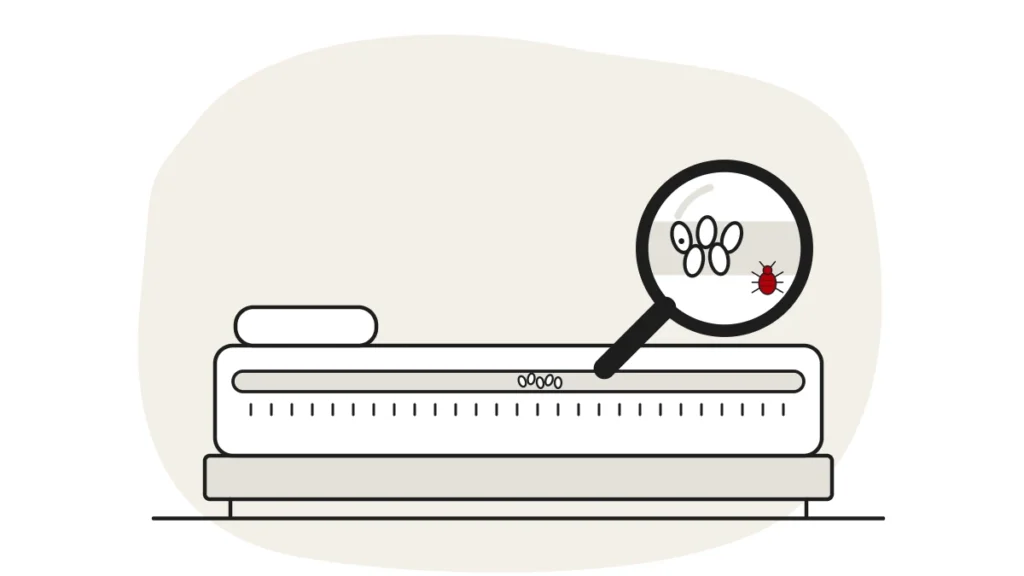
Bed bug eggs are tiny, pearl-white ovals about 1mm long, roughly the size of a pinhead. They’re glued in small groups into seams, cracks and joints close to where you sleep, most often along mattress piping and bed frames. Eggs more than five days old show an eye spot.
Reviewed by James Rhoades, Owner, ThermoPest · Last reviewed 15 October 2026
If you’ve just spotted tiny white specks on your mattress, this guide will help you work out what they are: what eggs and empty shells look like, where to check, how to tell them from salt or lint, whether washing or freezing kills them, and what finding them means.

What do bed bug eggs look like?
Once you know what to look for, bed bug eggs are quite distinctive:
- Size: about 1mm, the size of a pinhead. Up close, they’re not much bigger than a speck of dust.
- Shape: a long oval, a little like a very small grain of rice, often with one end slightly narrower than the other.
- Colour: pearl-white. They can look slightly shiny or translucent.
- Eye spot: eggs more than five days old are marked by an eye spot, a small spot visible through the shell as the nymph develops.
- Sticky: eggs are sticky when first laid, so they stay fixed to whatever they were laid on. They won’t brush or shake off easily.
Bed Bug Egg Clusters
Eggs are rarely alone. Adult females lay one, two or more eggs a day, potentially hundreds in a lifetime, and they tend to lay them in the same secluded spots. So you’ll usually see a small cluster, often mixed in with other signs.
Can you see bed bug eggs with the naked eye?
Yes, but only just. Eggs are whitish and hard to see without magnification. On a white mattress cover they blend in. They’re easier to spot in dark seams, on wood or against darker fabric, and a bright torch held at an angle makes them stand out.
What do hatched bed bug eggs look like?
Once a nymph has hatched, the empty shell stays stuck where it was laid. Hatched shells are still pale, but they look clearer and emptier than unhatched eggs, sometimes flattened or crumpled, and often open at one end where the nymph came out. In an established infestation our technicians usually find hatched and unhatched eggs together, along with the tan-coloured skins that nymphs shed as they grow.
Empty shells don’t mean the problem has passed: nymphs have hatched and are nearby, feeding. Our guide to identifying bed bug nymphs shows what those young bugs look like.
Where do bed bugs lay their eggs?
Bed bugs lay eggs in the same tight, dark places they hide, close to the person they feed on: the bed first, then the furniture around it.
On the Mattress
- along the seams, piping and stitching, especially at the corners;
- under labels and tags, and in any folds or tufts;
- on the underside of the mattress where it rests on the base.
Around the Bed
- bed frame joints, screw holes, slats and the back of the headboard;
- divan bases, including under the fabric lining;
- bedside tables and drawers, particularly joints and the underside.
Further From the Bed
In larger infestations, eggs turn up in less obvious places:
- along skirting boards and the edge of the carpet near the bed, where eggs, nymphs and droppings can collect at the carpet edge;
- in cracks in walls and behind loose wallpaper, picture frames and sockets;
- in the seams and cushions of sofas and armchairs that people sleep or rest on.
If you’re wondering about bedding, carpets and soft furnishings, our article on whether bed bugs live in duvets, pillows and carpets goes into more detail. For a full step-by-step routine, see how to check for bed bugs.
How to Check for Bed Bug Eggs
- Use a bright torch. Shine it along seams at a low angle so small objects cast a shadow.
- Use a magnifying glass or your phone camera. Zooming in on a photo is a good way to see the shape and any eye spot.
- Run a plastic card along seams. An old bank or loyalty card slid along piping and into joints will expose hidden clusters and push out any live bugs.
- Start at the head end. Work from the top corners of the mattress and headboard outwards, then move to the frame and nearby furniture.
Look for the other signs too: live bugs, pale shed skins, small dark spots of droppings and tiny blood spots on sheets. Our guide to what bed bugs look like shows adults, nymphs and eggs side by side.
Bed bug eggs or something else?
Plenty of tiny white specks turn up in bedrooms. The quickest test is whether the speck is stuck in place: bed bug eggs are glued down, while most look-alikes brush or blow away.
| What you’ve found | What it looks like | Does it stick? | Where you’ll find it |
|---|---|---|---|
| Bed bug egg | Pearl-white oval, pinhead-sized, may have a dark eye spot | Yes, glued in place | Clusters in seams, joints and cracks near the bed |
| Hatched egg shell | Pale, clear, flattened or open at one end | Yes | Same places as eggs, often beside them |
| Grain of salt or sugar | Angular, glassy crystal, not oval | No, brushes off | Anywhere, usually scattered |
| Lint or fluff | Soft, fibrous, irregular | No, lifts off | Seams, bedding, carpet |
| Flea egg | Smooth, white, oval | No, falls off easily | Pet bedding, carpets, sofas where pets rest |
Do bed bug eggs look like salt or rice?
From a distance, a cluster can look like a pinch of salt. Up close, the difference is clear: salt is a cube-like crystal that brushes away, while a bed bug egg is a smooth oval stuck to the surface. The shape is more like rice, but far smaller. Eggs are only about 1mm long, so if a speck is anywhere near the size of a real grain of rice, it isn’t a bed bug egg.
If you’ve found bugs rather than eggs and aren’t sure what they are, our guide to bugs that look like bed bugs covers the common mix-ups.
What kills bed bug eggs? Does washing or freezing work?
Eggs are the hardest life stage to deal with. They’re glued deep into seams and cracks, and bed bugs, especially eggs, can be difficult to dislodge with a vacuum.
Washing, Drying and Freezing
For bedding, clothes and other washable items, the NHS advises a hot wash at 60°C and tumble drying on a hot setting for at least 30 minutes. For items that can’t be washed, the NHS suggests sealing them in a plastic bag and putting them in the freezer for 2 to 3 weeks. A hot tumble dryer will kill all bed bug life stages, including eggs.
These steps protect the things you can bag, wash or freeze. They don’t reach eggs glued into your mattress seams, bed frame, skirting boards or furniture, which is where most of them are. The NHS itself says self-help measures are unlikely to get rid of bed bugs completely. For more on laundry, see whether ironing, washing or drying kills bed bugs on clothes.
Sprays, Foggers and Home Remedies
Shop-bought sprays easily miss eggs tucked into cracks. Foggers, bug bombs and smoke bombs don’t solve the problem: they tend to scatter bed bugs into new hiding places and other rooms.
Professional Treatment
Because eggs are hidden and hard to reach, professional treatment is the reliable route. With heat treatment, carefully controlling the temperature means bugs and eggs can be killed wherever they are hiding. At ThermoPest, our treatment is heat-led, with targeted spray where it’s needed, so it reaches the seams and cracks where eggs are laid. Read how bed bug heat treatment works, or see our prices.
What does finding bed bug eggs mean?
It means bed bugs are breeding in your home, not just passing through. A cluster of eggs points to adult females that have been feeding nearby.
- More bugs are coming. At room temperature, eggs hatch in about a week. The nymphs then need blood meals to grow, so bites usually continue.
- There are probably more eggs. If you’ve found one cluster, there are usually others in places you haven’t checked.
- It’s worth acting early. Smaller infestations are easier to treat and less likely to have spread into other rooms. Our guide to the bed bug life cycle explains how quickly numbers can build.
Try not to move mattresses, furniture or bags of belongings into other rooms in the meantime, as this can spread the problem. If you live in a flat, bed bugs can travel between neighbouring homes, so when we treat flats we ask to inspect neighbouring flats as well.
If you’re not sure whether what you’ve found are eggs, a professional bed bug inspection will confirm it and show how far the infestation has spread. And if you’ve already had a treatment and are now finding shells or dead insects, our guide to what dead bed bugs look like after treatment explains what’s normal.
FAQs
What do bed bug eggs look like on a mattress?
On a mattress, bed bug eggs look like tiny pearl-white ovals, about the size of a pinhead, stuck in small clusters along the seams, piping, labels and corners. They’re easier to see on darker fabric or in shadowed seams. You’ll often find them alongside dark spots of droppings and pale shed skins.
Are bed bug eggs sticky?
Yes. Bed bug eggs are sticky when first laid, which is why they stay fixed in seams and cracks. If white specks brush or blow away easily, they’re more likely to be salt, lint or skin flakes.
How many bed bugs come out of one egg?
One. Each egg hatches into a single nymph, a tiny, pale young bed bug about 1.5mm long in its first stage. Because females lay eggs in groups, though, a cluster of eggs can produce several nymphs at once.
Can bed bug eggs survive washing?
Eggs are unlikely to survive a hot tumble dry, which kills all bed bug life stages. The NHS advises a 60°C wash, then a hot tumble dry for at least 30 minutes. Washing only treats what’s in the machine, though, not eggs glued into the mattress, bed frame or furniture.
Found tiny white eggs in your bed?
If you’ve found what look like eggs, an inspection will confirm what you’re dealing with and where the bugs are hiding. ThermoPest is a member of the BPCA and NPTA, and our technicians arrive in unmarked vans.