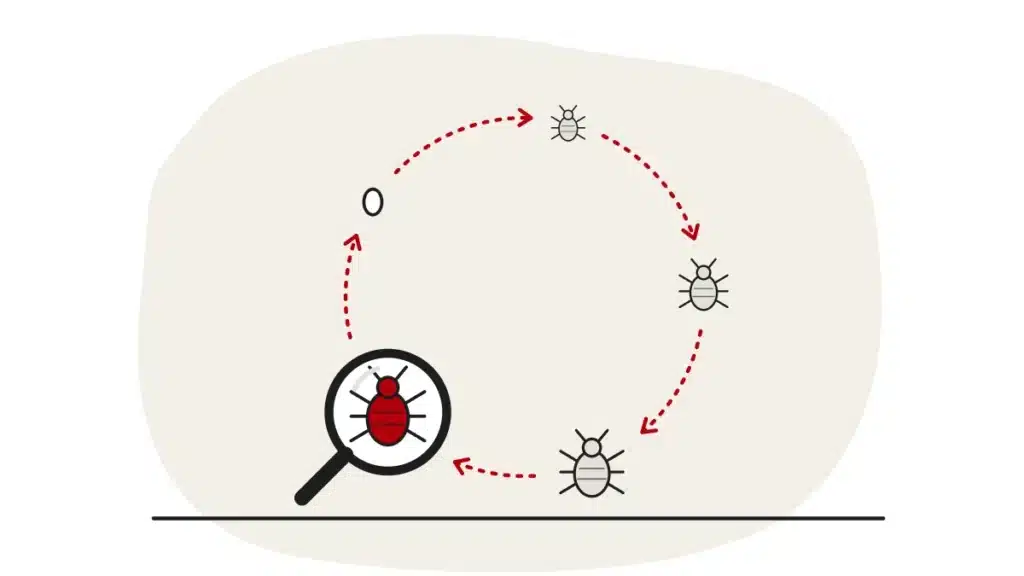
The bed bug life cycle has three stages: egg, nymph and adult. Eggs hatch in about a week at room temperature, and nymphs moult five times, needing a blood meal before each moult. In warm conditions with regular feeds, bed bugs can reach adulthood in as little as a month.
Reviewed by James Rhoades, Owner, ThermoPest · Last reviewed 15 October 2026
Knowing what each stage looks like helps you recognise what you’ve found, and knowing how fast they develop explains why a few bugs can turn into a settled infestation. This guide covers each stage with sizes, how long each part takes, how quickly bed bugs multiply and what that means if you’ve found signs at home.
What are the stages of the bed bug life cycle?
Bed bugs don’t have a larva or pupa stage like flies or moths. The young, called nymphs, look like small, pale versions of the adults and grow by shedding their skin. So the life cycle runs:
- Egg: tiny, white and stuck to surfaces in hidden spots.
- Five nymph stages: each one a little bigger than the last, separated by a moult.
- Adult: full size, able to mate and, for females, lay eggs.
Every stage after the egg feeds on blood. A blood meal is needed between each moult, and adult females must feed periodically to keep laying eggs.
Bed Bug Sizes at Each Stage
The table below gives the approximate length of each stage. Use it as a rough guide: a bug that has just fed looks bigger and rounder than one that hasn’t.
| Stage | Approximate length | What it looks like |
|---|---|---|
| Egg | 1mm | Pearl-white, about the size of a pinhead; an eye spot shows once it’s more than five days old |
| 1st stage nymph | 1.5mm | Straw-coloured and no bigger than a pinhead; very hard to see before it has fed |
| 2nd stage nymph | 2mm | Translucent or whitish-yellow |
| 3rd stage nymph | 2.5mm | Translucent or whitish-yellow |
| 4th stage nymph | 3mm | Translucent or whitish-yellow |
| 5th stage nymph | 4.5mm | Translucent or whitish-yellow; close to adult shape |
| Adult | 5–7mm | About the size of an apple seed; flat, oval and brown when unfed, reddish-brown and swollen after feeding |
The NHS describes adult bed bugs as around 5mm long and dark yellow, red or brown. The sizes above are approximate, and the colour of nymphs changes a lot depending on when they last fed.
Stage 1: Bed Bug Eggs
What do bed bug eggs look like?
Bed bug eggs are tiny, about the size of a pinhead, and pearl-white. They’re sticky when first laid, so they stay stuck to the surface they’re laid on: mattress seams, the joints of a bed frame, the edges of carpet or the backs of furniture. Our technicians often find both hatched and unhatched eggs in these hiding places.
Eggs are easy to miss, especially on light fabric. Our guide on how to spot bed bug eggs shows where to look and how to tell them apart from other specks.
How long do bed bug eggs take to hatch?
Bed bug eggs hatch in about a week at room temperature. Cooler conditions slow development down, so in a cold room it can take longer.
Stage 2: Bed Bug Nymphs
A newly hatched nymph is straw-coloured and no bigger than a pinhead. Before its first feed it can be nearly invisible to the naked eye. After a feed it fills with blood, which makes it darker and easier to spot.
Each nymph goes through five stages. To move from one to the next it needs a blood meal, then sheds its skin. Those pale, empty skins are one of the most useful signs to look for, because they collect where bed bugs hide. For close-up identification tips, see our guide to bed bug nymphs (baby bed bugs).
Can bed bug nymphs lay eggs?
No. Only adult females lay eggs. Nymphs are still developing and can’t reproduce until after their final moult. Finding nymphs does tell you something important, though: eggs have been laid and hatched in your home, so the bugs are breeding there rather than having just arrived.
Stage 3: Adult Bed Bugs
After the fifth moult, the bug is an adult. Adults are about the size of an apple seed: long, brown and flat when they haven’t fed recently, and balloon-like, reddish-brown and more elongated after a feed.
Adults feed, mate and, in the case of females, lay eggs. Adult females lay one, two or more eggs a day, potentially hundreds over their lifetime, and need to keep feeding to do so. Our guide to bed bug feeding habits explains when and how often they feed.
How long is the bed bug life cycle?
It depends mostly on temperature and how easily the bugs can feed. Under favourable conditions, around 21–27°C with a ready supply of blood, bed bugs can mature in as little as a month and produce several generations a year. Cooler temperatures or limited access to a host make development slower.
Many heated homes are kept at around those temperatures, and a person sleeping in the same bed every night is a reliable food source. That’s why bed bugs in a bedroom can keep breeding all year round rather than slowing down in winter.
How long do bed bugs live?
Given enough food and the right conditions, the average lifespan of a bed bug is about 10 months. Nymphs and adults can also go months without feeding, typically about 1 to 4 months in a heated home. Our post on how long bed bugs can live without feeding goes into this in more detail.
How fast do bed bugs multiply?
Bed bugs don’t breed explosively the way some insects do. A female lays a few eggs a day rather than hundreds at once. What makes them a problem is that it keeps adding up:
- Each female keeps laying a small number of eggs every day while she can feed.
- Those eggs hatch in about a week, and the nymphs can be adults within weeks if they feed regularly.
- The new adults then start laying eggs too, so each generation overlaps with the next.
The result is that numbers grow quietly for a while, often before anyone notices bites or marks. In our experience, as numbers grow the bugs spread beyond the bed into other places in the room, and infestations left to persist can spread further, which makes them harder to clear. If you’re wondering how far that can go, see if one room has bed bugs, do they all?
We haven’t given a figure for how many bed bugs you’d have after a set number of weeks, because it varies too much with temperature, food and how many bugs arrived in the first place. What’s consistent is the pattern: the longer they’re left, the more stages you’ll find and the further they’ll have spread.
What affects how quickly bed bugs develop?
Temperature
Warmth speeds every stage up and cold slows it down. Cold doesn’t stop bed bugs for long indoors, though, and they won’t die off just because the heating is turned down. Read more in can bed bugs live outside?
Access to Blood Meals
Nymphs can’t moult and females can’t keep laying without blood. Moving to another room may slow things down, but bed bugs can survive for months between meals and will often follow people to where they sleep.
Hiding Places
Seams, cracks, screw holes and clutter near the bed give bugs safe spots to hide, moult and lay eggs. The more hiding places there are, the harder it is to find every stage.
What the Life Cycle Means If You’ve Found Bed Bugs
The life cycle explains why bed bugs are hard to clear with sprays or one-off fixes. Eggs are stuck tight in seams and cracks, nymphs can be almost invisible, and adults can survive for months without feeding. A method that only reaches the bugs you can see leaves the rest to carry on. Shop-bought foggers and bug bombs tend to scatter bugs into new hiding places rather than clear them.
For bedding and clothes, the NHS advises a hot wash at 60°C and a hot tumble dry for at least 30 minutes, or sealing items that can’t be washed in a plastic bag in the freezer for 2 to 3 weeks. That helps with your belongings, but it won’t deal with bugs and eggs in the bed frame, furniture and room. Washing in plain water alone isn’t a fix either, as we explain in can bed bugs survive in water?
Professional treatment is designed to reach every stage. At ThermoPest our approach is heat-led, with targeted spray where it’s needed, so it reaches the cracks and seams where eggs and nymphs hide. Read how bed bug heat treatment works. Because eggs and hidden nymphs can be missed by any method, a follow-up visit is sometimes needed. If you’re in the capital, see our page on bed bug treatment in London.
FAQs
What is the life cycle of a bed bug?
A bed bug starts as an egg, hatches into a nymph, goes through five nymph stages and becomes an adult. Eggs hatch in about a week at room temperature and nymphs need a blood meal before each moult. In warm conditions with regular feeds, they can mature in as little as a month.
How long does it take for bed bug eggs to hatch?
About a week at room temperature. It takes longer in cooler conditions. Eggs show an eye spot once they’re more than five days old.
How many eggs does a bed bug lay?
Adult females lay one, two or more eggs a day, potentially hundreds over their lifetime. They need regular blood meals to keep laying.
Do bed bugs have larvae?
No. Bed bugs don’t have a larva stage. Young bed bugs are called nymphs and look like small, pale adults. They grow by moulting five times before reaching adult size.
How long do bed bugs live?
The average lifespan is about 10 months when bed bugs have enough food. They can also go months without feeding, typically about 1 to 4 months in a heated home.
Source: NHS, Bedbugs.
Found eggs, nymphs or shed skins?
If you’re finding bed bugs at different stages, they’re breeding in your home. An inspection will confirm what you’re dealing with and how far it has spread. ThermoPest is a member of the BPCA and NPTA, and our technicians arrive in unmarked vans.