Chemical bed bug treatment uses professional insecticides applied to the seams, cracks and joints where bed bugs hide. It can work well, but it rarely works in one go: follow-up visits are usually needed, and many bed bugs now resist common insecticides. That’s why professionals often combine sprays with other methods, such as heat.
Reviewed by James Rhoades, Owner, ThermoPest · Last reviewed 15 October 2026
If you’ve found bed bugs and you’re wondering whether spraying will sort it out, this guide explains what a professional insecticide treatment involves, why it usually takes more than one visit, what insecticide resistance means for you, and what fumigation is. We use insecticides ourselves, in a targeted way, so this is a fair look at what they can and can’t do.
Does chemical treatment work for bed bugs?
Yes, when it’s done properly by a trained technician. Professional insecticides kill bed bugs that come into contact with them, and some products keep working on treated surfaces for a while after they dry. The catch is reach and timing. Bed bugs and their eggs sit deep in mattress seams, bed frame joints, skirting gaps and furniture, and any that the product doesn’t reach will carry on breeding.
Professionals treat every area where bugs are, or are likely to be, and in our experience follow-up visits are often needed. The NHS is clear that bed bugs are very difficult to get rid of yourself, and advises contacting your local council or a pest control service.
What a Professional Insecticide Treatment Involves
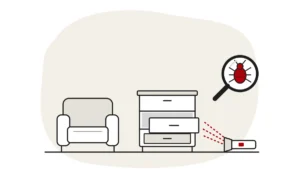
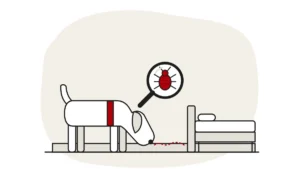
- Inspection first. A technician finds where the bugs are living and how far they’ve spread, including nearby rooms.
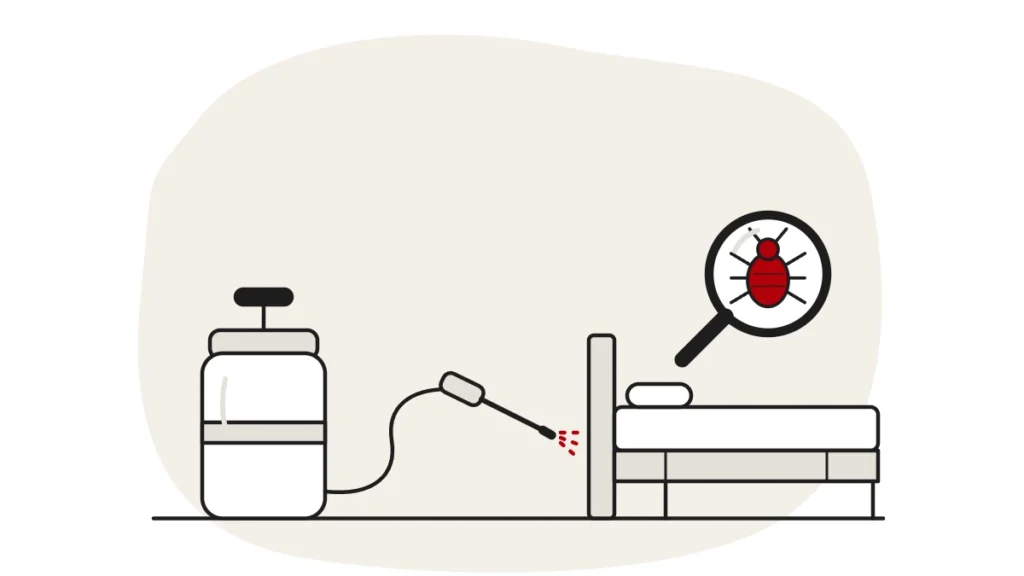
- Targeted application. Products go into the places bed bugs hide: seams and crevices of beds, chairs and sofas, frame joints, skirting boards and wall gaps. Professionals don’t spray bedding or clothing, which should be laundered or heated instead.
- Different product types. Professionals choose from liquids, aerosols and dusts, and may use more than one type in the same job.
- A follow-up. The technician comes back to check for survivors and newly hatched bugs, and treats again if needed.
What chemicals do pest control technicians use for bed bugs?
Professional products fall into a few broad groups. You won’t need to know the chemistry, but it helps to understand why a technician might use more than one.
| Product type | How it works | Things to know |
|---|---|---|
| Pyrethroids | Act on the bug’s nervous system | Widely used for years; resistance is well documented |
| Combination products | Pair a pyrethroid with a second active ingredient, such as a neonicotinoid | Designed to work where one ingredient alone struggles; some tolerance has been reported |
| Desiccant dusts | Damage the bug’s waxy outer layer so it dries out | Slow-acting; works on a physical rather than a chemical basis |
| Insect growth regulators | Disrupt development of young bugs | Don’t kill adults directly; used alongside other products |
Diatomaceous earth (a type of desiccant dust) is messy to apply and seldom helps much to eliminate an infestation, while silica gel dusts applied in tiny amounts can be very effective. Professionals know where and how much to apply, which matters as much as the product itself.
What chemical kills bed bugs and their eggs?
This is one of the most common searches, and the honest answer is that eggs are the hard part. Eggs are tiny, glued into crevices and protected by a shell, so contact sprays don’t reliably reach or kill them. That’s the main reason chemical programmes rely on a follow-up: the return visit deals with bugs that hatch after the first treatment. There’s no single product that clears eggs and adults in one application.
Why does chemical treatment need several visits?
- Eggs survive. Bugs that hatch after the first visit need to be treated before they mature and lay eggs of their own.
- Hidden bugs. Some bugs sit in places that aren’t reached the first time, such as inside furniture or behind fittings.
- Resistance. Some bugs survive contact with a product that would once have killed them.
- Slower results. Some products, such as dusts, work gradually, so you may still see a few bugs for a while after treatment.
Seeing a bug a few days after a visit doesn’t mean the treatment has failed. Keep a note of what you see and where, and tell your technician before the follow-up.
Bed Bug Pesticide Resistance: What It Means
Insecticide resistance means some bed bugs can survive a product that would normally kill them. Those survivors breed, and over time a whole population can become harder to kill with that type of product. The NHS notes that bed bugs may be resistant to some insecticides. It’s a growing problem, much like germs becoming resistant to antibiotics.
How Bed Bugs Resist Insecticides
There are three main ways bed bugs resist insecticides:
- A tougher outer layer. A thicker or altered cuticle lets less insecticide in.
- Breaking the chemical down. Some bugs produce more of the enzymes that neutralise insecticides before they do harm.
- Changes at the target. Small genetic changes, known as kdr mutations, make the bug’s nerves less sensitive to pyrethroids.
Which insecticides show high levels of resistance?
Pyrethroid resistance has been found in many parts of the world. Bed bugs also became resistant to several older insecticide groups decades ago, and some populations now show tolerance or resistance to neonicotinoids, the ingredient often paired with pyrethroids in combination products.
This doesn’t mean insecticides are useless. It means the product, the placement and the follow-up all matter, and that relying on one product over and over isn’t a good plan. It’s also why shop-bought sprays so often disappoint: many use the same types of active ingredient that resistant bugs already cope with. Our guides to whether Indorex kills bed bugs and whether Dettol kills bed bugs look at two common household products in more detail.
Do foggers or bug bombs work on bed bugs?
No. Foggers and bug bombs release a mist that settles on open surfaces. It doesn’t get into mattress seams, frame joints or skirting gaps where bed bugs hide, and it can scatter bugs into new rooms or neighbouring flats, which makes the problem harder to treat. Bug bombs should not be used to control bed bugs, and nor should bleach, alcohol or cigarette lighters. The same goes for gadgets with big promises: see our look at whether UV light kills bed bugs.
Bed bug fumigation: what is it?
Fumigation is different from spraying. The building is sealed and filled with a gas (a fumigant) that penetrates walls, furniture and belongings. The gas used for bed bugs is usually sulfuryl fluoride. The building has to be vacated for a period of days, only certain companies offer it, and it’s harder to carry out in multi-unit buildings such as blocks of flats.
The Health and Safety Executive (HSE) describes fumigation as dangerous, with potentially harmful or fatal consequences if it isn’t done correctly, and says it must be carried out by competent, properly trained fumigators who hold a certificate of competence. It’s a specialist job, not something to attempt at home, and the word “fumigation” is sometimes used loosely for ordinary spraying or fogging, which is something else.
At ThermoPest, fumigation is used only in certain circumstances. It isn’t a common method, but it is available to our technicians. Heat-led treatment is our usual approach.
How does bed bug fumigation work, and how long does it take?
The building is sealed, filled with the fumigant and usually left overnight, then aired and checked with a gas meter before anyone goes back in, so residents have to stay elsewhere for a period of days. Fumigation has no lasting effect, so bugs brought back in later can start a new infestation.
Heat vs Chemical Treatment for Bed Bugs
Heat and insecticides do different jobs, which is why many professionals use both. Heat reaches bugs and eggs in the treated items and rooms, and it doesn’t depend on insecticides that some bugs resist. But heat treatment alone has no lasting effect if bed bugs are brought back in. A targeted residual spray in the right places covers that gap.
At ThermoPest our treatment is heat-led, with targeted spray where it’s needed, and a return visit may be needed. Residential re-entry after heat treatment is 2 hours unless your technician advises otherwise. Read how our bed bug heat treatment works, or see our bed bug treatment prices. If you’re in a flat, we’ll ask to inspect neighbouring flats too, because bed bugs move between homes.
If you’ve already tried products yourself, our guide to DIY bed bug treatments explains why they often fall short.
FAQs
Does chemical treatment kill bed bugs?
Professional insecticides kill bed bugs they reach, but eggs and hidden bugs often survive the first visit, and resistance is common, so follow-ups are usually needed. Expect a return visit, and tell your technician about any bugs you see in between.
What chemical kills bed bugs permanently?
No chemical does that on its own. Some products keep working on treated surfaces for a while, but bed bugs can be brought back in on luggage, furniture or from a neighbouring flat. Reliable control comes from a thorough inspection, the right products in the right places, a follow-up and, often, heat.
How long does it take to fumigate for bed bugs?
The building has to be vacated for a period of days while it’s sealed, fumigated, aired and checked. Fumigation is a specialist job carried out only by trained fumigators.
Are bed bugs resistant to pesticides?
Many are. The NHS says bed bugs may be resistant to some insecticides, and pyrethroid resistance has been found in many parts of the world, along with tolerance to neonicotinoids in some populations. That’s why professionals vary their products and combine methods.
Still finding bed bugs after spraying?
If you’re still seeing bugs or new bites, an inspection will confirm what you’re dealing with and where they’re hiding. ThermoPest is a member of the BPCA and NPTA, and our technicians arrive in unmarked vans.