Bed bug detection dogs can be very accurate in controlled tests but are less reliable in real homes. Results also vary a lot from one dog team to the next, and false alerts do happen.
Reviewed by James Rhoades, Owner, ThermoPest · Last reviewed 16 October 2026
So a dog can be a useful tool, but an alert is a strong lead rather than proof. This guide explains how detection dogs work, how accuracy in controlled tests compares with real homes, where dogs help most, and what to ask before you book a K9 inspection.
How do bed bug detection dogs work?
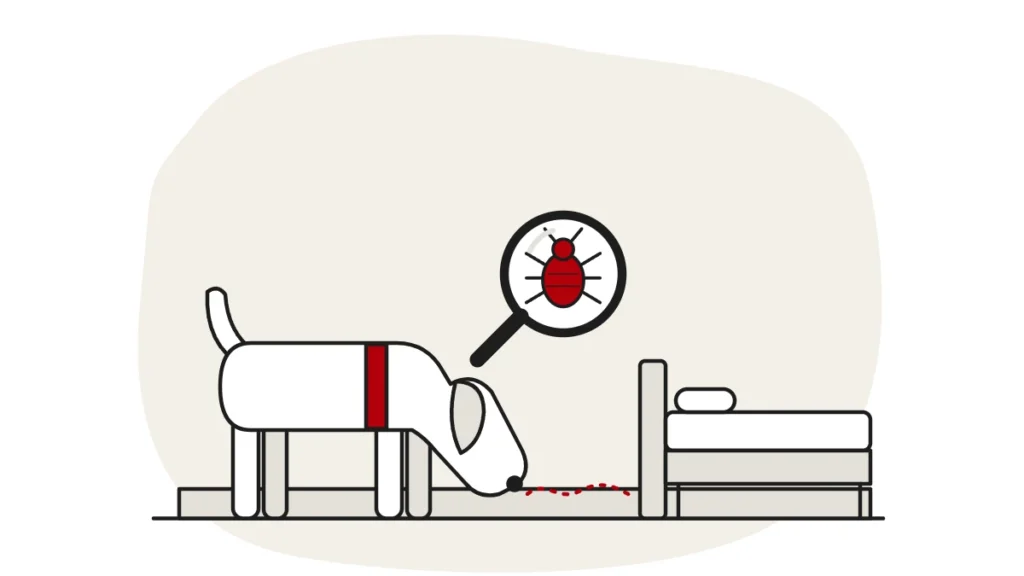
Detection dogs search by smell, not sight. They’re trained, usually with food or praise as a reward, to recognise the scent of live bed bugs and their eggs, and to give a set signal when they find it, such as sitting or pointing their nose at a spot. A handler leads the dog around the room in a planned pattern, watches for that signal and notes where it happened.
Because the dog works by scent, it can indicate a spot where nothing is visible: a gap behind a headboard, the joint of a bed frame or the edge of a carpet. That’s the main appeal. Bed bugs are small, flat and good at hiding, so a light infestation is easy to miss by eye.
The dog is only half of it. The handler has to read the dog correctly, keep up its training and decide what each signal means. A detection dog team is the dog and handler together, and the results depend on both.
How accurate is professional K9 bed bug detection?
It depends on whether you mean a test with planted bugs or a real home with a natural infestation. The two give very different pictures, and both are worth knowing.
In Controlled Tests
When bed bugs are placed in known spots and a well-trained dog is tested on them, results can be excellent:
- Trained dogs can reliably tell the scent of bed bugs apart from other insects such as ants and cockroaches.
- They can pick out live bed bugs and viable eggs rather than dead bugs, shed skins or droppings, although droppings can occasionally trigger a false alert.
- In test rooms where live bed bugs have been hidden, a good dog finds the great majority of them.
These are controlled results: whoever ran the test knew exactly where the bugs were.
In Real Homes
Real buildings with natural infestations are a much harder test. When commercial dog teams work in occupied homes:
- Detection rates are far lower than in controlled tests, and vary widely between teams and between inspections.
- False alerts happen, and some teams give many more than others.
- How many bed bugs a home has doesn’t reliably predict whether a team finds them.
Dogs are much less accurate in real conditions than in controlled ones, so an alert which can’t be confirmed shouldn’t be treated as proof of bed bugs. It should be treated as suspect and checked further.
| Setting | Conditions | What to expect |
|---|---|---|
| Controlled tests | Bugs placed in known spots | Very high accuracy and few false alerts |
| Real homes | Natural infestations, commercial teams | Much lower and more variable detection; false alerts happen |
Why the Two Results Differ
A planted test is a fair way to show what a well-trained dog can do. A real home is messier: the bugs could be anywhere, there are other smells, and every team trains and handles differently. The wide range between teams in real homes is the key point. Some teams do very well and some do poorly, so the team matters more than the method. Properly trained dogs can be quite effective, but reliability can vary from one inspection to the next.
Be careful with any single accuracy figure you see in an advert. Ask where it comes from and whether it was measured in a lab or in real homes.
K9 Bed Bug Detection vs a Human Inspection
We haven’t found a reliable study that tested dogs and human inspectors side by side in real homes, so treat any “dogs vs humans” percentage with caution. What you can say is that each has strengths:
- A detection dog can cover rooms quickly and point to places a person can’t easily see into. It needs a handler to interpret it, and its alerts need checking.
- A visual inspection by a trained technician gives direct evidence you can see: live bugs, eggs, shed skins and dark spots of droppings. It’s slower, and a very light infestation can be missed.
Used together, the dog narrows down where to look and the technician confirms what’s there. That’s why alerts should be confirmed before acting on them.
Can K9 bed bug detection help find hidden infestations?
Yes, that’s what dogs are best placed to do. Well-trained dogs pick out live bugs and viable eggs rather than dead bugs or shed skins, which matters after a treatment, when old debris can be left behind. A dog’s signal can lead the technician to the right seam, joint or gap.
The limit is that a signal tells you where to look, not what’s there. Because false alerts do happen in real buildings, a positive signal should be followed by a close physical check of that spot. If nothing can be found, monitoring and a follow-up visit give a clearer answer than treating on the dog’s signal alone.
Where Detection Dogs Are Most Useful
Dogs earn their keep where there are lots of rooms to check, or where a person can’t easily inspect every surface.
Hotels and Hostels
Guests can bring bed bugs in at any time, so hotels often want to screen rooms regularly and catch a problem early. A dog team can work through rooms between guests with little disruption. Our hotels page explains how we work with hospitality businesses, and our guide to hotel pest control rules in the UK covers your responsibilities.
Care Homes and Supported Living
Residents may not notice or report bites, and rooms are full of personal belongings. A dog can help narrow down which rooms need a closer look. Our guide to bed bugs in care homes and assisted living covers what managers need to know.
Cluttered Homes and Large Buildings
Clutter gives bed bugs far more places to hide and makes a visual check slow. A dog can point to the areas worth searching first. See how hoarding conditions affect bed bug infestations. In blocks of flats and HMOs, a dog can help check several units, including neighbouring flats.
How to Choose a K9 Bed Bug Detection Team
Because results vary so much between teams, it’s worth asking a few questions before you book:
- How is the dog trained and kept sharp? Ask how often the dog is tested and how its accuracy is checked.
- Do they follow BPCA standards? In September 2025 the BPCA published a Code of Best Practice for working dogs in pest management, which includes detection work and sets welfare and training rules.
- What happens after an alert? Ask whether the technician checks each alert by eye, and what they recommend if nothing is found.
- What will you get in writing? A clear report of the rooms checked, where the dog alerted and what was confirmed is useful for landlords, hotels and care homes.
- Where does their accuracy claim come from? If a firm quotes a percentage, ask whether it was measured in a lab or in real buildings.
Does ThermoPest use detection dogs?
Yes. Our bed bug detection service uses a trained detection dog working with a professional handler. The team inspects the areas you need checked, then we give you a report of the findings and the locations where bed bugs were detected. If bed bugs are found, we’ll recommend the right next step.
Where treatment is needed, ours is heat-led, with targeted spray where it’s needed, and return visits may be needed. We work with homes, landlords, hotels, care homes and other organisations; see the sectors we work with. In flats, we ask to inspect neighbouring flats too, because bed bugs can move between them.
FAQs
How accurate is professional K9 bed bug detection?
It varies. With bugs placed in known spots, trained dogs are highly accurate. In real homes with natural infestations, commercial teams find infestations far less often on average, results vary widely between teams, and false alerts happen.
Can dogs detect bed bugs?
Yes. Dogs can be trained to recognise the scent of live bed bugs and their eggs. Trained dogs can tell live bugs and viable eggs apart from dead bugs and shed skins. How well a dog does in a real building depends a lot on its training and its handler.
Can a detection dog find bed bugs you can’t see?
It can point to a spot where bugs are hidden, such as inside a bed frame joint or behind a headboard. The signal shows where to look, not what’s there, so a technician should check that spot. If nothing is found, monitoring and a follow-up visit can confirm whether bed bugs are present.
Do bed bug detection dogs give false alerts?
Sometimes. In real buildings commercial teams do give false alerts, though some give far fewer than others. That’s why we advise confirming alerts before acting on them, rather than treating a signal alone as proof.
Are bed bug detection dogs better than a human inspector?
We haven’t found a reliable study comparing them side by side in real homes, so there’s no trustworthy figure. A dog can cover rooms quickly and point to hidden spots; a trained technician finds visible evidence you can see. Used together, the dog narrows the search and the technician confirms what’s there.
Want to know for sure?
If you’ve found bites or signs on the mattress, or you manage rooms you need checked, an inspection will confirm what you’re dealing with and where. ThermoPest is a member of the BPCA and NPTA, and our technicians arrive in unmarked vans.