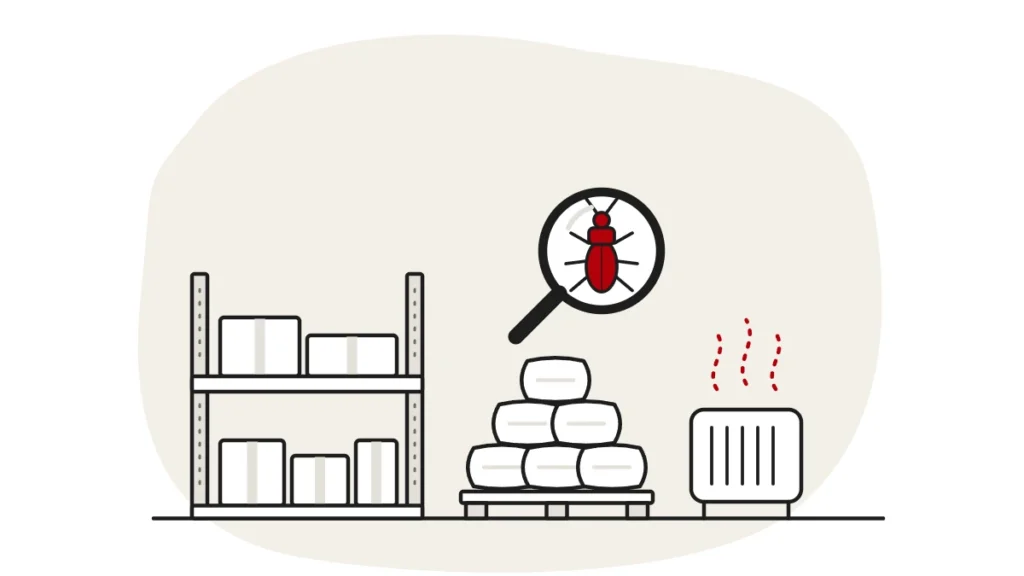
Stored product insect (SPI) treatment usually means heat or fumigation. Heat treatment warms the affected area to a temperature that kills the insects and their eggs, then lets it cool, with no gas involved. Fumigation fills a sealed, evacuated space with a toxic gas, and nobody goes back in until it’s tested clear. Each suits different sites.
Reviewed by James Rhoades, Owner, ThermoPest · Last reviewed 16 October 2026
If you’ve found beetles, moths or webbing in flour, grain, dried fruit or other dry goods, you’ll want the problem dealt with without losing more stock or shutting down for longer than you have to. This guide explains what each method involves, how they compare, and where each one fits, so you can have an informed conversation with whoever surveys your site.
What is SPI heat treatment?
“SPI” stands for stored product insects: the beetles, weevils and moths that live in and feed on stored dry food and similar materials. Common examples in UK food businesses include biscuit beetles, flour beetles, grain weevils and warehouse or Indian meal moths. You can read more about them on our stored product insects page.
SPI heat treatment uses professional heaters to raise the temperature of an affected room, storage area or piece of equipment to a level that is lethal to the insects, including their eggs, larvae and pupae, when held for long enough. Heat reaches into cracks, voids, packaging and machinery where the insects hide, and there’s no gas to clear once the area cools down.
Our heat treatment raises rooms to 50–60°C and holds that heat until the hardest-to-reach spots stay above 50°C. Rooms don’t heat evenly, so we place temperature monitors in known cold spots and hard-to-reach areas.
What does professional SPI treatment involve?
A professional treatment isn’t just the heat. It normally follows a set order:
- Survey. Identify the species, find where the infestation started and how far it has spread, and check which stock and equipment can stay in the area.
- Preparation. Clear or protect anything that could be damaged by heat, and open up areas so warm air can circulate.
- Treatment. Heat-led, with targeted spray to cracks and crevices where it’s needed.
- Monitoring. Traps and follow-up checks to pick up any further activity early. Return visits may be needed.
Our SPI heat treatment page sets out how we run this for food businesses.
What does fumigation involve?
Fumigation means releasing a fumigant gas into a sealed space so it reaches every part of the stock and structure. The Health and Safety Executive (HSE) describes fumigation as “a potentially hazardous process involving toxic gases”, and its guidance for employers and fumigators, HSG251, sets out how it must be done safely. Fumigants named in that guidance include phosphine and sulphuryl fluoride. HSE also notes that methyl bromide is banned as a pesticide and fumigant in the EU.
Who can carry out fumigation?
Only trained, competent people. HSE says fumigators must be competent and properly trained, and that since 26 November 2015 professional users of pesticide products need to hold a specified certificate of competence. This isn’t a job for a general handyman or a DIY product.
How the Building Is Sealed, Vacated and Cleared
HSG251 sets out the main steps:
- Sealing. The fumigation area must be sealed from other areas and made as gas-tight as possible, with openings taped over, or the whole structure covered with low-permeability fumigation sheets.
- Vacating. The area is evacuated, foodstuffs and absorbent liquids are removed, and warning notices go up at every way in. Nobody enters during the fumigation except in a serious emergency such as a fire.
- Neighbours. If the space shares a wall with another area, the area on the other side should also be considered part of the risk area.
- Notifying others. For certain fumigants, including phosphine, the local council, police and fire and rescue service must be told at least 24 hours in advance.
- Clearance. After treatment the fumigator tests the air until fumigant levels fall below the workplace exposure limit, then issues a certificate of clearance confirming the site is safe to reoccupy.
SPI Heat Treatment vs Fumigation: Side by Side
Neither method is right for every job. This table compares them on the things that usually matter to a business.
| SPI heat treatment | Fumigation | |
|---|---|---|
| What it uses | Heaters and fans to raise the temperature of the affected area, with targeted spray where it’s needed | A fumigant gas, such as phosphine or sulphuryl fluoride, released into a sealed space (HSE) |
| Who carries it out | Trained pest control technicians with heat equipment and temperature monitoring | Competent fumigators holding a specified certificate of competence (HSE) |
| Preparation | Remove or protect heat-sensitive stock and equipment; open up areas so air can circulate | Seal the area gas-tight or sheet the structure; remove foodstuffs and absorbent liquids; put up warning notices (HSE) |
| People and neighbours | The treated area is out of use while it’s heated and cooled | Area evacuated; areas on the other side of a shared wall count as part of the risk area (HSE) |
| Time out of the area | Depends on the size and layout of the site; we confirm timings at survey | No re-entry until air tests show the gas is below the exposure limit and a certificate of clearance is issued (HSE) |
| What’s left afterwards | No gas; the area cools down, and any targeted spray is limited to where it’s needed | The gas is ventilated away and tested before reoccupation |
| Where it fits | Rooms, production areas, storage areas and equipment that can be safely heated | Large bulk stores of dried food, where it can de-infest stock without damaging the food (BPCA) |
How effective is SPI treatment for infestations?
Both heat and fumigation can work well when they’re done properly. In practice, how well a treatment works depends less on the label and more on a few practical points:
- Reaching every hiding place. Heat has to reach the coldest spots, and gas has to reach every part of a sealed space. Gaps in either let insects survive.
- Every life stage. Eggs and larvae hidden inside product are the ones that restart an infestation, so the treatment has to reach them too.
- The source. If infested stock keeps arriving, or spilled product builds up in machinery and floor gaps, insects will come back after any treatment.
- Follow-up. Neither heat nor fumigation leaves anything behind to stop new insects arriving in fresh stock. Monitoring traps and good hygiene do that job, and a return visit may be needed.
The BPCA’s technical article on preventing insect damage in dry food storage makes the same point about hygiene: “high standards of good hygiene will always pay dividends.”
Which SPI treatment is right for your site?
When Heat Treatment Is the Better Fit
Heat tends to suit rooms and areas that can be cleared and safely warmed: production areas, dry stores, bakeries, kitchens, packing rooms and individual pieces of equipment. Because no gas is used, there’s no need to seal the building gas-tight, evacuate neighbouring areas or wait for a clearance certificate. Many sites can keep other areas running while one is treated.
The trade-offs are real. Anything that could be damaged by heat has to be moved or protected, and the BPCA article notes that heat treatment “requires a huge energy cost”. Very large bulk stores can be hard to heat evenly.
When Fumigation May Be the Better Fit
Fumigation can treat large volumes of bulk commodity in place. The BPCA article describes it as “the only practical way of de-infesting a substantial bulk storage of dried foods” without damaging the food, and notes that phosphine is usually involved.
The trade-offs are the sealing, evacuation, notifications and clearance HSE requires, and the time the area is out of use while that happens. HSG251 also asks employers to consider whether a safer alternative would do the job before choosing fumigation.
Questions to Ask Before You Decide
- Which species is it, and where did it start?
- Is the problem in the building, the stock, or both?
- Can the affected stock and equipment be heated safely?
- Which areas can you close, and for how long?
- Do you share walls or spaces with other businesses or residents?
- What will your auditor or customers expect to see in your records?
How ThermoPest Approaches SPI Treatment
Our usual approach is heat-led, with targeted spray where it’s needed. We start with a survey, agree what can stay in the area, treat, and then monitor. Fumigation is only used in certain circumstances; it isn’t a common method for us, but it is available to our technicians where a site genuinely needs it. If you run a food business, warehouse or other site and want to understand your options, see how we work across different business sectors, including food production.
If you also manage guest accommodation, our guide to hotel pest control rules in the UK covers your wider duties, and for residential care settings see our guide to bed bugs in care homes. If bed bugs are a concern in staff or guest areas, our article on how accurate bed bug detection dogs are explains how dogs are used in surveys.
FAQs
What does professional SPI treatment involve?
It starts with a survey to identify the species, find the source and see how far the insects have spread. The affected area is then prepared and treated, usually with heat and targeted spray where it’s needed, or with fumigation for some bulk stores. Monitoring traps and follow-up visits check that activity has stopped.
How effective is SPI treatment for infestations?
Heat and fumigation can both work well when they reach every hiding place and every life stage. Results depend on finding the source, removing heavily infested stock and keeping up hygiene and monitoring afterwards. A return visit may be needed, particularly where infested stock keeps arriving.
Is fumigation safe for food premises?
Fumigation is used in food storage, but it involves toxic gases, so HSE guidance requires competent, certificated fumigators, a sealed and evacuated area with foodstuffs removed, warning notices, and air testing before a certificate of clearance allows people back in. Done that way, the site is confirmed safe to reoccupy.
Can I treat stored product insects myself?
You can help by clearing out infested products, cleaning shelves and gaps, and checking deliveries. Fumigants are for certificated professionals only, and shop-bought sprays won’t reach insects inside product and packaging. If the insects keep coming back, a professional survey will find where they’re coming from.
Found insects in your stored stock?
A site survey will identify the species, find the source and tell you which treatment suits your premises. ThermoPest is a member of the BPCA and NPTA, and our technicians arrive in unmarked vans.