Diatomaceous earth can kill bed bugs, but slowly and only under the right conditions. It is a fine dust that dries out insects that crawl through it, so it doesn’t work on contact and does little to eggs. In lived-in homes, it rarely makes a meaningful difference to an infestation.
Reviewed by James Rhoades, Owner, ThermoPest · Last reviewed 15 October 2026
Diatomaceous earth, often shortened to DE, is one of the most searched DIY bed bug remedies. It’s cheap, easy to buy and often described as natural, so it’s easy to see why. Below is what the research actually says about how well it works, how to use it without putting your lungs at risk, and why it shouldn’t be your only plan.
What is diatomaceous earth?
Diatomaceous earth is a soft, chalky powder made from the fossilised remains of diatoms, tiny single-celled algae with shells made of silica. Ground up, it looks like flour and feels gritty between your fingers.
It’s sold for lots of jobs, from garden pest control and animal feed to filtering liquids and swimming pools. That matters, because not every bag of DE is the same material or safe to use indoors. We cover the different grades further down.
How does diatomaceous earth kill bed bugs?
DE is a desiccant, which means it kills by drying insects out rather than by poisoning them. It absorbs the oils and fats from the insect’s waxy outer layer, and its sharp edges are abrasive, which speeds this up. Without that protective coating, the bug slowly loses water and dies.
Because desiccants work physically, bed bugs can’t become resistant to them the way they can to some insecticides. That is DE’s real strength. Its weakness is everything else.
How effective is diatomaceous earth on bed bugs?
In our experience, DE’s results in real homes are disappointing. Here’s why:
- Constant contact works, eventually. Bed bugs kept in continuous contact with DE do die, but it takes days rather than hours.
- Brief contact doesn’t. A bug that walks across a line of DE once and then moves on is unlikely to die from it.
- Real homes are different. In an occupied home, bugs move between hiding places and their host, and most never get enough exposure for the dust to make a meaningful difference.
- Other dusts do better. Silica gel dusts are generally more effective than DE against bed bugs.
So the honest answer is that DE can kill bed bugs that sit in it, but in a lived-in home most bugs simply don’t get enough exposure.
Why Diatomaceous Earth Often Doesn’t Work in Homes
It Needs Contact, and Lots of It
Bed bugs spend most of their time tucked into mattress seams, bed frame joints, headboards and cracks. They come out to feed and go back. Unless the dust sits exactly on that route, many bugs never touch it, and a single walk across it isn’t enough.
It’s Slow
Even with constant exposure, DE takes days to kill bed bugs. During that time, surviving bugs keep feeding and females keep laying eggs.
Eggs Don’t Walk Through Dust
Bed bug eggs are glued in place in seams and cracks, so a desiccant dust isn’t a reliable way to deal with them. Young bugs that hatch later are only affected if they cross a treated area, and only if they stay in contact long enough.
Humidity and Disturbance Weaken It
DE is less effective at higher humidity, which may matter in the tight, sheltered spaces where bed bugs gather. It only stays effective as long as it’s kept dry and undisturbed. Hoovering, cleaning or moving furniture can sweep it away.
Food-grade vs pool-grade diatomaceous earth: which is safe?
This is the most important safety point in this guide. The silica in DE can be in two forms: amorphous, which is the main form in natural DE, and crystalline, which is the one linked to lung disease.
Natural (uncalcined) DE contains only a small amount of crystalline silica, but heat-treated (calcined) DE, the kind used in pool filters, can contain much more, in a crystalline form called cristobalite. Long-term inhalation of crystalline silica is associated with silicosis, a serious lung disease, while the amorphous form is associated with milder, reversible lung irritation.
| Type of DE | What it’s made for | Use it for bed bugs? |
|---|---|---|
| Pesticide product labelled for bed bugs | Insect control, with label directions and safety advice | The safest DIY choice. Follow the label exactly. |
| Food-grade DE | Purified for uses such as animal feed | Not made for indoor pest control. It carries a higher inhalation risk when used this way. |
| Pool or filter-grade DE | Filtering water and other liquids | No. Never spread it around your home. |
Only use desiccants that are approved and labelled for bed bug control. Desiccants intended for other uses, such as food-grade products or those for swimming pools, pose an increased inhalation risk to people. “Food grade” sounds reassuring, but it describes purity for other uses, not safety for puffing dust around a bedroom.
Health Risks of Breathing in DE
Breathing in DE can irritate the nose and nasal passages, and very large amounts can cause coughing and shortness of breath. It can also irritate the eyes and dry or irritate the skin. Take extra care if anyone at home has asthma or another lung condition, and keep it away from children and pets. If you’re worried about symptoms after using DE, speak to a pharmacist or GP, or call NHS 111.
How to Use Diatomaceous Earth for Bed Bugs Safely
If you decide to try DE while you arrange an inspection, use it carefully and in the right places.
- Choose a product labelled for bed bugs and read the whole label before you start. The label is the instruction, not a blog post.
- Apply a very thin, barely visible film. More isn’t better: piles and drifts just make more loose dust to breathe in.
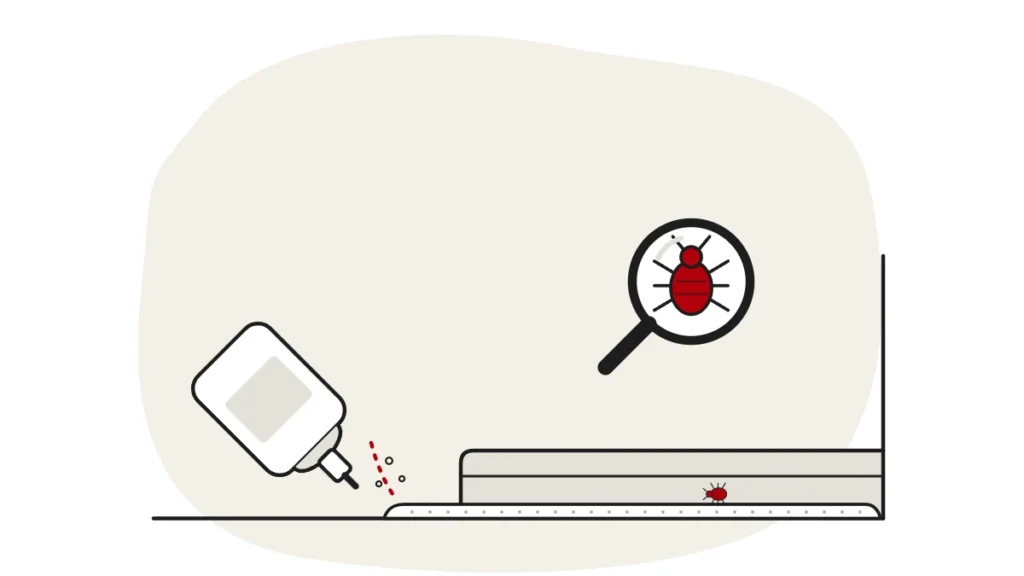
- Stick to cracks and crevices. Keeping desiccants to cracks and crevices reduces the risk of breathing them in. Think gaps along skirting boards, behind loose skirting, around bed legs and in the joints of a bed frame.
- Keep it off beds, bedding and pillows. Don’t sprinkle it on a mattress you sleep on or anywhere it will be kicked into the air.
- Avoid making dust clouds. Use a small duster or applicator rather than shaking it from the bag, ventilate the room, and consider a dust mask and gloves while applying.
- Leave it undisturbed and dry. It only keeps working while it stays in place.
What Not to Do
- Don’t spread DE across carpets or floors as a general layer.
- Don’t mix it with water or spray it. It only works while it’s kept dry.
- Don’t use DE alongside foggers, bug bombs or smoke bombs. They scatter bed bugs into other rooms and neighbouring flats rather than clearing them.
What to Do Instead of Relying on DE
DE is, at best, a slow supporting measure. While you work out what you’re dealing with, these steps help:
- Wash and dry what you can. The NHS advises washing affected bedding and clothing on a hot wash (60°C) and tumble drying on a hot setting for at least 30 minutes. Items you can’t wash can be sealed in a bag and frozen for 2 to 3 weeks.
- Don’t move furniture or bedding between rooms. This spreads the problem.
- Get it confirmed. The NHS notes that DIY methods are unlikely to get rid of bed bugs completely and recommends contacting your local council or a pest control service.
Other home remedies have similar limits. Our guides to whether Dettol kills bed bugs, whether Indorex spray kills bed bugs and whether UV light kills bed bugs look at what each can and can’t do, and what kills bed bugs instantly covers the quick-kill claims you’ll see online.
Where Professional Treatment Fits
Some professionals use registered dusts as one part of a wider treatment, for example in wall voids or behind skirting, but whether a dust is used depends on the property and what the technician finds. ThermoPest’s bed bug heat treatment is heat-led, with targeted spray where it’s needed. Heat reaches bugs and eggs deep in seams and cracks without relying on them crossing a treated line. In flats, we ask to inspect neighbouring flats too, and a follow-up visit may be needed. For costs, see our pricing page.
FAQs
How long does diatomaceous earth take to kill bed bugs?
Even with constant exposure, DE takes days to kill bed bugs. Bugs that only cross it briefly usually survive, and in lived-in homes the dust rarely makes a meaningful difference, so don’t expect quick results.
Does diatomaceous earth kill bed bug eggs?
You shouldn’t rely on it to. Eggs are glued in place and don’t move through dust, so a desiccant isn’t a dependable way to deal with them. Young bugs that hatch would need to cross treated areas and stay in contact for long enough.
Does food-grade diatomaceous earth kill bed bugs?
It can dry out bed bugs that stay in contact with it, but we’d advise using only desiccants approved and labelled for bed bug control. Food-grade and swimming pool desiccants pose an increased inhalation risk when used for pest control.
Can I put diatomaceous earth on my bed or mattress?
No. Keep DE off mattresses, bedding and pillows, where you’d breathe it in as you sleep. Desiccants should be kept to cracks and crevices to reduce inhalation risk. Use a mattress encasement on the bed instead and apply any dust only in gaps around the bed frame and skirting.
Can I sleep in a room with diatomaceous earth?
Check the label of the product you’re using: it’s the label, not general advice, that says where the dust can go and when a room can be used again. Use only desiccants approved and labelled for bed bug control, and only in cracks and crevices, to reduce the risk of breathing them in. Don’t sleep somewhere with loose powder on the bed or dust in the air. If anyone develops breathing, eye or skin irritation, stop using it and speak to a pharmacist or GP, or call NHS 111.
Still seeing bed bugs after trying DE?
An inspection will confirm what you’re dealing with and how far it has spread. ThermoPest is a member of the BPCA and NPTA. Our treatment is heat-led, with targeted spray where it’s needed, and our technicians arrive in unmarked vans.