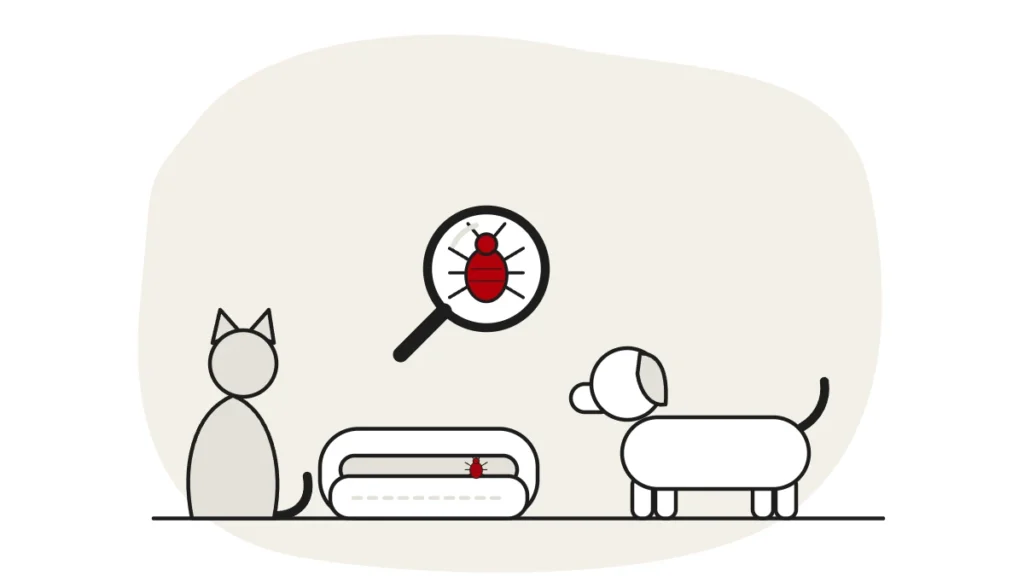
No. Bed bugs don’t live on cats or dogs the way fleas do. They hide in beds, sofas and cracks near where people sleep, come out to feed and then go back into hiding. They mainly bite people, but they can bite pets, and they can hide in pet beds close to yours.
Reviewed by James Rhoades, Owner, ThermoPest · Last reviewed 16 October 2026
If you’ve found bites, or bugs in your pet’s bed, it’s natural to wonder whether your cat or dog brought them in. Below is what bed bugs actually do around pets, how to tell them apart from fleas, how to deal with pet bedding safely, and what happens to your pets if your home needs treatment.
Can bed bugs live on cats or dogs?
Bed bugs don’t live in fur. They spend almost all their time hidden in seams, joints and cracks close to where people rest, such as mattress piping, bed frames, headboards, sofas and skirting boards. They come out to feed, usually at night, and then crawl straight back into hiding.
Bed bugs don’t stay on or attach to their host the way lice or ticks do, and they can’t fly or jump like fleas. A cat or dog isn’t somewhere a bed bug settles. It’s a host it might feed from before going back to its hiding place.
Can a bed bug hitch a ride on a pet?
It’s possible for a bug to be carried a short distance on a pet, its blanket or its carrier, but it isn’t how bed bugs usually spread. They travel far more often in luggage, bags, coats, second-hand furniture and clothing, or through gaps from a neighbouring flat.
Do bed bugs bite cats and dogs?
They can. The common bed bug prefers feeding on people but will also bite other warm-blooded animals, including dogs, cats, birds and rodents. In practice, pets are more likely to be bitten if they sleep on or near an infested bed or sofa.
Are bed bugs harmful to cats and dogs?
Bed bugs aren’t known to spread disease, and the NHS says bites on people don’t usually cause other health problems. A pet may still scratch at bites, and scratching can make skin sore. Itchy skin in pets has many possible causes, fleas included, so if your cat or dog is scratching, has sore or broken skin, or seems unwell, speak to your vet rather than guessing.
What do bed bug bites look like on cats and dogs?
There’s no reliable way to tell from the skin alone. Bites can be hard to see under fur and can look like flea bites or other skin problems. Finding bugs, dark spots or shed skins in your pet’s bed or your own is a better guide, and your vet can check any sore skin.
Can cats or dogs detect bed bugs?
Some pest controllers use specially trained detection dogs to find small infestations. That’s a trained skill. A pet sniffing around the bed isn’t a reliable sign either way, so look for the physical signs instead.
Can cats or dogs bring bed bugs into the house?
It’s unlikely. Bed bugs need people, so they live where people sleep and sit, not in gardens, parks or soil. A cat coming in from outside isn’t a likely source. Most infestations start with something carried in from a place that already had bed bugs: a hotel stay, a visitor’s bag, second-hand furniture, or a neighbouring flat.
Do cats or dogs cause or attract bed bugs?
No. Pets don’t cause bed bugs, and having a cat or dog doesn’t make your home more likely to get them. Bed bugs are drawn to the warmth and carbon dioxide of a sleeping person. If they turn up in a pet bed, it’s usually because that bed is close to where you sleep or sit.
If you’re worried about other places bed bugs can hide, our guides on whether bed bugs can infest cars and whether bed bugs can live in electronics cover two of the questions people ask most.
Is it bed bugs or fleas?
If you’re finding insects on your pet, or your pet is scratching, fleas are the more likely culprit. The PDSA says fleas can live on dogs, cats and rabbits and in your home, that most live in the environment rather than on the animal, and that you can check for flea dirt around your pet’s back end and above the base of the tail.
| Bed bugs | Fleas | |
|---|---|---|
| Live on the pet? | No, they hide in beds and furniture and only visit to feed | Yes, they live on the animal as well as in the home |
| Can they jump? | No, they crawl | Yes |
| Where you find them | Mattress seams, bed frames, headboards, sofas, pet beds near your bed | In the pet’s coat, pet bedding, carpets and rugs |
| Signs to look for | Dark spots and shed skins in seams, small blood spots on sheets, live bugs | Flea dirt in the coat, a pet scratching, small jumping insects |
| Who they bite | Mainly people; pets sometimes | Pets and people |
Flea bites on people tend to be around the ankles, while bed bugs bite any skin left uncovered in bed. If it looks like fleas, see our guide on how to get rid of fleas in your home. Where an infestation needs a professional, our flea treatment uses heat or targeted spray, depending on the job. The PDSA advises treating all your pets at the same time, so ask your vet which product is right for each animal.
What should I do with my pet’s bed?
If you think bed bugs have got into pet bedding, treat it like your own bedding.
- Check the seams, folds and zips of pet beds, blankets and carriers for dark spots, pale shed skins and live bugs. Our guide on how to check for bed bugs shows what to look for.
- Bag bedding in a sealed plastic bag before you carry it to the washing machine, so nothing drops off on the way.
- The NHS advises washing affected bedding and clothes on a hot wash (60°C) and tumble drying on a hot setting for at least 30 minutes. Do the same with pet bedding, soft toys and washable covers where the care label allows.
- For items that can’t be washed, the NHS suggests sealing them in a plastic bag in the freezer for 2 to 3 weeks.
- Only throw away items that can’t be washed or treated, and seal them in a bag first so they don’t spread bugs on the way out.
- Don’t move pet beds from room to room. If bugs are in the bed, moving it can spread them.
Don’t Use Insect Sprays on Your Pet
Never spray household insecticides, foggers or bug bombs on your pet or its bedding. Foggers also tend to scatter bed bugs into other rooms rather than clear them. Pet flea treatments are made for fleas on the animal and won’t reach bed bugs hiding in your bed frame or sofa.
Take particular care with cats. The PDSA warns that permethrin, a chemical found in a number of flea products for dogs, is safe to use on dogs but extremely poisonous to cats in high doses. A cat can also be poisoned through contact with permethrin on a dog, for example when grooming it or sharing a bed. If you think your cat has been exposed, contact your vet immediately. Before using any product on or around your pets, ask your vet.
What happens to pets during bed bug heat treatment?
Tell us about any pets, including fish tanks and other aquariums, when you book, so we can plan around them. Your technician will tell you what to do with your pets during the treatment. Our preparation guide lists what else to tell us about and what to remove before we arrive.
ThermoPest’s bed bug heat treatment is heat-led, with targeted spray where it’s needed. Heat reaches bed bugs and eggs deep in seams, cracks and furniture, including around pet beds close to where you sleep.
Bed bugs and their eggs die when held above about 50°C for long enough. We heat rooms to 50–60°C and hold that heat until the hardest-to-reach spots stay above 50°C. Rooms don’t heat evenly, so we place temperature monitors in known cold spots and hard-to-reach areas.
Your technician will tell you how to handle pet bedding and toys for your job, and when it’s safe for everyone, pets included, to come home. Return visits may be needed, and we’ll talk you through checking for signs afterwards.
FAQs
Can bed bugs live in a cat’s fur?
No. Bed bugs don’t stay on their host the way fleas, lice or ticks do. They hide in cracks and seams near where people sleep and only come out to feed. If you’re finding insects in your cat’s fur, fleas are much more likely.
Can my cat bring bed bugs in from outside?
It’s very unlikely. Bed bugs don’t live in gardens or soil. They live where people sleep, so they usually arrive in luggage, bags, second-hand furniture or from a neighbouring flat, not on a cat coming in from outdoors.
Do bed bugs bite dogs?
They can. Bed bugs prefer people but will feed on other warm-blooded animals, including dogs, especially if the dog sleeps on or near an infested bed or sofa. If your dog is scratching or has sore skin, ask your vet to check it.
Can you get bed bugs from a pet?
It’s uncommon. A bug could be carried a short way on a pet’s blanket or carrier, but pets aren’t a usual source. Bed bugs are almost always brought in on belongings or come through from a neighbouring home.
How do I get rid of bed bugs if I have pets?
Don’t treat your pet for bed bugs and don’t use foggers. Wash pet bedding at 60°C where the label allows, as the NHS advises for bedding, and arrange a professional inspection. If treatment is needed, tell us about your pets when you book, and your technician will tell you what to do with them.
Found bed bugs near your pet’s bed?
An inspection will confirm what you’re dealing with, whether that’s bed bugs or fleas, and where they are. ThermoPest is a member of the BPCA and NPTA, and our technicians arrive in unmarked vans.