Bed bug guides
Where to look, what each sign of bed bugs looks like, and when to book a professional inspection.

4.9 / 5 on Google



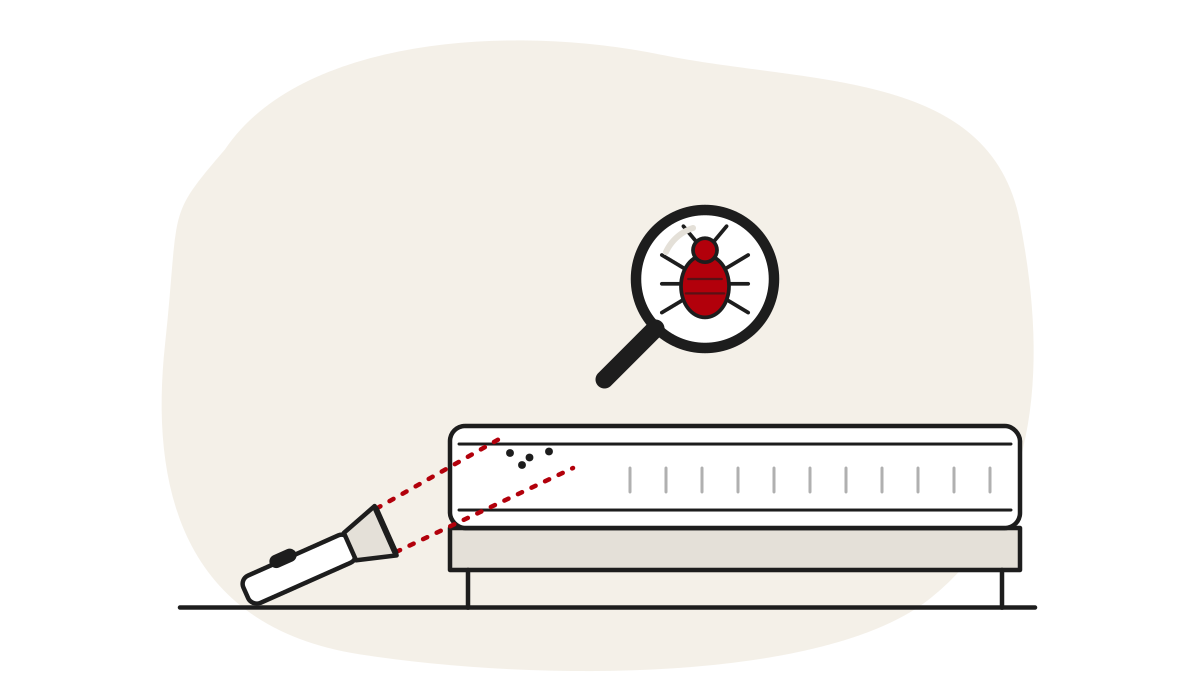
To check for bed bugs, use a bright torch to search the mattress seams, piping and labels, the bed frame joints and headboard, then nearby furniture and skirting. Look for live bugs, pale shed skins, tiny dark spots like pen marks, blood smears on sheets and tiny whitish eggs. Check slowly; they hide in thin gaps.
Reviewed by James Rhoades, Owner, ThermoPest · Last reviewed 15 October 2026
If you’ve woken up with bites or seen something small and brown on the sheets, it’s natural to want an answer tonight. This guide shows you what each sign of bed bugs looks like, where to look room by room, and when it makes sense to call in a professional. The descriptions draw on NHS guidance and what our technicians find on inspections.
Bites alone don’t prove you have bed bugs, so look for physical evidence. These are the signs to search for.
The NHS says adult bed bugs are around 5mm long and can be dark yellow, red or brown. They’re flat and oval, so they fit into very thin gaps. Young bed bugs (nymphs) are smaller and lighter, and newly hatched ones are no bigger than a pinhead. Our guides on what bed bugs look like and how to identify bed bug nymphs have photos to compare against.
Nymphs shed their skin as they grow. These skins are pale yellow or tan. They look like empty, see-through bed bugs and tend to collect where the bugs hide.
The NHS describes small brown spots on bedding or furniture, which are bed bug droppings. These dark spots are about the size of a full stop and may bleed into fabric like a marker pen. On wood or plastic they look like tiny raised dots of black ink.
The NHS lists spots of blood on bedding, from bites or from squashing a bed bug. They show up as rusty or reddish stains on sheets or mattresses.
Eggs and empty eggshells are tiny, about 1mm, whitish and hard to see without magnification. You’re most likely to find them tucked into seams and cracks close to where the bugs shelter.
You may read that bed bugs have a sweet or musty smell. In our experience, this odour is seldom noticeable except in extreme infestations, so don’t rule bed bugs out because the room smells normal.
| Sign | Where to look | What it looks like |
|---|---|---|
| Live bed bugs | Mattress seams and labels, bed frame joints, headboard | Flat, oval, brown or reddish insects; adults around 5mm (NHS) |
| Shed skins | Seams, cracks and corners near the bed | Pale yellow or tan, empty, bug-shaped husks |
| Dark spots | Mattress, bed frame, bedside furniture, skirting | Dots like a full stop that may smudge like marker pen |
| Blood spots | Sheets, pillowcases, mattress cover | Small rusty or reddish smears |
| Eggs | Deep in seams, joints and cracks | Whitish, about 1mm, easy to miss |
| Musty smell | The room as a whole | Seldom noticeable unless the infestation is extreme |

You don’t need special kit. With patience and a good torch, you can get good at finding bed bugs. Before you start, get:
If a crack will hold a credit card, it could hide a bed bug, which is why a card is a useful guide to what to check.
Start with the bed and work outwards. Bed bugs tend to hide close to where people sleep during the day, so most evidence is found within a short distance of the bed.

Take off the bedding. Shine the torch along every seam, the piping round the edge and the labels, and look into any folds or buttons. Lift the mattress and check the underside and the divan base, especially corners and fabric flaps. Our step-by-step mattress check goes through this in more detail.
Look over the sheets, pillowcases and mattress protector in good light for blood smears and dark spots. Check duvet and pillow seams too.
Check every joint, slat end, screw hole and crack in the frame. Look along the back and edges of the headboard where it meets the wall. Don’t try to take apart a heavy headboard on your own.
Empty the bedside drawers and look at the joints, runners and corners inside, and underneath the furniture. In heavier infestations, bed bugs can hide in drawer joints too. Check wardrobe corners and the hinges of doors near the bed.
Sofas and recliners can be major bed bug hotspots, especially if someone sleeps on them. Remove the cushions and check the seams, the gaps where the back meets the seat, and underneath. Our guide on bed bugs in sofas covers this in more depth.
Bed bugs often live along skirting boards, and behind pictures, mirrors, sockets and switch plates. Run the torch along the top edge of the skirting and check behind frames. Look at the edges of sockets and switches from the outside only. Never unscrew a socket or switch plate or poke anything into electrics. If you think bugs are behind one, leave it for a professional.
In heavier infestations, bed bugs can also hide in curtain folds, under loose wallpaper and where the wall meets the ceiling. Clutter near the bed gives bed bugs more places to hide, so check bags, boxes and piles of clothes, but don’t carry them into other rooms. For a fuller list, see where bed bugs hide.
Unpack on a hard floor, not the bed. Check the seams, pockets and zip channels of your case with a torch. Be aware that it’s difficult to spot bed bugs in luggage, so finding nothing doesn’t always mean nothing came home with you. The NHS suggests washing affected clothing on a hot wash (60°C) and tumble drying on a hot setting for at least 30 minutes. For more, see our guides to bed bugs in luggage and whether bed bugs live in clothes.
Check the bed before you unpack by looking at the sheets and mattress seams. Keep your case on a luggage rack or hard surface away from the bed while you check. Our guide on how to check a hotel room for bed bugs walks you through it.
Second-hand beds and furniture are a common way for bed bugs to get into homes, and the NHS advises checking second-hand furniture before you bring it inside. Check it outside or in a hallway, paying close attention to seams, joints, screw holes and the underside. Our guide on checking second-hand furniture for bed bugs has a full checklist.
Yes, adults can be seen, but they’re good at hiding. Nymphs and eggs are much harder. Because bed bugs are hidden and active mainly at night, a visual inspection alone can miss them. If you’d like more detail, read can you see bed bugs?
A light infestation can be very hard to find, and some people show no physical signs of bites at all, so evidence in the room matters more than marks on your skin. Bites can also be caused by something else. Our guide to what bed bug bites look like explains the usual patterns and when to speak to a pharmacist or GP.
Small plastic dishes, called interceptors, sit under bed legs and catch bed bugs as they move about. Monitors like these can help show whether bugs are active, but they don’t get rid of an infestation. Our guide to bed bug traps and interceptors explains how to set them up.
Book a professional bed bug inspection if:
Until then, try not to move furniture, bedding or bags out of the affected room, as this can spread the problem. Don’t use foggers, bug bombs or smoke bombs either: they tend to scatter bed bugs into new hiding places, including neighbouring rooms.
The NHS says it’s very difficult to get rid of bed bugs yourself and advises contacting your local council or a pest control service. In the meantime, it suggests washing affected bedding and clothing on a 60°C wash and tumble drying on hot for at least 30 minutes, and putting items that can’t be washed in a plastic bag in the freezer for 2 to 3 weeks.
At ThermoPest our approach is heat-led, with targeted spray where it’s needed, so it reaches the seams, joints and cracks where bugs and eggs hide. You can read how bed bug heat treatment works. ThermoPest is a member of the BPCA and NPTA, and our technicians arrive in unmarked vans. If you live in a flat, we’ll ask to inspect neighbouring flats too, and a return visit may be needed to make sure the problem is cleared.
4.9 / 5 on Google
FAQs
Can’t see your question? Call 0808 189 2310 and speak to a specialist.
Strip the bed and use a bright torch to check the mattress seams, piping, labels and underside, then the bed frame joints, headboard and bedside furniture. Work outwards to sofas, skirting boards and the edges of picture frames. Look for live bugs, shed skins, dark spots, blood smears and tiny whitish eggs.
Often the first signs are bites, small dark spots on the mattress or sheets, or spots of blood on bedding. The NHS lists the bugs themselves, blood spots on bedding and small brown spots of droppings. Shed skins and eggs tend to turn up in seams and cracks near the bed.
Adults, yes: the NHS says they’re around 5mm long and dark yellow, red or brown. Eggs are about 1mm and newly hatched nymphs are no bigger than a pinhead, so they’re much easier to miss.
Bed bugs are active mainly at night and hide close to where people sleep during the day. So check their hiding places rather than open surfaces: mattress seams, bed frame joints, the headboard and nearby furniture, using a torch.
Before you unpack, put your case on a luggage rack or hard surface, pull back the sheets and check the mattress seams and corners with your phone torch. If you see live bugs, dark spots or blood smears, tell reception and ask to move. Our hotel room guide has a full checklist.
Check seams, cuffs, collars and pockets in good light for live bugs, dark spots and shed skins. If you’re worried, the NHS suggests a 60°C wash and a hot tumble dry for at least 30 minutes, and freezing items you can’t wash in a bag for 2 to 3 weeks.
They can help you find out whether bed bugs are active. Interceptor dishes under bed legs catch bugs as they move. They won’t get rid of an infestation, though, so if they catch anything, book an inspection.
Found signs of bed bugs?
Found signs and not sure what you’re dealing with? An inspection will confirm it and show how far it’s spread. ThermoPest is a member of the BPCA and NPTA, and our technicians arrive in unmarked vans.
Prefer to call? 0808 189 2310
Talk to a specialist
Speak to a bed bug expert today. Tell us what you’ve found and we’ll come back to you with the right next step.
Enter Your Details To Request A Call Back
Enter Your Details To Request A Call Back


