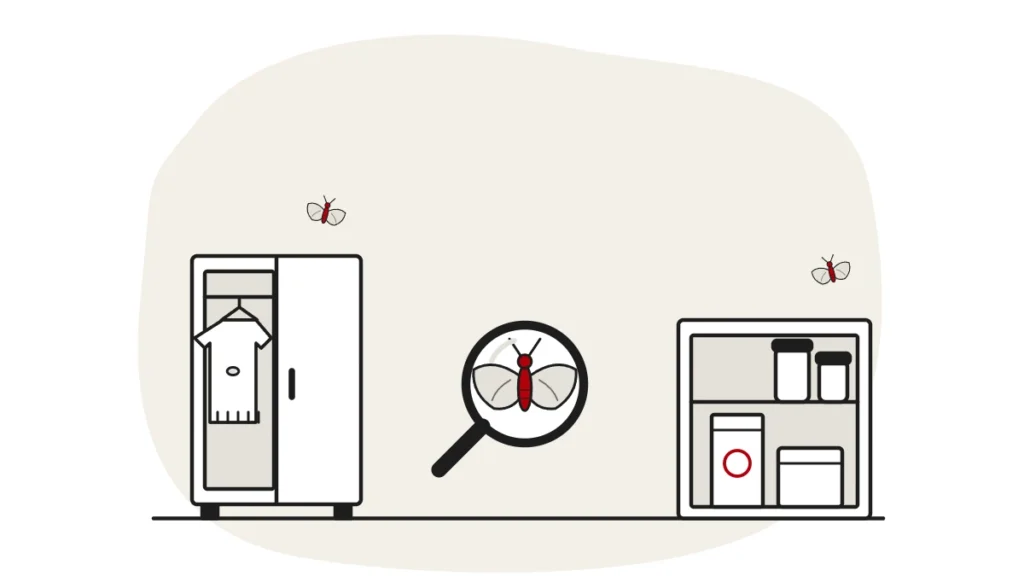
Clothes moths and pantry moths are different pests. Clothes moths are small, plain golden moths whose larvae eat wool, silk, fur and feathers, so you find them in wardrobes and carpets. Pantry moths, usually the Indian meal moth, have two-tone wings and their larvae eat dry food, so you find them in kitchen cupboards.
Reviewed by James Rhoades, Owner, ThermoPest · Last reviewed 16 October 2026
Working out which one you have matters, because the fix is completely different. Clearing out the kitchen won’t save your jumpers, and moth-proofing the wardrobe won’t stop moths coming out of a bag of flour. Here’s how to tell them apart, what each one damages, and what to do next.
Clothes Moth vs Pantry Moth: The Quick Comparison
The quickest clue is where you’re seeing them. Moths around wardrobes, drawers, carpets and stored textiles are usually clothes moths. Moths in the kitchen, near food cupboards or around open packets are usually pantry moths.
| Clothes moth | Pantry moth | |
|---|---|---|
| What it looks like | Small, shiny, plain golden or silvery-gold wings with no markings | Slightly bigger, with two-tone wings: pale at the base, reddish-brown towards the tips |
| Where you find it | Wardrobes, drawers, under beds and sofas, carpet edges, lofts | Kitchen cupboards, larders, food storage, pet food and bird seed |
| What the larvae eat | Natural fibres: wool, cashmere, silk, fur, feathers | Dry foods: flour, cereals, grains, nuts, dried fruit, biscuits, dry pet food |
| Signs | Holes in clothes, bare patches in carpet, silk webbing, small cream larvae | Webbing or clumps in food, larvae in packets or on shelves, moths flying in the kitchen |
| What to do | Find the hotspots, vacuum, freeze or clean affected items, store woollens sealed; call a professional if damage keeps spreading | Throw away infested food, empty and deep clean the cupboards, store dry food in sealed containers |
What do clothes moths look like?
In UK homes, most clothes damage comes from the common clothes moth (Tineola bisselliella). The British Pest Control Association (BPCA) describes it as small, shiny and silvery-gold, about 5–8mm long, with no markings on its wings and gingery-brown hairs on its head.
The Natural History Museum notes that adults often scramble across fabric rather than fly, and that clothes moths prefer low light and dirty fabrics. So if you see a small golden moth running along a carpet edge or fluttering out of a dark wardrobe, that’s a strong clue.
Clothes Moth Larvae
The adults don’t eat. The damage is done by the larvae, which the Natural History Museum describes as white with a brown head. They feed on keratin, a protein in natural fibres, and spin silk tunnels and mats as they go. A second species, the case-bearing clothes moth, has larvae that carry a small silk case around with them.
“Carpet moths” are usually the same species found in a different place. Our guide to the signs of carpet moths shows what the damage looks like in carpets and rugs.
What do pantry moths look like?
“Pantry moth” or “food moth” covers several moths whose larvae live in stored food. The one you’re most likely to find in a kitchen is the Indian meal moth (Plodia interpunctella). The BPCA gives its size as 8–10mm long, with forewings that are pale yellowish-buff near the body and reddish-brown with a coppery sheen towards the tips. That two-tone look is the easiest way to tell it from a plain golden clothes moth.
The BPCA also lists the white-shouldered house moth among food pests: a brown, mottled moth with a white head and shoulders, which you may find in kitchens as well.
Pantry Moth Larvae
Pantry moth larvae are small, pale caterpillars. The BPCA says Indian meal moth larvae grow to about 12mm. They spin silk as they feed, so infested food often has fine webbing through it or clumps stuck together. The Natural History Museum notes that fully grown larvae wander away from the food to spin white silk cocoons, and are often seen climbing walls or crossing ceilings at this stage. So you may find them or their cocoons on shelves, in cupboard hinges, or on the walls and ceiling nearby.
What do pantry moths eat?
According to the BPCA, Indian meal moth larvae feed on grains, grain products, dried fruit, nuts and cereals, as well as flour, biscuits and dog biscuits. Anything dry and starchy in a packet that isn’t sealed tightly is at risk, including:
- flour, oats, rice and pasta;
- breakfast cereals and muesli;
- nuts, seeds and dried fruit;
- biscuits, crackers and baking ingredients;
- dry pet food and bird seed.
Pantry moths don’t eat clothes, and clothes moths don’t eat food. That’s the most reliable way to tell them apart if you’re unsure what you’ve seen.
Where do pantry moths come from?
Pantry moths usually arrive in food. Eggs or tiny larvae can already be in a packet when you bring it home, and the BPCA notes that the Indian meal moth is often found in imported foods such as peanuts, cocoa beans and dried fruit. Bird seed and pet food stored in a garage or utility room are common starting points too.
Once they’re in, the moths lay eggs on or near other food, so the problem spreads from one forgotten packet to the rest of the cupboard. In its advice on stored product insects, the BPCA points out that partly used packets left at the back of shelves are a common source, so start your search there.
Signs of Each Type
Signs of Clothes Moths
- Small, irregular holes in wool, cashmere and silk, often under collars, along seams and in folds.
- Bare or thinning patches in wool carpets, especially along skirting boards and under furniture.
- Fine silk webbing, tubes or cases on fabric or in the carpet pile.
- Small cream larvae on clothes that haven’t been worn for a while.
- Small golden moths scrambling across fabric or carpet rather than flying.
Signs of Pantry Moths
- Moths flying around the kitchen.
- Webbing inside packets, or food clumped together in strands.
- Small pale larvae in food or crawling on shelves.
- Cocoons in cupboard corners, door hinges or on the ceiling.
If you’re seeing lots of moths but no damage to clothes or food, they may be harmless garden moths coming in at night. Our guide on why there are so many moths in your house helps you work that out. And if you’re finding holes but no moths, the culprit could be carpet beetles instead: see signs of carpet beetles vs moths.
How to Get Rid of Pantry Moths
Pantry moths are usually dealt with by clearing and cleaning your cupboards yourself. The BPCA’s advice comes down to removing the food source and cleaning thoroughly:
- Empty the cupboard. Take everything out of the affected cupboard and the ones next to it.
- Check every packet. Look for webbing, clumps, larvae or small holes in packaging. Start with forgotten, part-used packets at the back.
- Throw away infested food. Seal it in a bag and put it in an outside bin. The BPCA suggests returning an infested item to the shop if you bought it recently, so they can investigate.
- Deep clean the cupboard. Vacuum shelves, corners, cracks and door hinges, then wipe everything down. Remove spills and crumbs.
- Check nearby food and repeat. If the moths have spread, the BPCA advises repeating the process across other cupboards.
- Store dry food sealed. Use airtight glass, metal or sturdy plastic containers so any new arrival can’t spread.
Keep an eye on the cupboards for a few weeks afterwards, because larvae that had already crawled off to pupate can still turn into adults. If moths keep appearing after you’ve cleared and cleaned everything, the BPCA recommends contacting a professional pest controller.
How to Deal With Clothes Moths
Clothes moths need a different approach, because the larvae are spread through fabrics and carpet rather than in one packet you can throw away.
- Find the hotspots. Check wardrobes, drawers, stored clothes, under beds and sofas, and carpet edges.
- Vacuum thoroughly along edges, under furniture and inside wardrobes, and empty the vacuum into an outside bin.
- Freeze or clean affected items. The BPCA advises sealing items in a plastic bag and freezing them at −18°C for at least two weeks, longer for larger amounts.
- Store clean and sealed. Clean clothes before you put them away and keep woollens in sealed bags or boxes.
Our full guide on how to get rid of carpet and clothes moths goes through each step in detail.
If damage keeps spreading after a few weeks, professional moth control starts with an inspection to find every hotspot. At ThermoPest our moth heat treatment is heat-led, with targeted spray only where it’s needed, so heat does most of the work and reaches larvae and eggs deep in carpet pile, furniture and fabrics. Some cases need a follow-up visit, and we give aftercare and monitoring advice afterwards. Moth treatments are covered by our 12-week guarantee.
Our moth service is for clothes and carpet moths. Pantry moths can usually be cleared by emptying and cleaning your cupboards as above, but if you’re not sure which moth you have, give us a call and we’ll help you work it out.
Can you have clothes moths and pantry moths at the same time?
Yes. They live in different places and eat different things, so having one doesn’t stop you getting the other. If you’re seeing moths in both the kitchen and the bedroom, treat them as two separate problems: clear the food cupboards for pantry moths, and check wardrobes and carpets for clothes moths.
FAQs
Are pantry moths and clothes moths the same?
No. They’re different species. Clothes moth larvae eat natural fibres such as wool and silk, while pantry moth larvae eat dry food such as flour, cereals and nuts. Pantry moths won’t damage your clothes, and clothes moths won’t infest your food.
Are pantry moths harmful?
Pantry moths don’t bite or sting. The problem is the food they spoil: throw away anything with larvae, webbing or clumps in it. If you’ve eaten some by accident and feel unwell, speak to a pharmacist or call NHS 111.
Does vinegar kill pantry moths?
Vinegar isn’t part of the BPCA’s advice on pantry moths. You can use it to wipe shelves once you’ve emptied the cupboard, but it won’t reach eggs and larvae inside food packets. The BPCA’s advice is to throw away infested food, preferably in an outside bin, and deep clean wherever food has been stored.
Do pantry moth traps work?
Pheromone traps are sticky boxes that use an artificial scent to attract adult moths. The Natural History Museum describes them as a way to monitor an infestation, so they’re useful for spotting activity and checking whether the problem has gone. They don’t reach eggs or larvae in your food, so they won’t clear an infestation on their own. Check the label to make sure the trap is meant for the moth you’re seeing.
Why are there pantry moth larvae on my ceiling?
According to the Natural History Museum, fully grown larvae wander away from the food to pupate and are often seen climbing walls or crossing ceilings. Find and clear the food source, then keep checking for a few weeks while any larvae that have already left finish developing.
Not sure which moth you’ve got?
If you’re finding holes in clothes or bare patches in carpets, an inspection will confirm what’s causing it and where the larvae are. ThermoPest is a member of the BPCA and NPTA, and our technicians arrive in unmarked vans.