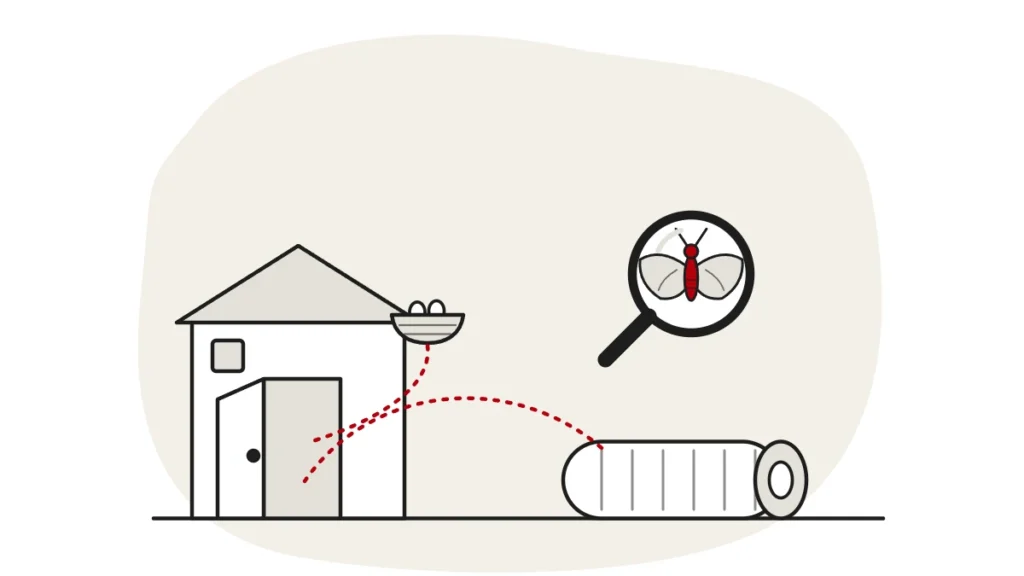
Carpet moths come from other infested places, not from the carpet itself. Adults fly or walk in through open windows and from neighbouring flats, and eggs or larvae arrive hidden in second-hand rugs, furniture and clothes, or in old bird nests in lofts and chimneys. Once inside, wool, dim light and warmth let them settle and breed.
Reviewed by James Rhoades, Owner, ThermoPest · Last reviewed 16 October 2026
Most people only notice carpet moths once there’s a bare patch in the rug or a jumper with holes, so it feels as though they appeared from nowhere. They didn’t. This guide explains where carpet moths actually come from, the routes they take into a home, what makes them stay, when they’re most active and why they’ve become so common in the UK.
Where do carpet moths come from?
“Carpet moth” isn’t a separate species. In UK homes the moths eating carpets are the same ones eating clothes: the common clothes moth (Tineola bisselliella) and the case-bearing clothes moth (Tinea pellionella). The British Pest Control Association (BPCA) describes the common clothes moth as a small, shiny, silvery-gold moth about 5–8mm long.
The adults don’t eat. The Natural History Museum explains that the larvae are adapted to feed on keratin, the protein in natural fibres such as wool, fur and feathers, which is why they damage woollen carpets, upholstery and clothing. Their original food was never carpet. The BPCA notes that in warmer climates clothes moths live naturally in animal and bird nests, and English Heritage’s case-bearing clothes moth fact sheet says that species is frequently found in natural situations such as birds’ nests and animal carcasses.
To a moth, a wool carpet is simply a large nest lining that nobody disturbs. Every infestation starts with a moth, egg or larva carried or flown in from somewhere that already had them.

How do carpet moths get in your house?
There are five routes we see again and again. Most homes with a problem have been reached by more than one of them.
Flying in Through Open Windows and Doors
Adult clothes moths are weak fliers and avoid light, but they do fly in warm weather. The BPCA points out that we’re more likely to keep windows open in summer, which invites moths inside. A moth that drifts in from a neighbouring garden, a shed or next door’s loft only needs to find a wool rug or a quiet wardrobe to start laying.
Second-Hand Rugs, Furniture and Clothes
This is the route people most often overlook. Eggs are tiny and laid deep in fibres, and larvae hide in folds, seams and the underside of rugs, so an infested item can look perfectly clean. Vintage wool rugs, inherited blankets, charity-shop knitwear, upholstered chairs, taxidermy and feather-filled cushions can all carry moths into a home that never had them.
Neighbouring Flats and Shared Walls
Moths and larvae move through the gaps around pipes, cables, floorboards and skirting that connect flats and terraced houses. When English Heritage surveyed homes across England in its Operation Clothes Moth results (2018), it found flats were more susceptible to clothes moths, which it put down to shared walls. If a neighbour has an untreated problem, their moths will keep arriving however carefully you clean.
Old Bird Nests in Lofts, Eaves and Chimneys
Because clothes moths naturally breed in nests, an abandoned bird nest in the loft, behind a soffit or down an unused chimney can act as a moth nursery inside your own building. The BPCA advises checking old bird nests in attic spaces or chimneys as a source of house moths, and English Heritage recommends checking unused chimney flues for old nests or dead birds, and removing any nest material found in lofts. Moths emerging from a nest then make their way down into the rooms below.
They Were Already There When You Moved In
A small population can tick over for a long time under a wardrobe, beneath a fitted carpet edge or in a box of stored woollens. The Natural History Museum says larvae can take from one month to two years to develop, depending on conditions, so a problem a previous occupant never noticed can surface months after you arrive, especially once the heating goes on.
| Route in | What usually carries them | Where to check first |
|---|---|---|
| Open windows and doors | Adult moths in warm weather | Wool rugs and wardrobes in rooms with windows left open |
| Second-hand items | Eggs and larvae in rugs, upholstery, knitwear, blankets, feathers, fur | The underside and edges of the item, seams and folds |
| Neighbouring flats | Adults and larvae through shared walls and floors | Skirting, pipe gaps and carpet edges on the shared wall |
| Old bird nests | Larvae feeding on feathers and nest debris | Loft, eaves, soffits and unused chimneys |
| Existing hidden population | Larvae under furniture or in stored textiles | Under beds and sofas, behind wardrobes, stored woollens |
Do carpet moths come from outside?
Yes, some do, but not in the way people picture. They aren’t blown in off fields in large numbers. Outdoors, clothes moths live in bird and animal nests, so the “outside” source is usually very close to the house: a nest under the eaves, in a neighbour’s roof space or in a garden shed. From there, a few adults find their way into a bedroom or living room through an open window.
Large, dark moths that fly straight to a lamp at night are a different thing altogether. Those are garden species that have come in by accident and don’t eat fabric. Our guide on why there are so many moths in your house explains how to tell them apart, and what carpet moths look like shows the signs to look for.
What causes carpet moths to stay and breed?
Getting in is only half the story. Moths arrive in plenty of homes and never take hold. A carpet moth infestation is caused by conditions that let the larvae feed undisturbed.
- Natural fibres. Wool carpets and rugs, wool-mix underlay, felt, silk, cashmere, fur and feathers are all food. Synthetic carpet on its own isn’t, though larvae can still feed on pet hair and wool fluff caught in it.
- Dirt and stains. The Natural History Museum says clothes moths prefer dirty fabrics, such as carpets and rugs, and the BPCA notes they’re attracted to perspiration and food stains. Clean, worn, brushed fabric is far less attractive.
- Low light and no disturbance. The Natural History Museum notes clothes moths prefer low light levels, and that adults often scramble across fabric rather than fly. That’s why damage starts under beds, behind sofas, along skirting boards and at the back of wardrobes.
- Warmth. English Heritage’s clothes moth research explains that one generation normally takes a year to develop, but up to three life cycles can occur in warm conditions. A centrally heated flat gives them that warmth all year.
- Damp corners. English Heritage’s fact sheet says the case-bearing clothes moth prefers damper conditions than the common clothes moth, so a rug against a cold outside wall or a poorly ventilated bedroom suits it well.
None of this means a moth problem is a sign of a dirty home. Spotless houses with a beautiful wool carpet get carpet moths; the carpet is the attraction, not the housekeeping.
When is carpet moth season in the UK?
Traditionally, clothes moths had a spring season. English Heritage’s case-bearing clothes moth fact sheet says adults emerge in spring and fly in warm weather, and the Natural History Museum says eggs hatch in 4–10 days in the summer months but can take up to three weeks in colder weather, so you tend to see more adult moths from spring through to late summer.
Indoors, that season has largely disappeared. The BPCA says warmer winters and temperature-controlled buildings mean moths can be a problem all year round, with summer’s warmer temperatures giving life cycles a helping hand. In practice, a heated home can produce more than one generation a year, and in very warm flats moths can appear at almost any time. If you’re seeing adults in November, that isn’t unusual, and it usually means larvae have been feeding somewhere for months. Our post on how long moths live covers the life cycle in more detail.
Why are carpet moths so common now?
You’re not imagining it. English Heritage, which has monitored clothes moths in its historic houses since 1997, reported in 2017 that its conservators had seen clothes moth numbers double over the previous five years, and launched Operation Clothes Moth, offering free traps to the public to find out where the moths were. About 5,000 traps were collected by visitors to its sites.
The 2018 results showed the common clothes moth population was significantly higher in London and the South East than anywhere else in the country, with an average of 23 moths per trap compared with 17 in the South West and 3 in the East Midlands. Flats came out worse than houses, which English Heritage attributed to shared walls, and older, pre-1950 properties had more moths, which it put down to voids, fireplaces and attics giving larvae more places to hide. The same survey picked up a newer arrival, the pale-backed clothes moth, 460 times, far more than expected.
How do carpet moths spread once they’re inside?
Adults live only a short time; the BPCA says their lifespan spans only days. In that time a female mates and lays her eggs among fibres the larvae can eat, and English Heritage notes eggs go into folds and crevices. Because adults walk more than they fly, an infestation usually spreads outwards from one hotspot: along a skirting board, under a bed, then into the wardrobe in the same room.
It jumps between rooms when something is moved: a rug rolled up and stored, a throw carried to another sofa, a box of jumpers put in the loft. In flats, larvae and adults also move through floor voids and pipe runs to the flat next door or below, which is why we ask to inspect neighbouring flats when we treat one. The larvae themselves are harmless to people and pets, as our guide to whether carpet moths are dangerous explains, but they’re very good at staying hidden until the damage shows.
What to Do Once You Know Where They Came From
Finding the source matters. Treat the carpet while a nest in the loft or a rug in the spare room keeps feeding it, and the moths come back.
- Check the routes above and deal with the source: remove old nests, isolate or freeze the second-hand item, and talk to the neighbour or landlord if moths are coming through a shared wall.
- Vacuum carpet edges, under furniture and inside wardrobes thoroughly, and empty the vacuum into the outside bin.
- Freeze small rugs and affected woollens. The BPCA advises sealing items in a plastic bag and freezing at -18°C for at least two weeks, longer for larger quantities.
- Put pheromone traps in each room to see where activity is highest. Traps catch adult males only, so they show you where the problem is rather than solving it.
- To stop them coming back, store woollens clean in sealed bags or airtight boxes, and move furniture now and then to vacuum underneath.
- Be wary of quick fixes. Vinegar cleans surfaces but won’t clear larvae, as we explain in does vinegar kill carpet moths?, and foggers or smoke bombs scatter moths rather than reach the larvae in the pile.
If bare patches keep spreading after a few weeks, or the damage covers fitted carpet in more than one room, a professional carpet moth treatment starts with an inspection to find every hotspot and the route they came in by. At ThermoPest our moth heat treatment is heat-led, with targeted spray only where it’s needed, so heat does most of the work and reaches larvae and eggs deep in carpet pile, furniture and fabrics. Some cases need a follow-up visit, and we give aftercare and monitoring advice afterwards. Moth treatments are covered by our 12-week guarantee.
FAQs
Why do carpet moths suddenly appear?
They rarely appear suddenly; the larvae have usually been feeding out of sight for weeks or months. What you notice is the adults emerging in a batch, often in spring or when the heating comes on, or a bare patch finally showing when furniture is moved. Trace it back to a rug, a wardrobe, a neighbour or a nest in the loft.
How do you get carpet moths in a clean house?
Cleanliness isn’t the deciding factor. Moths need natural fibres, dim light and quiet, and a wool carpet under a bed in a spotless home gives them all three. They arrive through open windows, in second-hand items, from neighbouring flats or from old bird nests, whatever the housekeeping.
Are carpet moths common in the UK?
Yes, and increasingly so. English Heritage reported clothes moth numbers doubling over five years to 2017, and its 2018 survey found the highest numbers in London and the South East, with flats and pre-1950 homes most affected.
Can carpet moths come from next door?
Yes. In flats and terraces, moths and larvae move through gaps around pipes, floorboards and skirting on shared walls. English Heritage found flats more susceptible to clothes moths for this reason. If your neighbour has an untreated problem, yours is likely to keep returning until both are dealt with.
When do carpet moths come out?
In unheated buildings adults emerge mainly in spring and fly in warm weather, according to English Heritage. In heated homes the BPCA says moths can be a problem all year round, so adults can turn up in any month.
Found where they’re getting in?
If moths keep arriving or bare patches keep spreading, an inspection will confirm what you’re dealing with, where the larvae are and the route they came in by. ThermoPest is a member of the BPCA and NPTA, and our technicians arrive in unmarked vans.