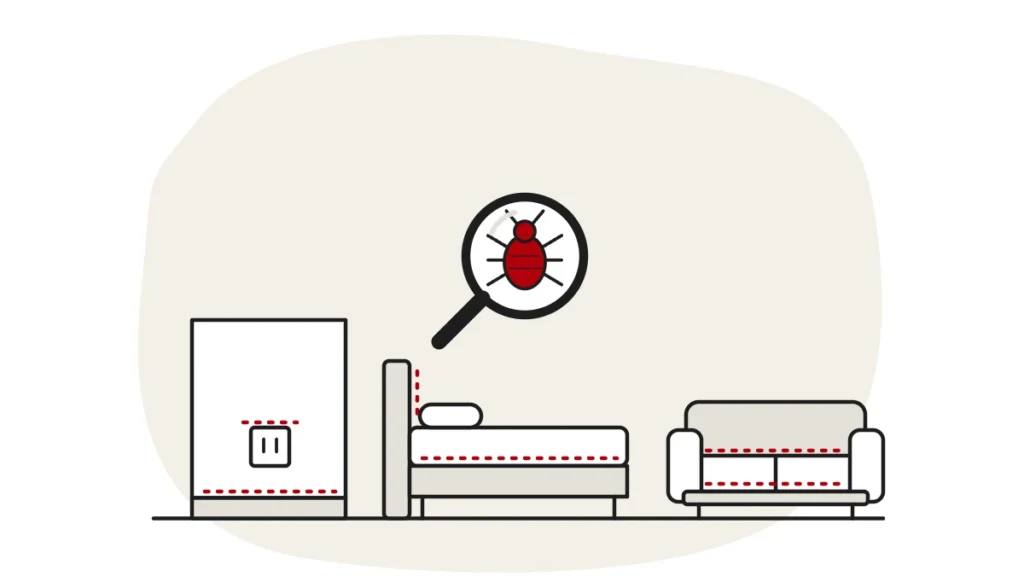
Bed bugs hide in tight, dark gaps close to where you sleep or rest. Start with the bed: mattress seams, piping and labels, the bed frame joints and the headboard. Then check bedside furniture, skirting boards, behind pictures, under loose wallpaper and around plug sockets, and the seams and underside of any sofa used for sleeping.
Reviewed by James Rhoades, Owner, ThermoPest · Last reviewed 16 October 2026
If you’ve woken up with bites or found a small dark mark on the sheets, you’ll want to know where to look. This guide goes room by room, starting with the bed, then explains the signs that show bed bugs are there, including whether they really smell.

Where do bed bugs hide during the day?
Bed bugs feed on blood, mainly at night, and spend the day tucked out of sight. They prefer to hide close to where they feed, so infestations start out concentrated around beds, sofas and other places where people sleep or rest. If an infestation is left to grow, they spread further out into the room.
Their flat bodies let them squeeze into very narrow gaps, often crevices no wider than a toothpick. That’s why you rarely see them out in the open in daylight, and why a quick look at the sheets isn’t enough. Females lay their eggs in secluded places, so these hiding spots are where bed bugs breed as well as rest.
Where do bed bugs hide in the bed?
The bed is the first place to check. The NHS lists bed frames and mattresses among the places bed bugs hide, and the BPCA (British Pest Control Association) says they hide in crevices in the bed and surrounding furniture.
The Mattress
- Seams, piping and the edges where the fabric folds.
- Labels, tags and handles.
- The underside of the mattress. The BPCA notes that the small dark spots of droppings are found on the bed frame, upholstery or the underside of the mattress.
The Bed Frame, Base and Headboard
- Joints, screw holes and corners of the frame.
- Slats, and the fabric and staples of a divan base.
- Behind and inside the headboard. Our technicians often find the area behind the headboard is one of the first places bed bugs become established.
Bedding, Pillows and Duvets
Bed bugs don’t usually live inside a duvet or pillow, but you may find signs on bedding, such as spots of blood or droppings. Our guide on whether bed bugs live in duvets, pillows and carpets covers soft furnishings in more detail.
Where else do bed bugs hide in the bedroom?
Once you’ve checked the bed, work outwards. The NHS and the BPCA both list places away from the bed that are easy to miss:
- Skirting boards: the BPCA lists the gaps behind skirting boards, and we often find bed bugs living along them.
- Loose wallpaper: named by both the NHS and the BPCA.
- Behind pictures and mirrors: the NHS mentions behind pictures. Check frames hung near the bed first.
- Plug sockets and light switches: the BPCA says bed bugs can even hide in plug sockets. Don’t unscrew a socket cover yourself; mention it to whoever inspects.
- Bedside tables and drawers: joints, drawer runners and the back panel.
- Carpet edges: along and under the edge of fitted carpet, especially behind the bed.
- Electronics: clocks, phones and televisions near the bed can also hide them. Read more in can bed bugs live in electronics?
Can bed bugs live in walls?
They can use gaps in and around walls. Bed bugs can crawl from room to room, or floor to floor, through cracks and openings in walls, floors and ceilings. Plug sockets, cracks in plaster, pipe openings and the gap behind skirting are typical routes.
This matters most in flats and terraced houses, where rooms and homes share walls. If bites keep coming back after you’ve checked the furniture carefully, the bugs may be sheltering further into the structure or coming from next door. Our guide on whether bed bugs can come from neighbours explains how this happens. When we treat a flat, we ask to inspect the neighbouring flats too.
Can bed bugs live on hardwood floors?
Not on the open surface. A smooth floor gives them nowhere to hide, so a bed bug you see crossing the floor is usually moving between hiding places or heading for someone asleep. They can crawl quickly over floors, walls and ceilings.
The risk is in the gaps: between floorboards, along the floor edge where it meets the skirting, and under rugs near the bed or sofa. Droppings and shed skins can also be harder to spot on wood than on fabric, so check the edges with a torch.
Where do bed bugs hide in a sofa and living room?
Sofas and recliners are major bed bug hotspots, especially when someone sleeps on them. If anyone naps or sleeps on the sofa, check it as carefully as the bed.
- Seams and piping on cushions, and under the cushions.
- Where the back meets the seat, and the folds in the arms.
- The underside: turn it over if you can and look at the fabric lining, staples and frame joints.
- The carpet edge and skirting behind the sofa.
- Armchairs, footstools and any cushions that move between rooms.
Can bed bugs be in other rooms?
Usually they start where people sleep, but they don’t stay put if the infestation grows. Rooms where someone has started sleeping, such as a spare room or a sofa bed, are the next most likely places. Moving to another room to escape bites can carry bugs with you in bedding or clothes, so it’s best to stay put until the problem is confirmed.
The BPCA also warns that a room that has been unused for a few months may not be as empty as it appears, and that bed bugs can move to other parts of a building. If you’ve found them in one room, our guide if one room has bed bugs, do they all? explains what to check next.
Where do bed bugs hide when you travel?
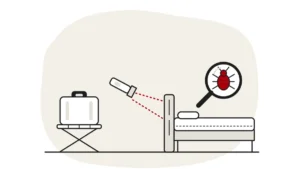
In a hotel room, check the same places you would at home: mattress seams, the headboard, bedside furniture and the sofa. Keep your suitcase off the bed and the floor, on a luggage rack or hard surface, until you’ve looked. Our guide on how to check a hotel room for bed bugs walks through it step by step.
Bed bugs can travel home in luggage seams and folded clothes. When you get home, unpack away from the bed and wash clothes as soon as you can. See bed bugs in luggage for how to check and treat a suitcase.
What are the signs of bed bugs?
You may not see a live bug, especially early on. These are the signs to look for in the hiding places above:
| Sign | What it looks like | Where you’ll find it |
|---|---|---|
| Live bugs | Flat, oval, reddish-brown; adults are around 5mm long (NHS) | Mattress seams, frame joints, headboard, sofa seams |
| Droppings | Small dark spots like an ink dot, about 1mm wide (BPCA) | Bed frame, underside of the mattress, bedding, furniture |
| Blood spots | Small red or rusty smears | Sheets, pillowcases, mattress, headboard |
| Shed skins | Pale, tan, empty bug-shaped skins left as young bed bugs grow | In and near hiding places |
| Eggs | Tiny, whitish and hard to see without magnification | Tucked into seams, cracks and crevices |
| Bites | Itchy bumps, often in a line or grouped together (NHS) | Skin uncovered in bed: face, neck, arms |
Eggs are the easiest sign to miss. Our guide to what bed bug eggs look like and where to find them has more detail. Bites on their own don’t prove bed bugs: some people don’t react to bites at all, and other things cause similar marks, so look for signs in the room too.
Do bed bugs smell?
Sometimes, but it’s not a reliable sign. Although bed bugs are often said to have a telltale “buggy” odour, the smell is seldom noticeable except in very heavy infestations, and it shouldn’t be relied on to detect them.
What does a bed bug infestation smell like?
People who have noticed it usually describe a musty or sweetish smell in the bedroom, close to where the bugs are hiding. But plenty of other things cause a musty smell in a home, such as damp, mould, laundry left damp or a poorly ventilated room. A smell without any of the visible signs in the table above doesn’t mean you have bed bugs, and no smell doesn’t mean you don’t. Use your eyes and a torch rather than your nose.
How to Find Where Bed Bugs Are Hiding
Take your time and work in order, starting closest to where you sleep:
- Strip the bed and check the mattress seams, labels and underside with a bright torch.
- Check the bed frame joints, slats, base and the back of the headboard. A thin card run along seams and cracks can push out bugs or skins.
- Move on to bedside furniture, then skirting boards, carpet edges, behind pictures and around sockets.
- Check the sofa and any other place people sleep.
- Take clear photos of anything you find, and keep a bug on clear tape if you can, so it can be identified.
Our room-by-room guide on how to check for bed bugs goes into each step in more detail.
If You Find Signs
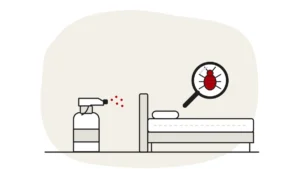
Wash bedding and clothes from the bedroom on a hot wash (60°C) and tumble dry on a hot setting for at least 30 minutes, as the NHS advises. Only throw away items that can’t be washed or treated. Avoid foggers, bug bombs and smoke bombs: they tend to scatter bed bugs into new hiding places, as we explain in do smoke bombs and foggers kill bed bugs?
The NHS says you’re unlikely to get rid of bed bugs completely yourself, and advises contacting your local council or a pest control service. Because bed bugs are small and good at hiding, a professional bed bug inspection is the quickest way to confirm what you’re dealing with and how far it has spread. If treatment is needed, ThermoPest’s approach is heat-led, with targeted spray where it’s needed, so it reaches the cracks and seams where bugs and eggs hide. Return visits may be needed. If you’re in the capital, see our bed bug treatment in London.
FAQs
Where are bed bugs most likely to hide?
Within a short distance of where people sleep. The mattress seams and underside, the bed frame joints and the headboard are the most common places, followed by bedside furniture, skirting boards and the sofa if someone sleeps on it. Further out, they hide behind pictures, under loose wallpaper and around plug sockets.
Do bed bugs smell like urine?
There’s no reliable evidence that bed bugs smell like urine. Any smell from bed bugs is usually described as musty, and it’s seldom noticeable except in very heavy infestations. A urine-like smell in a home is more likely to have another cause, such as pets, mice or damp.
How do you make bed bugs come out of hiding?
You can’t reliably lure them out, and sprays or foggers can drive them deeper into hiding. Bed bugs come out at night to feed, so a careful torch check of the bed and nearby furniture late at night can help. Interceptor cups under bed legs can show whether bugs are crossing to the bed, but they are a monitoring aid, not a treatment.
Are bed bugs invisible to the naked eye?
No. The NHS says adults are around 5mm long. They’re flat and reddish-brown. Young bed bugs and eggs are much smaller and paler, which is why light infestations are easy to miss. Look for the other signs too: dark spots, blood spots and shed skins.
Can bed bugs live in clean homes?
Yes. Bed bugs feed on people, not dirt, so a clean home can still get them. They usually arrive in luggage, clothing or second-hand furniture. Keeping clutter down around the bed doesn’t stop them arriving, but it gives them fewer places to hide and makes them easier to find.
Found signs but can’t find the source?
An inspection will confirm whether it’s bed bugs and show where they’re hiding, including the gaps that are easy to miss. ThermoPest is a member of the BPCA and NPTA, and our technicians arrive in unmarked vans.