Bed bug cases in the UK tend to peak in late summer, around August and September. A University of Sheffield analysis of council data from Birmingham, Manchester and Sheffield found that peak every year, and an earlier study of Greater London boroughs found the same. Summer travel, house moves and second-hand furniture are the likely reasons.
Reviewed by James Rhoades, Owner, ThermoPest · Last reviewed 16 October 2026
So if you’ve noticed bites or marks on the mattress since coming home from holiday or moving, you’re far from alone. This guide explains what the research shows, why cases bunch up after the summer, what to check for and what to do if you find something. Bed bugs aren’t a sign of a dirty home: the NHS says they’re found in both clean and dirty places.
Is there a bed bug season in the UK?
Yes, though it isn’t like wasp or moth season. Bed bugs live indoors, close to where people sleep, so they’re around all year. What changes with the seasons is how many new infestations are found.
What the UK Research Shows
William Hentley, a teaching associate in ecology at the University of Sheffield, looked at monthly records of confirmed infestations treated by councils in Birmingham, Manchester and Sheffield from 2009 to 2015. Writing in The Conversation, he reports “a significant peak in bed bug cases around August and September each year”, alongside a steady rise over the years.
London shows the same pattern. A study titled Are bed bug infestations on the increase within Greater London? looked at bed bug calls in seven London boroughs from 2000 to 2006. Monthly figures from six of them showed the most calls in late summer, in August and September.
Is it the same in other countries?
Broadly, yes. Hentley notes that internet searches for bed bugs in Australia, where the seasons are reversed, follow the opposite pattern, which fits the idea that cases rise with the warmer months.
Why do bed bug problems show up after the summer?
Nobody has proven exactly why, and researchers still disagree about how bed bugs travel long distances. Hentley points out that people assume they travel in luggage, but that has never been proven. Still, there are some likely reasons, and they all come down to people and their belongings moving around more.
| Likely reason | How bed bugs could arrive | What to check |
|---|---|---|
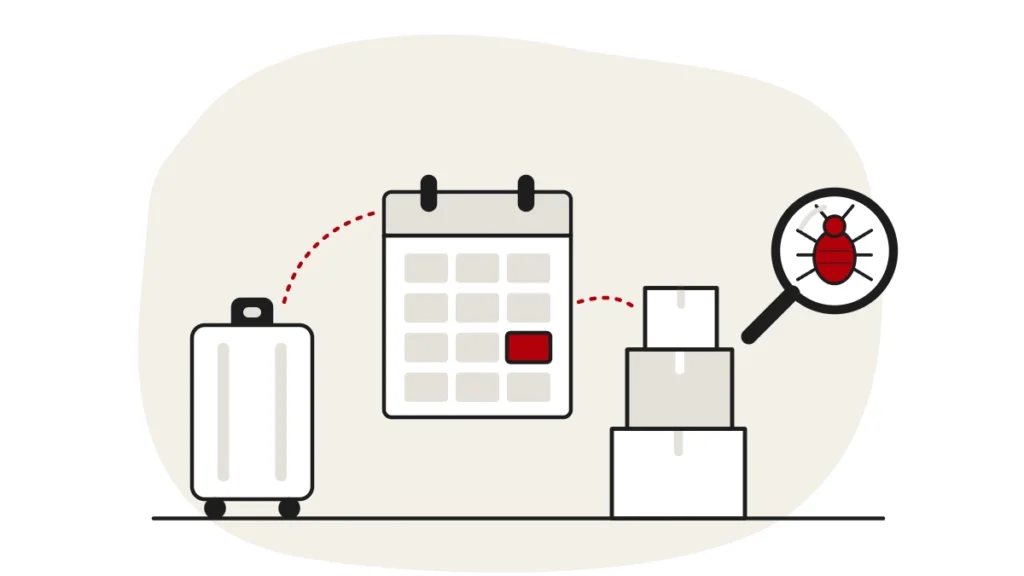
| Summer travel | In suitcases and clothes after hotel, hostel or holiday-let stays | Luggage seams and pockets before unpacking |
| Students moving in | In luggage and furniture moved into halls and shared houses | Mattress seams and bed frame on arrival |
| House moves and new tenancies | In furniture, boxes and removal vans, or left behind in the property | Beds and sofas in the first few weeks |
| Second-hand furniture | In joints, seams and fabric of beds, sofas and chairs | Every seam and joint before it comes indoors |
| Warmer weather | Bugs may move about and breed more in warm months | Any new bites or marks near the bed |
Summer Holidays and Travel
The British Pest Control Association (BPCA) says bed bugs can be transported on items such as luggage and second-hand furniture, and its experts encourage holidaymakers to check their luggage carefully so they don’t bring bed bugs home. More trips mean more chances to bring a few bugs home without knowing. A small number of bugs can take a while to become noticeable, so a problem picked up in July or August may not show itself until September.
Students Moving in September
September is when many students arrive at halls and shared houses, often with luggage and furniture from several places. University guidance reflects this risk: St Mary’s University, Twickenham’s bed bug protocol says bed bugs hitchhike on people, luggage and furniture, and asks students to inspect luggage when unpacking and check any second-hand items thoroughly.
House Moves and Second-Hand Furniture
Moving home means beds, sofas and boxes going in and out of vans and buildings. Second-hand furniture is a common route in: the NHS advises you not to bring secondhand furniture indoors without carefully checking it first. Our guide on how to check second-hand furniture for bed bugs walks through it step by step, and if you’ve just moved, see bed bugs after moving into a new home.
Warmer Weather
Bed bugs are thought to move about more in warmer months, and that breeding and development speed up too. That would mean small introductions grow faster over the summer and become easier to spot by late summer.
Why does it matter for London?
London has a lot of the things that move bed bugs around: hotels and short lets, a large student population, frequent tenancy changes and a busy trade in second-hand furniture. Many people also live in flats and shared buildings, where bed bugs can move between rooms and neighbouring homes. For more on why the capital sees so many cases, read bed bugs in London: how common they are and why.
Signs of Bed Bugs to Check for After the Summer
Bites alone can’t confirm bed bugs, because people react differently and some don’t react at all. Look for physical signs around the bed with a torch:
- Live bugs: flat, reddish-brown insects. The NHS says adults are around 5mm long.
- Small brown or dark spots on bedding, mattress seams or furniture. The NHS describes these as bed bug poo.
- Spots of blood on sheets or pillowcases.
- Pale shed skins left behind as young bed bugs grow.
- Tiny pale eggs tucked into seams, joints and cracks.
- Bites on skin left uncovered in bed, often the face, neck and arms, according to the NHS.
Check mattress seams and labels, the bed frame joints and headboard, bedside furniture, skirting boards and sofas. Our room-by-room guide to checking for bed bugs covers each spot in more detail.
Just Back From Holiday? What to Do
Don’t panic, and don’t throw everything away. Most trips don’t bring bed bugs home, and the steps below cut the risk if one did.
- Check your suitcase before bringing it into the bedroom: seams, zips, pockets and wheels. The NHS advises not taking luggage or clothing indoors without checking it carefully.
- Wash clothes and bedding on a hot wash (60°C) and tumble dry on a hot setting for at least 30 minutes, as the NHS recommends.
- Items that can’t be washed can go in a plastic bag in the freezer for 2 to 3 weeks, according to the NHS.
- Keep unpacking to one area, rather than spreading belongings around the home.
The BPCA’s Natalie Bungay has pointed out that checking luggage and hot washing are not failsafe, so keep an eye out for signs over the following weeks. For more detail, see our guide to checking and treating bed bugs in luggage, and next time you travel, how to check a hotel room for bed bugs.
Landlords, Hotels, HMOs and Student Housing
Anywhere with frequent turnover of guests or tenants has more chances for bed bugs to arrive. The BPCA advises accommodation providers to check rooms before the holiday season and to keep checking throughout the year, noting that a room left unused for a few months may not be as empty as it appears.
- Train staff to recognise spotting, shed skins and live bugs.
- Have a clear plan for what happens when a guest or tenant reports bites.
- Act on one room quickly, before bugs spread to neighbouring rooms.
Why Shop-Bought Sprays Often Make Things Worse
Bed bugs and their eggs hide deep in cracks, joints and seams that sprays don’t reach. The BPCA warns that DIY treatments often result in failure. Foggers, bug bombs and smoke bombs tend to scatter bed bugs into new hiding places, including neighbouring rooms, which can make the problem harder to treat.
How ThermoPest Treats Bed Bugs
Our approach is heat-led, with targeted spray where it’s needed. Bed bugs and their eggs die when held above about 50°C for long enough. We heat rooms to 50–60°C and hold that heat until the hardest-to-reach spots stay above 50°C. Rooms don’t heat evenly, so we place temperature monitors in known cold spots and hard-to-reach areas.
Every property is different, and a return visit may be needed. In flats, we ask to inspect neighbouring flats, because bed bugs can move between homes. If you’re in the capital, our bed bug treatment London page explains how it works, and our pricing page sets out costs.
FAQs
When is bed bug season in the UK?
UK council data points to late summer. A University of Sheffield analysis of confirmed cases in Birmingham, Manchester and Sheffield found a peak around August and September each year, and a study of Greater London boroughs found most calls in the same two months. Bed bugs are still found all year round.
Are bed bugs seasonal?
Partly. Bed bugs live indoors, so they don’t disappear at any time of year. But the number of new infestations found does rise and fall, with UK studies showing more cases in late summer. Researchers think travel and warmer weather both play a part.
Are bed bugs worse in summer or winter?
More cases are reported in late summer than in winter. UK council data shows a peak around August and September. That doesn’t make winter safe: heated homes give bed bugs what they need all year.
Do bed bugs go away in winter?
No. They live in heated homes, close to people, so cold weather outside doesn’t kill them off. An infestation found in autumn won’t clear up on its own as the weather turns. Our guide to whether bed bugs die in winter explains why.
Should I check for bed bugs after a summer holiday?
It’s a sensible habit. Check your luggage before it goes into the bedroom, wash clothes at 60°C and tumble dry hot for at least 30 minutes as the NHS advises, and look around your bed for signs over the next few weeks.
Found signs since the summer?
If you’ve found bites, spots or bugs around your bed, an inspection will confirm what you’re dealing with and how far it has spread. ThermoPest is a member of the BPCA and NPTA, and our technicians arrive in unmarked vans.