Yes, a steamer can kill bed bugs and their eggs, but only the ones the hot steam actually reaches. Used slowly on mattress seams, bed frames and cracks, it’s a useful spot treatment. It can’t heat deep inside furniture, walls or thick padding, so on its own a steamer rarely clears an infestation.
Reviewed by James Rhoades, Owner, ThermoPest · Last reviewed 16 October 2026
If you’ve just found bed bugs, reaching for the steamer in the cupboard makes sense. This guide explains what the research says steam can and can’t do, which kinds of steamer are worth using (and which aren’t), how to use one safely, and when it’s time to bring in a professional.
Does steam kill bed bugs?
Steam does kill bed bugs, as long as it’s hot enough when it touches them. Used correctly, a steamer kills bugs and eggs on contact. The catch is in the words “on contact”: a bug tucked a few millimetres inside a seam, joint or cushion may never feel the full heat.
How well it works depends on where the bugs are:
- bugs out on a mattress or tucked into an open crack are killed;
- most, but not all, bugs hidden under a fabric cover are killed;
- bugs hidden behind leather often survive, however long you steam.
Used properly, a steamer can kill all life stages of bed bugs, and a decent household steam cleaner can do the job without you needing a professional machine. So the machine matters less than where the bugs are and how carefully you steam.
How fast will a handheld steamer kill bed bugs?
A handheld steamer works the same way as a larger one. Steam that is hot enough works on contact, so you don’t need to hold it on one spot for long. What takes time is coverage: you have to move slowly along every seam, edge and crack so the steam reaches each hiding place. Rushing is an easy way to miss bugs, because the steam cools and spreads before it gets into the gaps.
Does steam kill bed bug eggs?
Yes, if the steam reaches them. Steam can kill eggs as well as nymphs and adults. Eggs are tiny, pale and glued into crevices, so they’re easy to miss. Our guide on how to spot bed bug eggs shows where to look before you start.
How hot does a steamer need to be to kill bed bugs?
To be effective against bed bugs, steam needs to be at least about 54°C and shouldn’t have a forceful airflow, because a strong blast can scatter the bugs. A diffuser (a wider nozzle or cloth-covered head) helps stop that happening.
To work, the steam needs to be that hot where it meets the bug, not just inside the machine. Steam cools quickly once it leaves the nozzle, so hold the tip close to the surface and move slowly. A steamer that sputters water rather than producing a steady flow of steam won’t keep the surface hot enough.
Will a clothes or garment steamer kill bed bugs?
A garment steamer can kill a bed bug it hits directly, but it isn’t the best tool for the job. These steamers are designed to relax creases in hanging clothes, and many produce a light, damp steam that cools quickly and doesn’t get far into thick seams, pockets or folded fabric. There’s little good evidence on how well garment steamers work against bed bugs.
For clothes and bedding there’s a simpler, more reliable method. The NHS advises washing affected bedding and clothing on a hot wash (60°C) and tumble drying on a hot setting for at least 30 minutes. Items that can’t be washed can go in a sealed plastic bag in the freezer for 2 to 3 weeks, the NHS says. Only throw away items that can’t be washed or treated.
Keep a garment steamer for things that won’t go in the machine, such as curtains or the outside of a fabric headboard, and treat it as a spot treatment rather than a fix.
Which type of steamer works best for bed bugs?
Not all steamers are equal. Here’s how the common household types compare for bed bugs. We don’t sell or recommend particular brands.
| Type | Useful for | Limits |
|---|---|---|
| Cylinder or canister steam cleaner | Mattress seams, bed frames, skirting boards, carpet edges; usually the most useful household option | Still only treats surfaces and shallow gaps; can leave things damp |
| Handheld steam cleaner | Small, reachable spots such as a headboard joint or bedside table | Small water tank, so steam can weaken as it runs low; slow for a whole bed |
| Garment steamer | Curtains and fabric that can’t be washed | Light, damp steam; little evidence on how well it works against bed bugs |
| Steam mop | Hard floors | Bed bugs rarely live out on open floor; flat heads can’t get into seams or cracks |
| Steam iron | Flat clothes after washing | Short bursts, not continuous steam; washing and drying works better |
If you’re choosing a steamer, look for one that gives a steady, continuous flow of steam rather than short bursts, comes with a narrow nozzle for seams and a diffuser or cloth cover for fabric, and has a tank big enough to finish a bed without stopping. You don’t need an expensive machine: how carefully you steam matters more.
How to Use a Steamer on Bed Bugs Safely
If you decide to steam, a careful, methodical approach gives you the best chance of reaching the bugs:
- Strip and bag the bedding. Put sheets, covers and pillowcases straight into a bag and take them to the washing machine, so you don’t carry bugs around the home.
- Check where they are first. Use a torch to look along mattress seams, piping and labels, the bed frame joints, the headboard and nearby furniture. Steam where you find signs, not at random.
- Fit the right head. Use a narrow nozzle for seams and cracks, with a diffuser or cloth over it on fabric so the steam doesn’t blow bugs away.
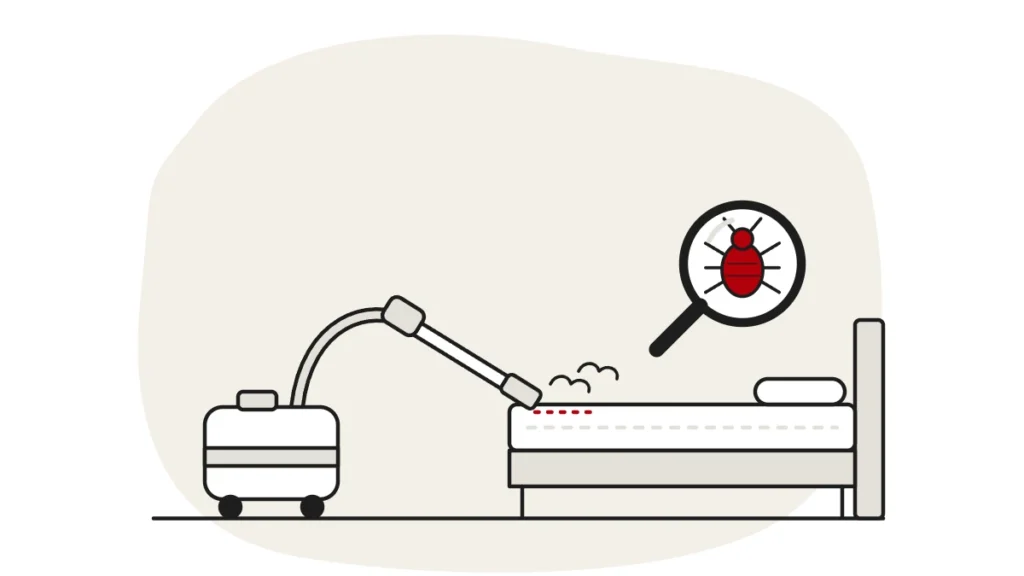
- Go slowly. Keep the tip close and move steadily along each seam and joint. Slow and thorough beats a quick blast.
- Don’t soak anything. You want heat, not water. Let mattresses and fabric dry fully, with a window open, before putting bedding back.
- Watch what you steam. Keep steam away from plug sockets, electrical items and anything that could be damaged by heat or moisture, such as leather, some wood finishes and delicate fabrics. Test a hidden spot first.
- Protect yourself. Steam can scald, so keep children and pets out of the room and don’t point the nozzle at skin.
Steaming works well alongside vacuuming. Our guide to DIY bed bug treatments explains what else you can safely do at home while you wait for help.
What a Steamer Can’t Do
Steam is a contact treatment, and that limits it in several ways:
- It doesn’t get deep. Steam has limited ability to get through fabric and other materials where bed bugs often hide. Bugs inside a mattress, divan base, sofa or wall void may survive.
- Some materials block it. Bugs hidden behind leather often survive.
- It leaves nothing behind. Steam gives no lasting protection, so any bug or egg you miss carries on, and new bugs that hatch later are untouched.
- It can spread them. A forceful jet can blow bugs off a surface and into the carpet or another room, which is why a diffuser helps.
- It’s easy to miss places. Bed bugs hide in cracks you can’t see, behind skirting boards and in furniture well away from the bed.
This is why steam on its own tends to work best on a small, early problem in reachable places, or as one part of a wider treatment. The British Pest Control Association (BPCA) says self-treatment of a bed bug infestation is unlikely to be successful. Other quick fixes have similar limits: our guides to whether Dettol kills bed bugs, whether Indorex kills bed bugs and whether UV light kills bed bugs explain what each can and can’t do. Avoid foggers and bug bombs: they tend to scatter bed bugs into new hiding places.
Steam vs Professional Heat Treatment
People sometimes search for “bed bug steam treatment” expecting it to be the same as a professional heat treatment. They work differently. A steamer heats the small patch the nozzle is pointing at, for a moment. Professional heat treatment uses specialist heaters to raise the temperature of the whole room and its contents, so the heat works its way into mattresses, furniture joints, skirting boards and the other places steam can’t reach.
Bed bugs and their eggs die when held above about 50°C for long enough. We heat rooms to 50–60°C and hold that heat until the hardest-to-reach spots stay above 50°C. Rooms don’t heat evenly, so we place temperature monitors in known cold spots and hard-to-reach areas.
At ThermoPest our approach is heat-led, with targeted spray where it’s needed. You can read how bed bug heat treatment works, including how to prepare. In flats, we ask to inspect neighbouring flats too, because bed bugs can move between them. Return visits may be needed, and you can usually go back into your home 2 hours after a residential heat treatment unless your technician advises otherwise. For costs, see our pricing page.
FAQs
Is a clothes steamer hot enough to kill bed bugs?
It can be at the moment the steam hits a bug, but garment steamers often give light, damp steam that cools quickly and doesn’t reach far into seams or folds. To be effective, steam needs to be at least about 54°C where it meets the bug. For clothes, the NHS advice of a 60°C wash and a hot tumble dry for at least 30 minutes is more reliable.
Can a steam iron kill bed bugs?
A steam iron can kill a bug it touches on a flat garment, but it only gives short bursts of steam and can blow bugs off the fabric. Washing and drying on hot settings is a better way to deal with clothes. Our guide to whether ironing kills bed bugs covers this in more detail.
Does steam kill bed bugs instantly?
Steam that’s hot enough kills bed bugs and eggs on contact. But it only works on the ones it reaches, so bugs hidden deeper in seams, furniture or cracks can survive. See what kills bed bugs instantly for how steam compares with other methods.
Does steam cleaning a carpet kill bed bugs?
A steam cleaner can be used on carpets and skirting boards. Focus on carpet edges and the gap under skirting boards near the bed, where bugs are more likely to hide, and don’t soak the carpet. Steam cleaning won’t deal with bugs in the bed, furniture or walls.
Can I use a steamer on my mattress?
Yes. Mattresses are one of the places steam works best, as long as you go slowly along the seams, piping, labels and edges, and let the mattress dry fully afterwards. Steam won’t reach bugs deep inside the mattress, so keep checking for new signs over the following weeks.
Steamed and still seeing signs?
If you’re still finding bites, bugs or dark spots after steaming, an inspection will confirm what you’re dealing with and where the bugs are hiding. ThermoPest is a member of the BPCA and NPTA, and our technicians arrive in unmarked vans.