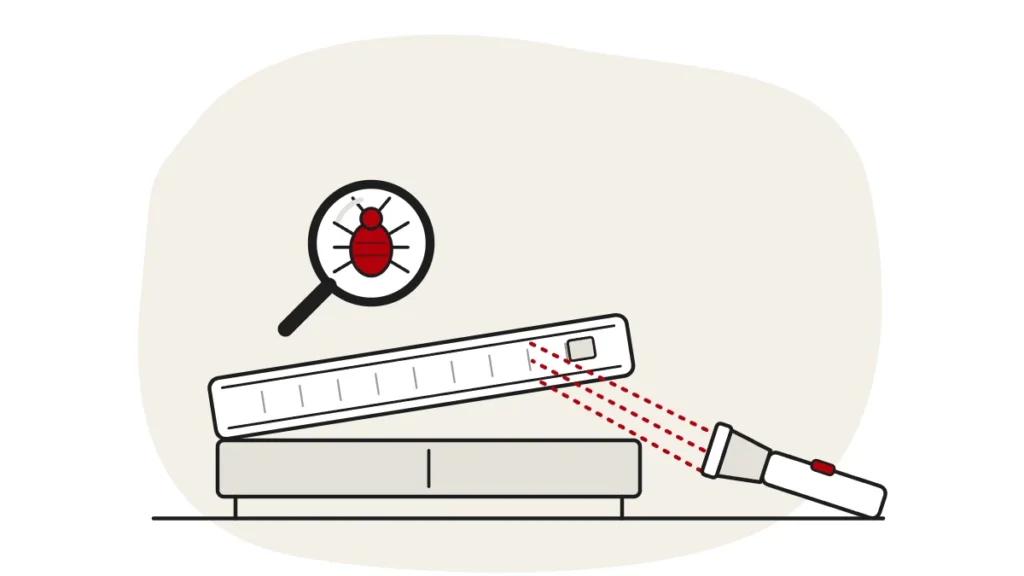
To check a mattress for bed bugs, strip the bedding and use a bright torch to work slowly along every seam, the piping, labels and corners, top and underneath. Then check the base, divan and headboard. You’re looking for live bugs, small dark spots of droppings, blood spots, tiny white eggs and pale shed skins.
Reviewed by James Rhoades, Owner, ThermoPest · Last reviewed 16 October 2026
If you’ve woken up with bites and you’re staring at your mattress, a slow, careful check of the bed tells you a lot. This guide walks through it step by step, shows what each sign looks like, covers memory foam mattresses and toppers, and explains what to do next if you find something.
What do you need to check a mattress?
You don’t need special equipment. Gather:
- A bright torch, or your phone’s torch. Bed bugs hide in shadowy folds, and a low, angled beam makes small marks stand out.
- A thin plastic card, such as an old loyalty card, to slide into seams and lift the edge of piping.
- Disposable gloves if you’d rather not touch anything directly.
- Your phone camera to take close-up photos of anything you find.
- Clear sealable bags to bag bedding straight away, and to keep a suspect bug or shed skin for identification.
Go slowly: a quick look is how light infestations get missed.
How to Check a Mattress for Bed Bugs, Step by Step
1. Strip the Bedding Carefully
Peel the duvet, sheets and pillowcases off slowly and fold them inwards so nothing drops onto the floor. Put them straight into a bag and tie it. Before you bag them, glance at the sheets for small blood spots or dark marks, especially near where your shoulders and legs lie. Duvets and pillows have their own hiding spots, which we cover in do bed bugs live in duvets and pillows?
2. Scan the Top Surface
Shine the torch across the mattress at a low angle. Look closely at any quilting, tufts, buttons and stitched channels, where a small bug can press itself into the fabric. Dark spots that have soaked into the fabric are worth noting.
3. Work Along the Seams and Piping
This is the most important step. Bed bugs are flat and like tight edges, and in our experience the seams, folds and crevices of the mattress, base, frame and headboard are the usual hiding places. Go all the way round the top seam, then the bottom seam. Use the card to fold back the piping and look into the stitch line, where eggs and droppings are often tucked in.
4. Check the Labels, Handles and Air Vents
Lift the care label and run the card underneath. Check behind each handle, around any small air vents, and along a zip if the cover has one. These folds give bugs the shelter they want.
5. Stand the Mattress on Its Side and Check the Underside and Corners
Standing the mattress on its edge lets you examine the upper and lower seams and surfaces properly. Lift the mattress (get help if it’s heavy), check the corners carefully, and work along the underside. The British Pest Control Association (BPCA) notes that the dark spots bed bugs leave are usually found on the bed frame or the underside of the mattress, so don’t skip it.
6. Check the Box Base or Divan
With the mattress off, look at the top of the base, its edges and corners. On a divan, take the drawers out and check inside them, along the runners and the frame around them. Many divans have a thin fabric cover underneath; this dust cover may need to come off for a proper look, as bugs can shelter behind it.
7. Check the Headboard and Bed Frame
Look at where the headboard fixes to the bed or wall, every joint, screw hole and slat end, and the back of the headboard. Upholstered headboards have buttons and seams to check, like the mattress. If you sometimes fall asleep on the sofa, check that too; our guide to bed bugs in leather and fabric sofas explains where to look.
8. Look Around the Bed
Finish with the furniture and edges closest to the bed: bedside tables (including the back and underside), the skirting board and carpet edge, and curtain headings. Only look at plug sockets; never open electrical fittings. Our guide to where bed bugs hide in every room covers the rest of the home.
What are you looking for?
You may find signs without ever seeing a live bug. This table sums up what each looks like and where it usually turns up.
| Sign | What it looks like | Where on the bed |
|---|---|---|
| Adult bed bugs | Flat, oval, dark yellow, red or brown; around 5mm long (NHS) | Seams, piping, corners, headboard joints |
| Droppings | Dark spots about 1mm wide, like an ink dot (BPCA); small brown spots (NHS) | Underside of the mattress, seams, bed frame |
| Blood spots | Small red or rusty marks from bites or a squashed bug (NHS) | Sheets, pillowcases, mattress top |
| Eggs | Tiny (about 1mm), whitish; hard to see without a magnifier | Stuck into stitch lines, folds and crevices |
| Shed skins | Empty, tan-coloured bug-shaped skins | Seams, folds, under labels |
Live Bugs
The NHS describes adult bed bugs as dark yellow, red or brown and around 5mm long. Young bugs (nymphs) are smaller and paler, so they’re easier to miss. Bed bugs are active mainly at night and hide close to where people sleep during the day, so they’re often found tucked in a seam rather than out in the open.
Droppings and Blood Spots
Droppings are often the first sign people find. The BPCA describes them as clusters of dark spots about 1mm wide that look like an ink dot. Our technicians often find them as dark spotting and staining along mattress seams. The NHS also lists spots of blood on bedding, from bites or from squashing a bug.
Eggs and Shed Skins
Bed bug eggs are tiny, whitish and hard to see without magnification, especially on light-coloured fabric, and they’re sticky when laid, so they stay glued in place. Young bugs shed their skins as they grow, leaving tan-coloured skins behind. For close-up detail, see our guide to what bed bug eggs look like and where to find them.
Things That Aren’t Bed Bugs
Fluff, crumbs, mould spots and the odd dead insect can all fool you at 2am. Bed bug droppings usually sit in clusters, often alongside other signs; a single speck on its own means less. If you’re not sure, photograph it next to a coin or bag it for identification.
Can bed bugs live in memory foam?
Yes. Bed bugs can live on a memory foam mattress just as they can on a sprung one. Their usual hiding places are the seams, folds and crevices of the mattress, base, frame and headboard. On a memory foam mattress, that means the seams, zips, piping, labels and folds of the cover, and the base and frame underneath. So check a memory foam mattress the same way as any other.
Memory Foam Toppers and Pillows
The same applies to toppers and pillows: check the edges, any zip and the label, and look under the topper where it meets the mattress. Removable covers can usually be washed hot; check the care label. Foam inserts often can’t be washed, so follow the maker’s care instructions and keep them bagged until the room has been dealt with.
Can you check inside a memory foam mattress?
If the mattress has a zipped cover, you can open it and look along the inside seams and the surface of the foam. You don’t need to cut into anything. If you find signs inside the cover, check the base and frame just as carefully.
What should you do if you find bed bugs on your mattress?
Finding bed bugs is upsetting, but there’s no need to panic or throw things away tonight. A few calm steps stop the problem spreading while you get it confirmed.
Don’t Throw the Mattress Out Straight Away
It’s the first thing many people want to do, but it rarely helps. Bed bugs live in the bed frame, headboard and furniture as well as the mattress, so a new mattress in the same room gets infested too. Carrying an infested mattress through a building can also drop bugs on the way out. Most infested belongings don’t need to be thrown away. A mattress in reasonable condition can usually be treated along with the rest of the room. If you do decide to get rid of a mattress, wrap it fully in plastic first, and see our guide to cleaning a mattress with bed bugs before you decide.
Wash What You Can
The NHS advises washing affected bedding and clothing on a hot wash (60°C) and tumble drying on a hot setting for at least 30 minutes. Items that can’t be washed can go in a plastic bag in the freezer for 2 to 3 weeks, the NHS says. Only throw away things that can’t be washed or treated.
Consider a Mattress Encasement
A bed bug encasement is a fabric cover that zips right round the mattress (and ideally the base) and seals it. Once an encasement is fitted and zipped shut, any bugs inside eventually die, and the smooth surface makes new bugs easier to spot. But an encasement won’t stop bugs elsewhere in the room from crawling onto the bed and biting, so it’s a support, not a fix.
Don’t Reach for Sprays or Foggers
Shop-bought sprays, foggers and bug bombs tend to scatter bed bugs into new hiding places, including other rooms and, in flats, next door. Don’t move to sleep in another room either, as bugs can follow and spread the problem.
Get It Confirmed and Treated
The NHS advises contacting your local council or a pest control service if you think you have bed bugs, and the BPCA says self-treatment of an infestation is unlikely to succeed. A professional bed bug inspection will confirm what you’ve found and how far it has spread. At ThermoPest, our bed bug heat treatment is heat-led, with targeted spray where it’s needed, and treats the mattress, frame and furniture together rather than one item at a time. In flats, we ask to inspect neighbouring flats too, and return visits may be needed.
For a wider check of the whole room, our FAQ on how to check for bed bugs walks through every hiding spot beyond the bed.
FAQs
How do I check my mattress for bed bugs step by step?
Strip and bag the bedding, then use a torch to scan the top of the mattress. Work along every seam and the piping with a thin card, lift the labels and handles, then stand the mattress on its side to check the corners and underside. Finish with the base, divan drawers and headboard.
Can bed bugs live in memory foam mattresses?
Yes. Check a memory foam mattress the same way as a sprung one: work along the cover’s seams, zips, piping and labels, then the base and frame underneath. The seams and folds of the mattress, base and frame are bed bugs’ usual hiding places.
Can bed bugs live in memory foam pillows and toppers?
They can hide in the seams, zips and labels of pillow and topper covers, and between a topper and the mattress. Wash removable covers hot if the care label allows; the NHS recommends 60°C and a hot tumble dry for at least 30 minutes.
Do I need to throw away my mattress if it has bed bugs?
Usually not. Bugs also live in the frame and furniture, so a new mattress in the same room gets infested again, and carrying an infested one out can spread them. A mattress in reasonable condition can usually be treated with the rest of the room.
What do bed bug droppings look like on a mattress?
The BPCA describes them as clusters of dark spots about 1mm wide, like an ink dot, usually on the underside of the mattress or the bed frame. The NHS describes them as small brown spots on bedding or furniture.
Found signs on your mattress?
If you’ve found dark spots, shed skins or live bugs, an inspection will confirm what you’re dealing with and where it has spread. ThermoPest is a member of the BPCA and NPTA, and our technicians arrive in unmarked vans.