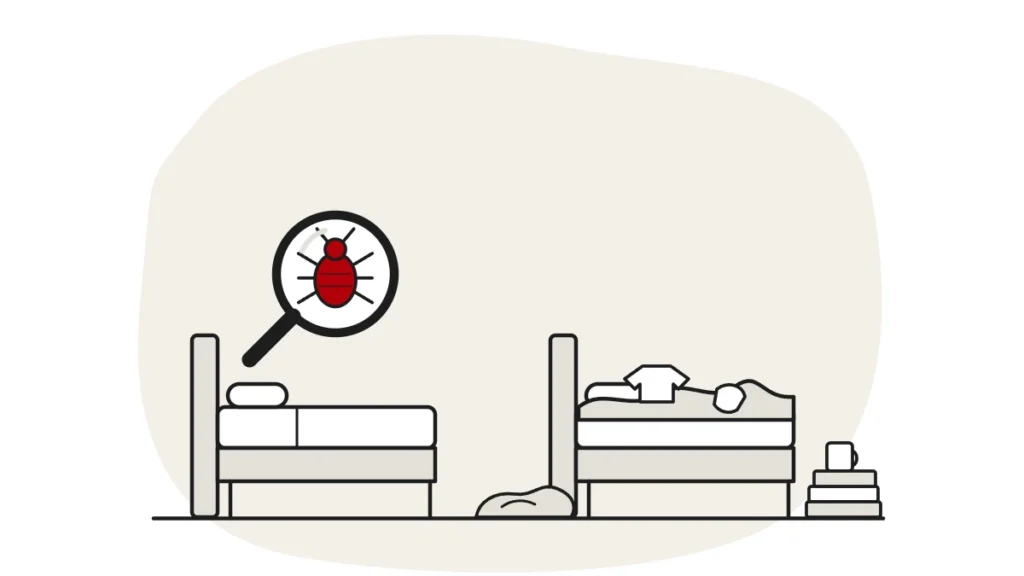
No. Most beds don’t have bed bugs, and neither do most homes. Bed bugs only turn up where they’ve been carried in, usually in luggage, bags, clothes or second-hand furniture, or from a neighbouring flat. They aren’t caused by dirt, and a clean, new bed can get them just as easily as an old one.
Reviewed by James Rhoades, Owner, ThermoPest · Last reviewed 16 October 2026
If you’ve been reading about bed bugs late at night, it’s easy to come away thinking they’re in every bed, every hotel and every seat on the bus. They aren’t. This guide answers the question plainly, then works through the most common bed bug myths one by one, with the facts from the NHS, the British Pest Control Association (BPCA) and our own experience as bed bug specialists.
Does every bed have bed bugs?
No. A bed bug infestation always starts with live bugs or eggs being brought in from somewhere that already has them. The BPCA says bed bugs are usually introduced on luggage, bags and clothing, or through second-hand beds and furniture, and in flats they can also come through from a neighbouring property. If none of that has happened, there’s no reason for bed bugs to be in your bed.
That applies to mattresses too. A mattress doesn’t “come with” bed bugs, and a brand-new one from a shop won’t have them. The risk sits with second-hand mattresses, bed frames and sofas, which can carry bugs and eggs in their seams and joints.
Why the Myth Persists
- News coverage. Stories about bed bugs in hotels, on public transport or in another city travel fast and make the problem sound universal.
- They hide well. Bed bugs tuck into seams, cracks and joints and mostly come out when you’re asleep, so people assume they could be anywhere, unseen.
- Bites that aren’t bed bugs. Itchy marks have many causes. The BPCA says bites alone, without other evidence, don’t necessarily mean you have an infestation. If you’re bitten at night but can’t find bed bugs, there are other things to rule out first.
How common are bed bugs in the UK?
There’s no national register of infestations, so nobody can put an honest number on it. The BPCA says pest technicians get plenty of call-outs to treat properties for bed bugs, so anyone dealing with them is far from alone. Bed bugs are a real and fairly common problem, especially in cities with lots of travel and shared buildings. “Fairly common” is still a long way from “in every bed”.
Bed Bug Myths and Facts
Here’s a quick reference, followed by the detail and where each fact comes from.
| Myth | Fact |
|---|---|
| Every bed has bed bugs | Most don’t. They have to be carried in. |
| Only dirty homes get them | Cleanliness makes no difference to whether they arrive. |
| They only live in beds | They hide in furniture, skirting boards and even plug sockets. |
| They spread disease | They’re not known to spread disease. |
| They’re too small to see | Adults are about 5mm long and visible; young ones and eggs are harder to spot. |
| They only come out at night | Mostly, but hungry bugs will feed in the day if that’s when you sleep. |
| They fly or jump | They do neither. They crawl, quickly. |
| Throwing the mattress away fixes it | Usually not. The bugs are rarely only in the mattress. |
| They die if they can’t feed for a few days | They can survive months, and up to a year in the cold. |
| A spray or fogger will sort it | DIY treatment is unlikely to work, and foggers scatter bugs. |
Myth: Bed Bugs Only Infest Dirty Homes
Fact: bed bugs feed on blood, not crumbs or dust, so the state of your home has nothing to do with whether they arrive. The BPCA notes that bed bugs were once associated with unhygienic surroundings, but says they can infest any property and are generally spread through bad luck, on luggage, clothes and second-hand furniture. Spotless flats, hotels and new-builds all get them. The one thing tidiness does help with is spotting them early, because there are fewer places to hide.
Myth: Bed Bugs Only Live in Beds
Fact: the bed is where they start, because it’s closest to a sleeping person, but it’s rarely where they stop. The BPCA says they infest crevices in surrounding furniture, behind skirting boards, under loose wallpaper, behind pictures and even in plug sockets. Sofas and armchairs where someone naps are common too. That’s why a proper inspection covers the whole room, not just the mattress. Our guide to whether one infested room means they’re everywhere explains how they spread within a home.
Myth: Bed Bugs Spread Disease
Fact: bed bugs are not known to spread diseases, according to the BPCA. The NHS says bites can be itchy but don’t usually cause other health problems, although a severe allergic reaction is possible but rare, and scratching can lead to infection. The bigger toll is often on sleep and peace of mind. If a bite is painful, swollen or spreading, speak to a pharmacist or your GP. There’s more in our guide to whether bed bugs are dangerous.
Myth: Bed Bugs Are Too Small to See
Fact: adult bed bugs are around 5mm long, according to the NHS, and dark yellow, red or brown. That’s about the size of an apple seed, and plainly visible if one is out in the open. What makes them hard to find is their hiding, not their size. Young bed bugs (nymphs) and eggs are a different matter: the BPCA describes nymphs as tiny and hard to detect with the naked eye, and eggs are about the size of a speck of dust. See what bed bugs look like at each stage.
Myth: Bed Bugs Only Come Out at Night
Fact: they’re mainly active at night, but that’s about opportunity rather than a rule. Hungry bed bugs may also feed during the day, especially if that’s when the occupant normally sleeps. Shift workers and daytime nappers get bitten in daylight. Seeing one in the afternoon doesn’t mean it’s something else.
Myth: Bed Bugs Fly or Jump
Fact: they can’t do either. The BPCA describes them as wingless, and they don’t jump like fleas, but they can crawl rapidly over floors, walls and ceilings. If something is jumping, it’s more likely a flea. Our guide to bugs that look like bed bugs helps you tell them apart.
Myth: Throwing Away the Mattress Gets Rid of Bed Bugs
Fact: usually it doesn’t. Most belongings don’t need to be thrown away, although at times it may be advisable. Because bugs and eggs are also in the bed frame, headboard, skirting boards and nearby furniture, a new mattress goes into an infested room and gets infested in turn. Dragging an infested mattress through the flat can also spread bugs along the way. If an item really does have to go, our guide on how to dispose of bed bug-infested furniture shows how to do it without spreading them.
Myth: Bed Bugs Die Quickly If They Can’t Feed
Fact: they’re unusually good at waiting. The BPCA says bed bugs can survive up to a year without feeding, particularly in the cold, and nymphs and adults can go for months without a meal. So leaving a room empty for a few weeks, or going on holiday, doesn’t starve them out. Read more in how long bed bugs can live without feeding.
Myth: A Shop-Bought Spray, Fogger or Home Remedy Will Sort It
Fact: the NHS says it’s very difficult to get rid of bed bugs yourself because they’re hard to find, and that DIY steps are unlikely to get rid of them completely. The BPCA says self-treatment with amateur pesticides is highly unlikely to be successful. Foggers and smoke bombs are the worst option: bug bombs should not be used to control bed bugs, and the BPCA warns that amateur products can push bed bugs into other rooms or neighbouring properties. Our post on whether smoke bombs and foggers kill bed bugs goes into why.
Myth: Spiders, Lights or Scents Will Keep Bed Bugs Away
Fact: none of these control an infestation. Bed bugs find you by body warmth and the carbon dioxide you breathe out, so a light left on or a strong smell doesn’t stop a hungry bug. A house spider might eat the odd one, but nowhere near enough to matter; see do spiders eat bed bugs? for why that idea doesn’t hold up.
How do you know if your bed has bed bugs?
If you’re worried, look rather than guess. The NHS lists three main signs:
- bites, often on skin exposed while sleeping, such as the face, neck and arms;
- spots of blood on your bedding, from the bites or from a squashed bug;
- small brown spots on bedding or furniture, which are bed bug droppings.
Add to that live bugs, pale shed skins and tiny white eggs in the mattress seams, under the mattress, in the bed frame joints and behind the headboard. The BPCA describes the droppings as dark spots about 1mm wide, like ink dots, usually on the bed frame or the underside of the mattress. Use your phone torch and check slowly. Our room-by-room guide to checking for bed bugs walks through it.
If you find nothing after a careful check, that’s reassuring. Bites on their own aren’t proof, and bed bugs don’t appear from nowhere, so think about whether anything has come into the home recently: a trip, a guest, a second-hand item, or a neighbour’s problem. Our guides on where bed bugs come from and whether bed bugs can come from neighbours cover the usual routes.
What to Do If You Do Find Bed Bugs
- Don’t move things between rooms. Keep bedding and clothes from the affected room bagged until they’re washed. The NHS advises washing affected bedding and clothing on a hot wash (60°C) and tumble drying on a hot setting for at least 30 minutes, and putting items that can’t be washed in a plastic bag in the freezer for 2 to 3 weeks. Only throw away things that can’t be washed or treated.
- Don’t use foggers or bug bombs. They scatter bugs rather than clear them.
- Don’t throw the mattress out in a panic. It usually isn’t necessary and can spread the problem.
- Tell your landlord or managing agent if you rent or live in a flat, so neighbouring flats can be checked.
- Get it confirmed and treated properly. The NHS recommends contacting your local council or a pest control service.
Professional bed bug heat treatment is heat-led, with targeted spray where it’s needed. Heat reaches the bugs and eggs hidden in seams, joints and cracks that sprays and DIY methods miss. Bed bugs and their eggs die when held above about 50°C for long enough. We heat rooms to 50–60°C and hold that heat until the hardest-to-reach spots stay above 50°C. Rooms don’t heat evenly, so we place temperature monitors in known cold spots and hard-to-reach areas. If you live in a flat, we’ll ask to inspect neighbouring flats as well, because the source is sometimes next door.
FAQs
Does every house have bed bugs?
No. Most homes in the UK don’t have bed bugs. An infestation needs bugs or eggs to be carried in from somewhere that already has them, which is why they cluster around travel, second-hand furniture and shared buildings rather than appearing everywhere.
Do all mattresses have bed bugs?
No. A new mattress from a shop doesn’t come with bed bugs, and a mattress that’s been in a bug-free home stays bug-free. The ones to be careful with are second-hand mattresses and bed frames, which can carry bugs and eggs in their seams and joints.
Are bed bugs only found in beds?
No. They start near where you sleep but spread into the bed frame, headboard, bedside furniture, skirting boards, behind pictures and into sofas and chairs. The BPCA even lists plug sockets as a hiding place. That’s why treatment has to cover the whole room, not just the mattress.
Do bed bugs mean my home is dirty?
No. Bed bugs feed on blood and are attracted to body warmth and breath, not dirt. They usually arrive in luggage, bags or second-hand furniture, whatever the state of the home. Clutter only makes them harder to find.
Can bed bugs carry diseases?
Bed bugs are not known to spread diseases, according to the BPCA. The NHS says their bites can be itchy but don’t usually cause other health problems. See a pharmacist if bites are bothering you, and your GP if they’re very painful, swollen or spreading.
Think your bed might have bed bugs?
Most beds don’t, but if you’ve found bites, blood spots or dark marks, an inspection will confirm what you’re dealing with. ThermoPest is a member of the BPCA and NPTA. Our treatment is heat-led, with targeted spray where it’s needed, and our technicians arrive in unmarked vans.